

The JEE Main April Attempt plays a very important role for students who want to improve their score or qualify for JEE Advanced. Many candidates appear in both sessions, including the January attempt, to secure the best possible percentile. However, while most students focus only on revision and syllabus completion, exam-day planning often gets ignored.
Meanwhile, even well-prepared students lose marks because of stress, confusion, or failure to follow rules. Therefore, understanding JEE exam day guidelines, JEE main instructions, and JEE do’s and don’ts becomes extremely important. This blog explains everything related to the JEE Main April Attempt in a simple and clear way so that students can stay calm and confident on the final day.
Why Exam-Day Guidelines Matter for JEE Main April Attempt
The JEE Main April Attempt tests not only knowledge but also discipline, focus, and time management. The National Testing Agency follows strict rules during the exam. As a result, ignoring even one small instruction can create unnecessary trouble.
By following official JEE exam day guidelines during the April Attempt, students can avoid last-minute panic, enter the exam center smoothly, stay focused during the paper, and use time efficiently. Moreover, many toppers believe that remaining calm on exam day matters just as much as the JEE preparation tips followed throughout the year. Aspirants preparing for upcoming sessions should also go through the JEE Main 2026 complete guide to understand the exam pattern, eligibility, marking scheme, and important updates.
Important Documents to Carry on JEE Main April Attempt Exam Day
Before leaving home for the JEE Main April Attempt, students must double-check all required documents. Missing even one document may stop entry into the exam hall.
Documents Checklist
| Required Item | Details |
| Admit Card | Printed copy with a clear photograph |
| Valid ID Proof | Aadhaar Card / School ID / Passport |
| Passport Size Photograph | Same as uploaded in the application |
| PwD Certificate (if applicable) | Only for eligible candidates |
Students must keep all documents inside a transparent folder. According to the official JEE Main instructions, digital copies are strictly prohibited inside the exam hall during the JEE Main April Attempt.
Reporting Time and Entry Rules for JEE Main April Attempt
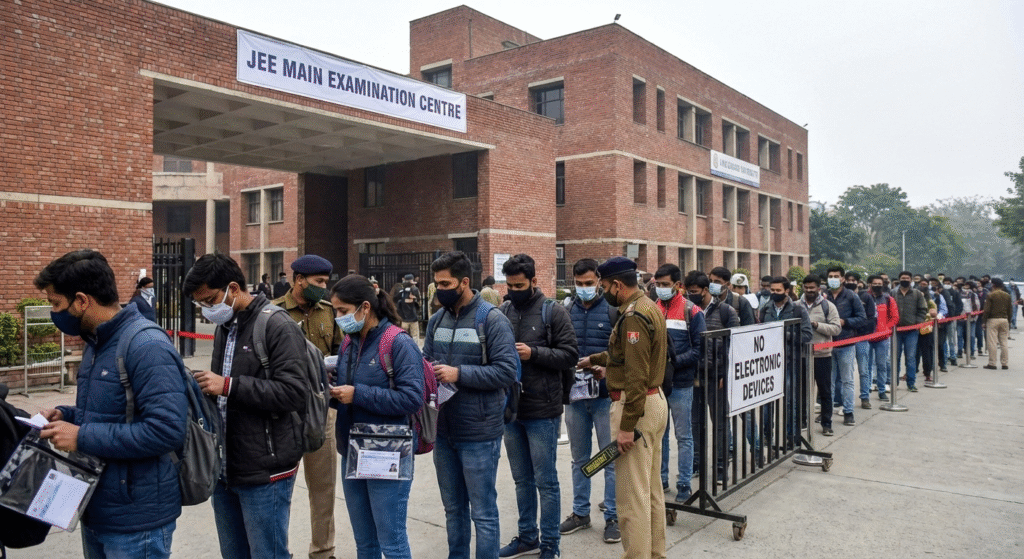
Students must reach the exam center well before the reporting time mentioned on the admit card for the April Attempt. Late entry usually does not get permission.
Key points to remember include arriving at least 90 minutes early, completing biometric verification patiently, and taking the allotted seat before the exam starts. Once the exam begins, entry is not allowed. Therefore, following JEE exam day guidelines helps students remain relaxed and confident.
What to Wear on JEE Main Exam Day
The dress code for the JEE Main April Attempt remains strict to maintain fairness and security. Wearing simple clothes saves time during security checks and avoids unnecessary stress. Students can refer to the detailed JEE Main dress code 2026 guidelines to avoid last-minute confusion and ensure smooth entry at the exam center.
Dress Code Rules
| Allowed | Not Allowed |
| Light clothes | Heavy jackets |
| Simple slippers/sandals | Shoes with thick soles |
| No accessories | Watches, rings, bracelets |
| Simple rubber band | Metal objects |
By following these JEE do and don’ts, students move through security smoothly on the April Attempt exam day.
What are the Items Allowed and Not Allowed Inside the JEE Main Exam Hall
The JEE Main exam system permits only a limited number of items inside the exam hall. Carrying restricted objects may lead to disqualification.
Allowed Items
- Admit card
- Valid ID proof
- Transparent water bottle
- Simple pen (if allowed by the center)
Not Allowed Items
- Mobile phones
- Smart watches
- Calculators
- Notes or paper chits
- Bags and wallets
According to official JEE main instructions, students must perform rough work only on sheets provided by the exam center during the JEE Main examination.
What are the Exam-Day Do’s for JEE Main
Following correct habits on the JEE Main April Attempt exam day can create a major difference in performance.
Important do’s include sleeping well the night before, eating light food, reading on-screen instructions carefully, managing time wisely for each section, and staying calm when a question appears difficult. Many students practice nta JEE mains mock test to reduce fear and get comfortable with the computer-based format before the JEE Main April Attempt.
What are the Exam-Day Don’ts for JEE Main
Avoiding mistakes matters just as much as attempting questions correctly in the JEE Main April Attempt.
Students should not carry prohibited items, panic over unknown questions, waste too much time on a single problem, argue with exam staff, or leave the exam hall early without permission. These simple JEE do and don’ts help students remain safe and focused throughout the exam.
Time Management During JEE Main
The JEE Main remains a strictly time-bound exam. Therefore, students must balance speed with accuracy.
Effective time management includes dividing time between Physics, Chemistry, and Mathematics, starting with the strongest subject, skipping extremely difficult questions initially, and reviewing marked questions at the end. Students who regularly solve JEE main question papers from previous sessions usually develop better speed and confidence.
Role of Previous Year Papers in JEE Main
Solving the previous year’s JEE main paper builds familiarity with question patterns, difficulty level, important topics, and time pressure. Many students also use the JEE mains PYQ book during preparation.
However, on the day of the JEE Main exam, confidence matters more than last-minute revision. Trusting preparation helps students perform better under pressure.
Importance of Instructions Displayed on Screen During JEE Main
Before the exam starts, instructions appear on the computer screen during the JEE Main. Students must read them carefully.
These JEE Main instructions explain question navigation, answer marking, and paper submission. Ignoring these steps may cause technical mistakes, even when answers remain correct.
How to Handle Stress and Anxiety on the Exam Day
Feeling nervous before the JEE Main exam remains normal. However, controlling stress helps students think clearly.
Simple stress management techniques include deep breathing, staying positive, trusting preparation, and focusing on one question at a time. Smart JEE preparation tips combined with calmness improve overall performance.
After the JEE Main Exam: What Should Students Do?
After completing the JEE Main April Attempt, students should submit the paper properly, return rough sheets if asked, and exit the exam hall calmly. Discussing answers immediately often increases anxiety.
Since JEE Main allows multiple attempts, students must treat each exam as a learning experience.
JEE Main April Attempt vs January Attempt
Students who appeared for the January session already understand the exam environment. The JEE Main April Attempt offers them a chance to improve scores and correct mistakes.
Students appearing only in April should stay calm, trust preparation, and strictly follow exam-day rules. Both sessions follow the same JEE exam day guidelines and marking scheme. First-time aspirants who are appearing directly in the April session can benefit from a structured JEE fresher course that focuses on fundamentals, exam strategy, and confidence building.
Final Preparation Reminder Before JEE Main
In the last few days before the JEE Main April Attempt, students should revise formulas, avoid new topics, practice easy questions, and stay healthy. Although some students revisit JEE main preparation books, revision and mental calmness remain more important.
Seating Arrangement and Login Process Explained
Once inside the exam hall, students receive a system number for the JEE Main examination. The invigilator guides students to their allotted seat, and login credentials appear on the screen. Students must verify their name and roll number before starting the exam. If any detail appears incorrect, they should immediately inform the invigilator. Understanding the login process beforehand helps students feel confident and focused during the JEE Main.
Understanding the Computer-Based Test Interface
The JEE Main follows a computer-based test format. The screen displays question numbers, time remaining, and navigation buttons. Students can mark questions for review, change answers, and move between sections easily. Knowing how to use these features saves time and avoids confusion. Students who practice online mock tests before the JEE Main handle the interface smoothly during the real exam.
Section-Wise Strategy for JEE Main
A smart section-wise approach improves performance in the JEE Main. Students should begin with their strongest subject to build confidence early. Physics often requires concept clarity, Chemistry rewards accuracy, and Mathematics demands time management. Switching sections wisely helps maintain momentum throughout the JEE Main. Balanced attempts across all subjects increase the overall score.
Common Mistakes Students Make During the Examination day
Many students prepare well for months but still lose marks due to small mistakes on the day of the JEE Main examination. One common mistake is rushing through questions without reading them properly. Sometimes, students misinterpret numerical values or overlook negative marking instructions. Another frequent mistake involves poor time planning, where too much time is spent on one difficult question. Additionally, some students forget to submit the paper properly due to nervousness. By staying calm and alert during the exam day, these avoidable errors can be easily prevented.
Conclusion
The JEE Main April Attempt provides a valuable opportunity for students aiming for engineering admissions. Success depends not only on preparation but also on discipline and calm behavior on exam day. By following JEE exam day guidelines, understanding JEE do and don’ts, carefully reading JEE Main instructions, and staying composed, students can perform their best. Regular practice with NTA JEE Mains mock test, solving JEE Main question paper, and learning from JEE Main previous year paper builds confidence, but correct exam-day behavior completes the preparation. Aspirants seeking expert mentorship, exam-oriented guidance, and consistent support can explore preparation resources and courses offered by SPM & Lalans, trusted by thousands of JEE aspirants.
Frequently Asked Questions
What should I carry for the JEE Main exam?
For the JEE Main exam, students must carry all mandatory documents to avoid entry-related issues. You should bring a printed copy of the admit card with a clearly visible photograph, as it serves as the primary entry pass. Along with this, carry a valid photo ID proof such as an Aadhaar card, school ID, or passport for identity verification. A passport-size photograph (same as uploaded in the application form) should also be carried as a backup. Candidates belonging to the PwD category must carry their valid PwD certificate. Missing documents can cause unnecessary stress or even denial of entry.
What is the dress code for JEE Main 2026?
The JEE Main dress code focuses on simplicity and security. Students should wear light and comfortable clothing without large buttons, zippers, or heavy layers. Slippers or sandals are preferred, while shoes with thick soles should be avoided. Accessories such as watches, rings, bracelets, chains, or metal items are not allowed inside the exam center. Following the dress code helps complete security checks quickly and keeps students mentally relaxed before the exam.
Can I enter the exam hall after the gate closes?
No, students cannot enter the exam hall after the gate closes. The National Testing Agency strictly follows the reporting and entry timings mentioned on the admit card. Even a small delay can lead to disqualification. Students are advised to reach the exam center well in advance to complete biometric verification and seating formalities calmly.
Are electronic devices allowed in JEE Main?
Electronic devices are strictly prohibited during the JEE Main exam. Items such as mobile phones, smart watches, calculators, Bluetooth devices, earphones, or any communication gadgets are not allowed inside the exam hall. Carrying such items may result in cancellation of the exam. Students should leave electronics at home or follow exam center storage instructions.
What should I do if there is a technical issue during the exam?
If a technical issue occurs during the JEE Main exam, remain calm and immediately inform the invigilator. Problems like screen freezing, mouse malfunction, or login issues can occur, and exam staff are trained to resolve them. Do not attempt to fix the issue yourself, as it may waste time. Prompt reporting ensures quick resolution and a smooth continuation of the exam.

This article is written by the SPM & LALAN’S Content Team, a group of skilled writers, researchers, and content strategists passionate about creating accurate, reliable, and student-friendly educational content. Every article is thoroughly researched, fact-checked, and updated to ensure readers receive trustworthy and relevant information. The goal is to help students make informed academic decisions through clear, well-researched, and easy-to-understand content.