


Every year, lakhs of medical aspirants appear for the National Eligibility cum Entrance Test (NEET UG). The competition is intense. Often, more than one candidate ends up securing the same score. To ensure a fair and transparent ranking, the National Testing Agency (NTA) has defined the NEET Tie-Breaking Policy 2026. It can decide your All India Rank (AIR), which, in turn, influences college admissions and seat allotment.
In this article, we will look into the NEET 2026 tie-breaking rules in simple language. We will explain what factors are used to resolve score ties. Additionally, we will highlight how merit is ultimately decided when candidates have identical marks. For more comprehensive preparation, visit S.P. Mandal’s NEET Coaching to explore expert coaching options.
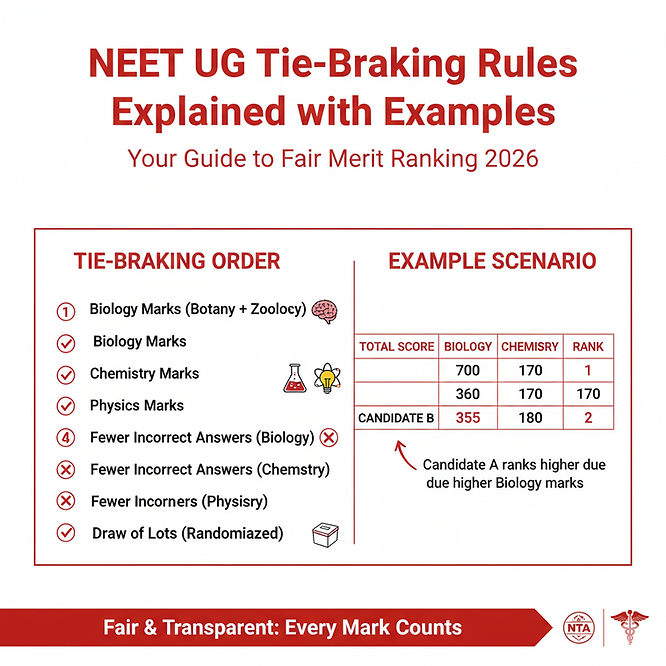
What is the NEET Tie-Breaking Policy 2026?
The NEET tie-breaking policy refers to a set of criteria used to rank candidates who score equal marks in the NEET UG exam. This is important because, in a high-stakes test like NEET, even a difference of one mark can change a student’s college allotment. To reduce subjectivity, the NTA follows a defined sequence of metrics. These metrics range from subject-wise scores to accuracy in answers, aiming to break ties effectively.
Furthermore, this policy ensures that candidates with a stronger mastery of core subjects receive priority in the NEET 2026 ranking criteria. Additionally, if all other criteria fail to separate tied candidates, a system-based random resolution step is added. This further enhances the fairness of the ranking process. To improve your NEET scores and ensure success, consider enrolling in NEET Coaching in Guwahati for targeted guidance and practice.
Why Tie-Breaking Policy for NEET Rules Matter in NEET 2026?
With millions of aspirants taking NEET, it’s common for several candidates to end up with identical total marks. To address this, a tie-breaking policy for NEET rules is implemented. First, these rules ensure that candidates are ranked fairly and consistently.
Moreover, they reward higher competency in key subjects like Biology and Chemistry. As a result, every aspirant receives a unique rank, which is important for counselling and seat allocation. Finally, the process remains transparent, with defined steps rather than subjective decisions.
NEET 2026 Tie-Breaking Criteria: Orderwise
Below is a summary of the order of priority used to break ties:
| Criteria Order | Tie-Breaker Used | Purpose |
| 1 | Higher marks in Biology (Botany & Zoology) | Biology is most relevant for medical studies |
| 2 | Higher marks in Chemistry | The next important subject after Biology |
| 3 | Higher marks in Physics | Final subject score comparison |
| 4 | Fewer incorrect answers (overall) | Rewards accuracy over guesswork |
| 5 | Fewer incorrect answers in Biology | Accuracy focus in the Biology section |
| 6 | Fewer incorrect answers in Chemistry | Accuracy focus in Chemistry |
| 7 | Fewer incorrect answers in Physics | Accuracy focus in Physics |
| 8 | Random process by an independent expert committee | Used only if all the above criteria tie |
This sequence ensures that subject proficiency is evaluated first and that accuracy in answering questions plays an important role when subject scores are equal. To understand how to maximize your performance and secure the best possible rank, check out our complete strategy to crack NEET 2026.
Detailed Explanation of Each 2026 NEET Tie-Breaking Policy
To ensure complete transparency in the ranking process, the 2026 NEET Tie-Breaking Policy follows a clearly defined sequence of criteria set by the National Testing Agency. Each step is applied systematically. Therefore, this method continues until the tie between candidates is resolved.
Below, you will find a detailed explanation. This section focuses on how subject-wise performance and accuracy are evaluated to determine the final rank.
1. Marks in Biology (Botany & Zoology)
Since NEET UG is mainly for admission into medical courses such as MBBS and BDS, the performance in Biology is weighted the most. If two candidates have the same overall score, according to the NEET tie-breaking policy 2026, the candidate with the higher Biology marks will receive preference.
2. Marks in Chemistry
If a tie remains after comparing Biology scores, the candidate with the higher Chemistry marks is ranked above. This step of the NEET tie-breaking policy 2026 ensures core science knowledge is prioritized in the overall NEET 2026 ranking criteria.
3. Marks in Physics
The Physics marks are compared. Although Physics carries the same maximum marks in NEET, it ranks third in the NNEET tie-breaking policy 2026 order.
4. Accuracy Considerations
When all subject scores are the same, the NTA examines accuracy. Specifically, it looks at the number of incorrect answers across all sections. Additionally, it evaluates the performance in individual subjects. This approach rewards candidates who attempted questions more carefully.
5. Random Process
In extremely rare cases, all the metrics above may fail to distinguish between candidates. Therefore, the NEET tie is resolved through a computerized random selection process. This process is overseen by an independent expert committee.
For a better understanding of what to expect in NEET 2026, refer to the official NEET UG 2026 syllabus.
NEET Tie-Breaking Policy 2026: What Has Changed?
The recent NEET tie-breaking policy 2026 has evolved over the years. For example, the age factor, which gave preference to older candidates, was part of earlier policies. However, this criterion has been removed in the 2026 policy.
Additionally, the application number as a last tie-breaker has also been eliminated in the latest criteria. These changes reflect a significant shift toward fair merit-based ranking. Thus, the focus now is on relevant factors rather than arbitrary or unrelated ones.
Key Takeaways: NEET Tie-Breaking Policy 2026
1. The total NEET score is the primary determinant of rank, but when tied, the policy ensures a systematic ranking through subject-wise performance and accuracy.
2. Biology marks carry the highest weight in breaking ties, followed by Chemistry and Physics.
3. Accuracy metrics further refine ranking, promoting careful answering strategies.
4. A random draw ensures a result even in exceptional tie conditions, maintaining fairness.
Conclusion
The NEET Tie-Breaking Policy 2026 plays an important role in determining your NEET All India Rank (AIR) when scores are equal. According to the National Testing Agency guidelines, higher marks in Biology are prioritized first. Additionally, marks in Chemistry come next, followed by Physics. Moreover, NEET fewer incorrect answers rule also influences the final ranking.
For NEET 2026 aspirants, it is important to focus on maximizing marks in Biology. Furthermore, improving accuracy to reduce negative marking is important. By understanding the updated NEET tie-breaking rules, you will be better prepared for how merit positions are finalized. In a competitive exam like NEET, even small differences can significantly impact your admission outcome. Therefore, every mark truly matters.
Frequently Asked Questions
1. What is the NEET Tie-Breaking Policy 2026?
The NEET Tie-Breaking Policy 2026 is a set of ranking rules used by the National Testing Agency (NTA) to resolve cases where two or more candidates obtain the same total marks in NEET UG. The policy compares subject-wise scores and accuracy levels to assign a unique All India Rank (AIR).
2. Which subject is given the highest priority in NEET tie-breaking?
Biology (Botany and Zoology combined) is given the highest priority in the NEET 2026 tie-breaking process. If two candidates have the same total score, the one with higher Biology marks is ranked higher, as it is the core subject for medical admissions.
3. What happens if Biology marks are also equal?
If Biology marks are equal, the tie-breaking process moves sequentially to:
- Higher marks in Chemistry
- Higher marks in Physics
- Fewer incorrect answers overall
- Fewer incorrect answers in Biology, Chemistry, and Physics, respectively
These criteria ensure fairness based on both subject mastery and accuracy.
4. Does age matter in NEET Tie-Breaking Policy 2026?
No. The age criterion has been removed from the NEET tie-breaking rules. Earlier, older candidates were given preference, but this rule no longer applies under the updated policy.
5. What if all tie-breaking criteria are still equal?
In extremely rare cases where all subject marks and accuracy parameters are identical, NTA uses a computerized random process supervised by an independent expert committee to assign ranks.
6. Where are the official NEET tie-breaking rules mentioned?
The official NEET tie-breaking rules are published in the NEET UG Information Bulletin released by the National Testing Agency (NTA) each year.

This article is written by the SPM & LALAN’S Content Team, a group of skilled writers, researchers, and content strategists passionate about creating accurate, reliable, and student-friendly educational content. Every article is thoroughly researched, fact-checked, and updated to ensure readers receive trustworthy and relevant information. The goal is to help students make informed academic decisions through clear, well-researched, and easy-to-understand content.