

The Class 12 Physics Marking Scheme for the 2025 plays a central role in helping students plan their preparation wisely for the board exams. The syllabus for physics includes 14 chapters divided into 9 units, and the overall exam format remains similar to previous years. The theory paper carries 70 marks, while the practical exam adds the remaining 30 marks. Since Pariksha Pe Charcha 2025 registration is now open, students are already getting into exam mode, and understanding the marking scheme becomes even more useful.
Moreover, the chapter-wise weightage is based on previous year papers, while the unit-wise distribution is officially released by the CBSE. Hence, due to this, students got to know the exact distribution which helped them to focus more on chapters that repeatedly carry higher marks. For more resources on CBSE Class 12 preparation and study guides, visit SPM & LALANS COACHING
CBSE Class 12 Physics Chapter-Wise Weightage 2024-25 (Theory Exam)
While analysing the Class 12 Physics Marking Scheme, students immediately notice how the exam gives weightage to core concepts. The theory paper of 70 marks includes a balanced mix of numerical questions, theory-based questions, and application-oriented questions. Therefore, it is important to understand the unit-wise and chapter-wise breakdown.
Here are the unit wise breakdown of marks for physics:
Unit I & II: Electrostatics and Current Electricity
| Chapters | Marks |
| Electric Charges and Fields | 5 marks |
| Electrostatic Potential and Capacitance | 5 marks |
| Current Electricity | 6 marks |
| Total Weightage | 16 marks |
Hence, these unit hold high importance in the Class 12 Physics Marking Scheme, and they usually include both numerical and concept-based questions.
Unit III & IV: Magnetic Effects of Current, Magnetism & Electromagnetic Induction
| Chapters | Marks |
| Moving Charges and Magnetism | 6 marks |
| Magnetism and Matter | 5 marks |
| Electromagnetic Induction | 4 marks |
| Alternating Current | 2 marks |
| Total Weightage | 17 marks |
Since these chapters involve strong fundamentals, students often benefit from solving past paper numericals.
Unit V & VI: Electromagnetic Waves & Optics
| Chapters | Marks |
| Electromagnetic Waves | 4 marks |
| Ray Optics and Optical Instruments | 10 marks |
| Wave Optics | 4 marks |
| Total Weightage | 18 marks |
As these chapters involve strong fundamentals, students often benefit from solving past year papers and it’s questions.
Unit VII & VIII: Dual Nature, Atoms & Nuclei
| Chapters | Marks |
| Dual Nature of Radiation and Matter | 4 marks |
| Atoms | 4 marks |
| Nuclei | 4 marks |
| Total Weightage | 12 marks |
These chapters are short but also highly scoring, and also they usually appear as direct conceptual questions.
Unit IX: Electronic Devices
| Chapters | Marks |
| Semiconductor Electronics: Materials, Devices, and Circuits | 7 marks |
| Total Weightage | 7 marks |
Hence, semiconductors hold a stable place in the Class 12 Physics Marking Scheme, especially for diagram-based and application-based questions.
CBSE Class 12 Physics Practical Weightage 2024-25
The practical exam holds 30 marks, and due its significant contribution to the final score, students must prepare carefully. The following table explains the exact marking pattern:
| Topic | Marks |
| Two experiments, one from each section | 7 Marks for each experiment |
| Practical record [experiments and activities] | 5 Marks |
| One activity from any section | 3 Marks |
| Investigatory Project | 3 Marks |
| Viva on experiments, activities, and projects | 5 Marks |
| Total | 30 marks |
Since practical questions test understanding directly, students must revise the theory behind each experiment as well.
CBSE Class 12 Physics: Chapter-Wise Exam Pattern & Marking Scheme
Here is the Physics chapter wise exam pattern with the class 12 Physics marking scheme :
| Sections | Type and Number of Questions | Marks (Per Question) | Weightage (Total Marks) |
| A | 16 Questions | 1 | 16 |
| B | 5 Questions | 2 | 10 |
| C | 7 Questions | 3 | 21 |
| D | 2 Case Study-Based Questions | 4 | 8 |
| E | 3 Long Answer Questions | 5 | 15 |
| Total Marks | 70 |
CBSE Class 12 Physics Exam Pattern 2026: Unit-Wise Marks Distribution
Here is the detailed unit wise marks distribution aligning with the exam pattern.
| Unit | Topics | Marks |
| Unit 1: Electrostatics | Chapter 1: Electric Charges and Fields | 16 |
| Chapter 2: Electrostatic Potential and Capacitance | ||
| Unit 2: Current Electricity | Chapter 3: Current Electricity | |
| Unit-3: Magnetic Effects of Current and Magnetism | Chapter 4: Moving Charges and Magnetism | 17 |
| Chapter 5: Magnetism and Matter | ||
| Unit-4: Electromagnetic Induction and Alternating Currents | Chapter 6: Electromagnetic Induction | |
| Chapter 7: Alternating Current | ||
| Unit 5: Electromagnetic Waves | Chapter 8: Electromagnetic Waves | 18 |
| Unit 6: Optics | Chapter 9: Ray Optics and Optical Instruments | |
| Chapter 10: Wave Optics | ||
| Unit 7: Dual Nature of Radiation and Matter | Chapter 11: Dual Nature of Radiation and Matter | 12 |
| Unit-8: Atoms and Nuclei | Chapter 12: Atoms | |
| Chapter 13: Nuclei | ||
| Electronic Devices | Chapter 7–14: Semiconductor Electronics: Materials, Devices and Simple Circuits | 7 |
Hence, the distribution remains largely aligned with the 2024-25 structure, and also keeps the Class 12 Physics Marking Scheme predictable and manageable.
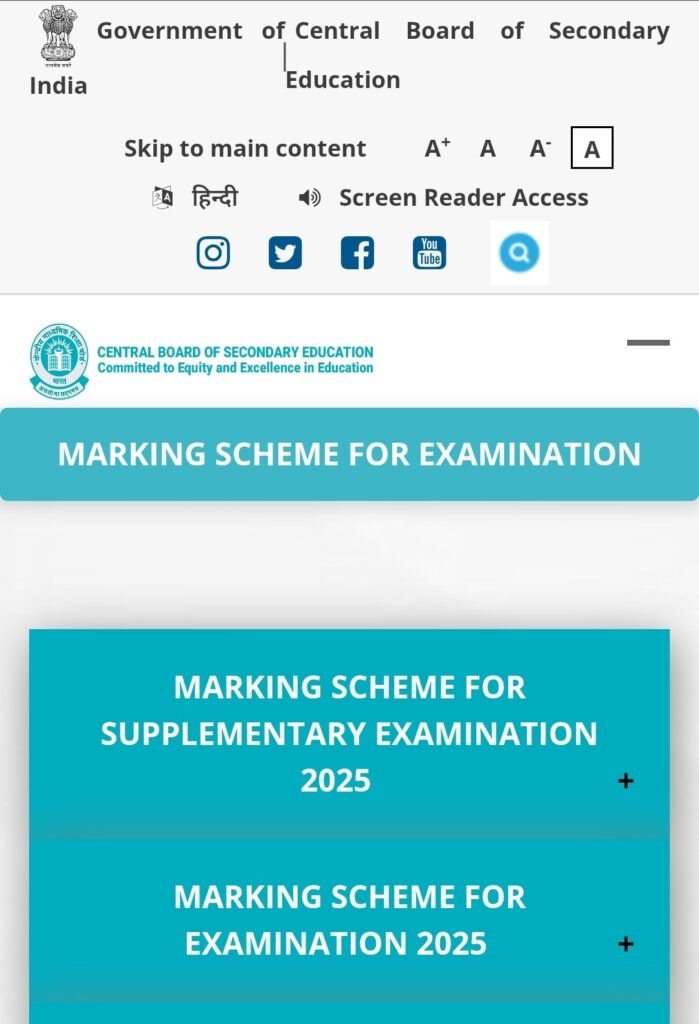
Here are the links to download the official PDF for the Class 12 Physics Marking Scheme
CBSE Class 12 Physics Preparation Tips 2024-25
When students look at the Class 12 Physics Marking Scheme, they immediately understand that smart preparation becomes more helpful than lengthy studying. Therefore, the tips below can help students stay organized and focused:
1. Understand the Syllabus and Weightage
First, have a knowledge of the exact weightage which will help you to focus on high-mark chapters like Optics, Current Electricity, and Electromagnetic Induction.
2. Create a Simple Study Plan
Secondly, divide time based on the basis of chapter difficulty and weightage which will help in covering the entire syllabus steadily.
3. Rely on NCERT First
Do not leave NCERT books as it remains the most important source for both theory and numericals.
4. Solve Sample Papers & PYQs
Moreover, practicing previous year papers improves speed, accuracy, and confidence.
5. Strengthen Numericals + Theory
As both sections carry good marks, make a balance of them as it is truly important for a better scoring strategy.
6. Revise Frequently
Additionally, make a habit of revising regularly as it prevents last-minute confusion and improves retention.
7. Prepare Well for Practicals
Also, you must practice experiments too, as it maintains a tidy record, and helps in preparing for viva questions.
8. Clear Doubts Early
Always take guidance from the teachers or use reliable study platforms, which will help in avoiding conceptual gaps.
9. Manage Stress Smartly
Take short breaks, proper sleep, and make healthy habits help together with proper focus. For students aiming for JEE as well, focusing on high-weightage chapters is key. You can check out this high-weightage chapters in JEE Main Physics 2025 for additional insights on how to prioritize topics.
10. Attempt the Board Exam Strategically
Lastly, always start with easy questions as it helps to build confidence and secure marks from the beginning.
Conclusion
The Class 12 Physics Marking Scheme for 2025 gives every student a clear and straightforward path to score well in the board exam. With a steady study routine and smart time management, Class 12 Physics becomes far more comfortable to master. For more expert tips on excelling in Physics, check Strategies for Scoring High in Physics for NEET. Moreover, the mix of numericals, theory, diagrams, and case-based questions makes the paper balanced and predictable.
Hence, by understanding the marking scheme early, practicing PYQs, revising NCERT concepts, and preparing well for practical exams, students can confidently aim for high scores. With a steady study routine and smart time management, Class 12 Physics becomes far more comfortable to master. If students follow the pattern carefully, they can approach the exam with clarity, confidence, and a strong strategy.
FAQs
1. What is the total marks distribution for the Class 12 Physics board exam?
The theory exam carries 70 marks, while the practical exam carries 30 marks.
2. Which unit carries the highest marks in the Class 12 Physics Marking Scheme?
Optics carries the highest weightage with 18 marks.
3. How many chapters are included in the Class 12 Physics syllabus?
The syllabus includes 14 chapters divided into 9 units.
4. Are numerical questions important in the exam?
Yes, numerical questions form a major part of high-weightage chapters like Current Electricity and Magnetism.
5. How should students prepare for Physics practicals?
Students should practice every experiment, revise the related theory, and prepare for viva questions.
6. Does CBSE follow the same marking scheme for all regions?
Yes, CBSE applies a uniform marking scheme for all states and regions.