
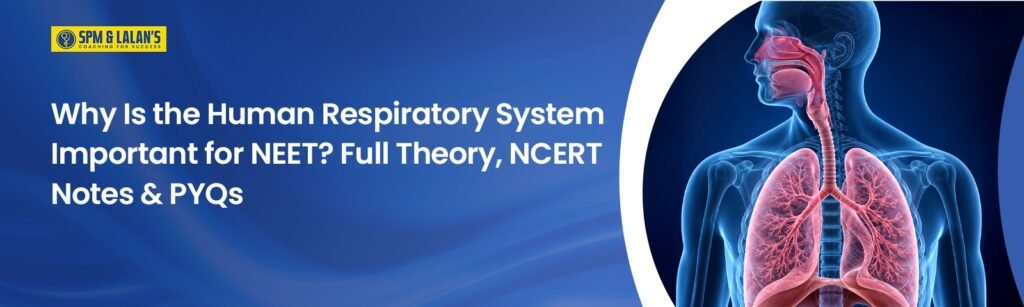
The human respiratory system is one of the most vital systems in the human body. It is responsible for the exchange of gases, mainly oxygen (O₂) and carbon dioxide (CO₂). It ensures that each cell in the body receives a sufficient amount of oxygen for energy production and also plays the most important role of carbon dioxide (CO₂) removal.
The human respiratory system is also an important part of the NEET Biology syllabus 2026, especially under Human Physiology. If you want structured guidance for such high-weightage topics, expert-led NEET coaching in Guwahati can help you prepare with better clarity and consistency.
What is the human respiratory system?
The human respiratory system is a network of organs and tissues that help us perform one of the most essential functions of the human body, which is breathing. The organs such as the nose, Pharynx
The larynx, trachea, bronchi, and lungs constitute the human respiratory system. You might think that the human respiratory system only helps us perform the function of breathing, but that is not the case. Besides its primary function of Breathing (Inhalation and exhalation), it also helps us maintain pH balance in the body, enables us to speak (through the larynx), and acts as a defence mechanism against molecular pathogens in the air (through nasal hairs)
What are the Organs of the Human Respiratory System
| Organs | Primary Functions |
| Nose or Nasal Cavity | The entry point of air in our body filters dust particles, |
| Pharynx | Passage of air and food |
| Larynx | Enabling us to speak, the voice box |
| Tracea | Carry air to and from the lungs |
| Bronchi | Conduct and distribute air |
| Lungs | Carry out gas exchange |
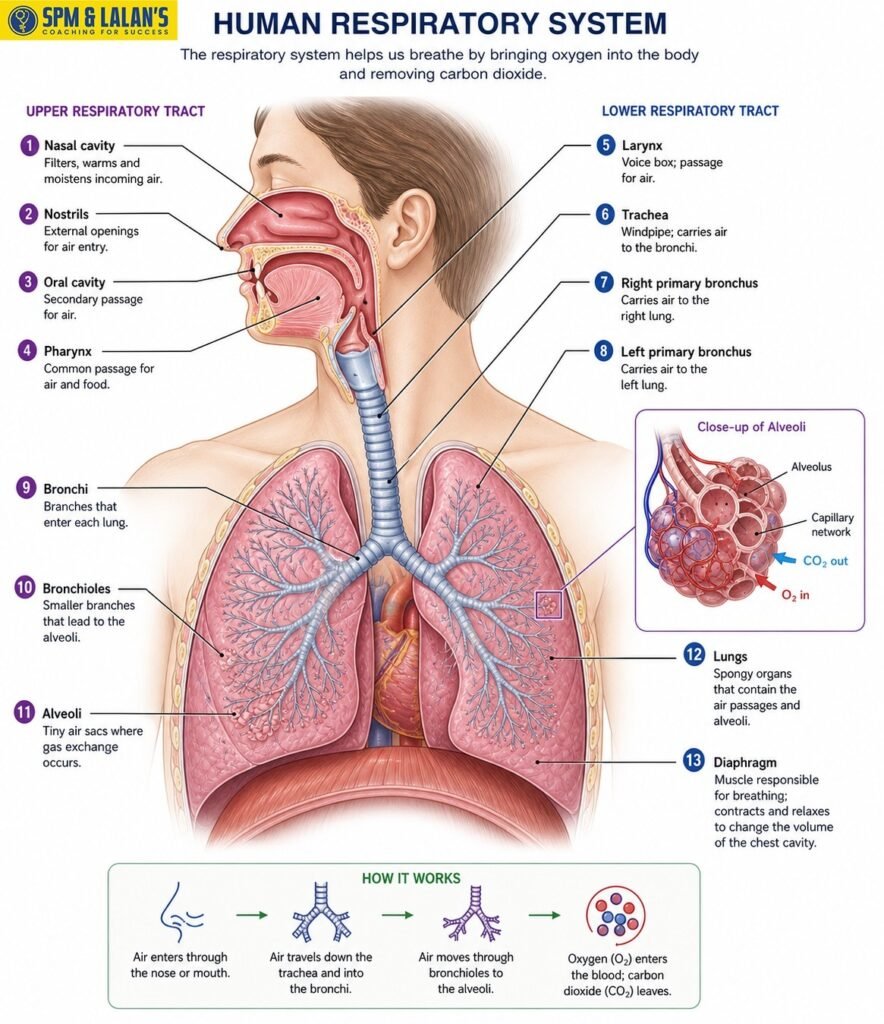
Labelled diagram of the human respiratory system
Let’s discuss what your NCERT books tell you.
Human respiratory system class 7 – Have you ever wondered how your body gets the oxygen it needs to stay active? The human respiratory system is responsible for breathing and includes organs like the nose, trachea, and lungs. When you breathe in, oxygen enters your lungs, and when you breathe out, carbon dioxide is removed from your body.
Human respiratory system class 10. Have you ever thought about how your body efficiently exchanges gases to keep you alive? The human respiratory system plays a crucial role in this process and has organs like the nasal cavity, trachea, bronchi, and lungs. During inhalation, oxygen reaches the alveoli in the lungs, where it diffuses into the blood, while carbon dioxide moves out to be exhaled.
Functions of the Human Respiratory System
The human respiratory system performs multiple functions in the human body. We have seen that the primary function of the human respiratory system is to facilitate breathing, which involves the intake of oxygen (O₂) and the exhalation of carbon dioxide (CO₂). Have you ever wondered why exactly oxygen is required in our body?.
The answer to this is to release energy from food during cellular respiration and to eliminate carbon dioxide (CO₂), a harmful gas. Another important function of the respiratory system is to maintain gas exchange in the body. Lungs are the place in our body where the exchange of gases takes place, where oxygen from the inhaled air diffuses into the blood and carbon dioxide from the blood goes into alveoli to be exchanged. The respiratory system also plays a vital role in the production of sound through the vocal cords, known as the larynx. It also helps us to protect against harmful substances, such as dust particles, as the nasal cavity filters harmful substances out.
Organs of the Human Respiratory System with Diagram
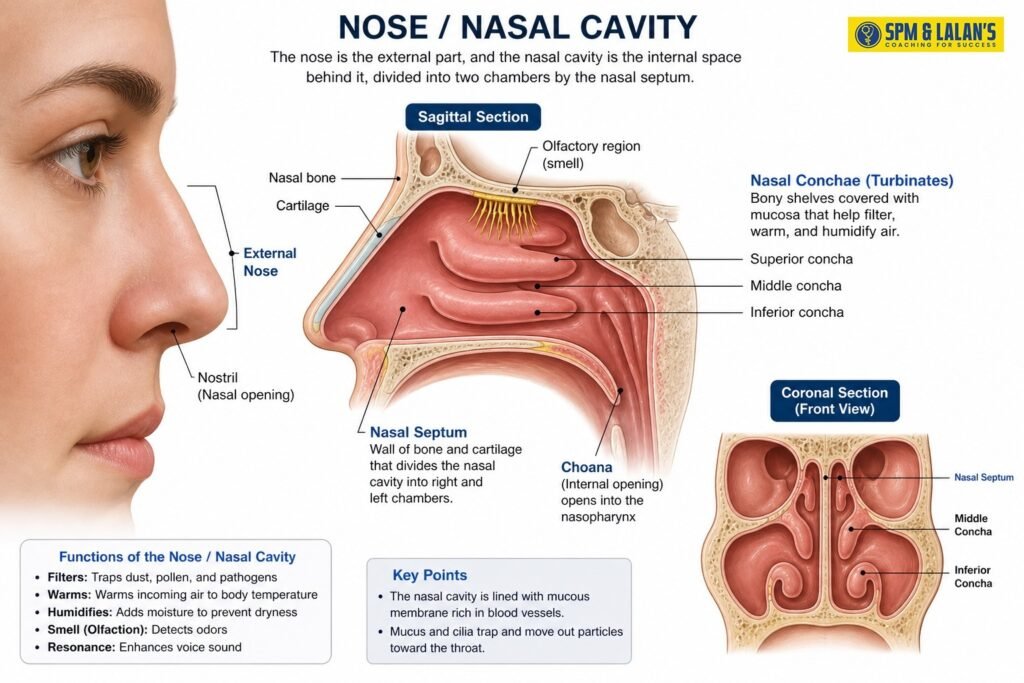
- Nose and Nasal Cavity
- When you breathe in, where does the air enter first? Through your mouth or your nose. It is the entry point of air, which filters out dust particles via nasal hairs.It is lined with mucus-ciliated epithelium. It also moistens warm and humid air.
- Pharynx
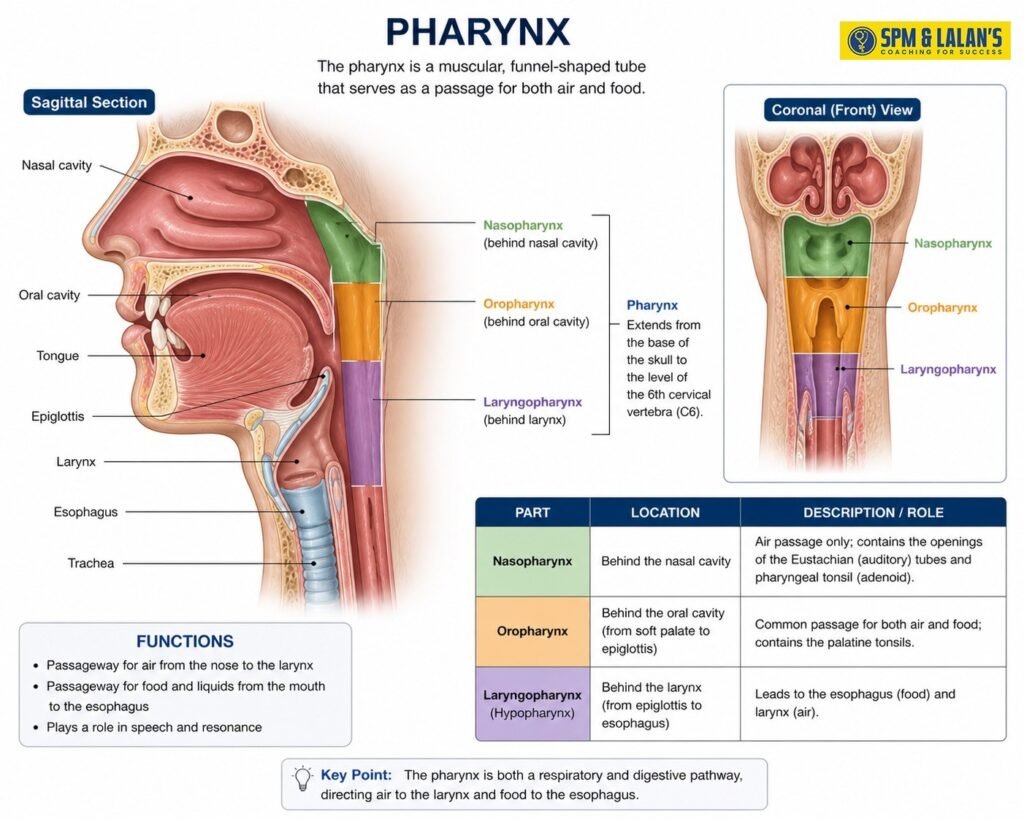
- After the nose, where does the air go? It is the pharynx where it enters; it also performs the role of a dual entry point of air and food. It can be divided into the nasopharynx, Oropharynx, and Laryngopharynx
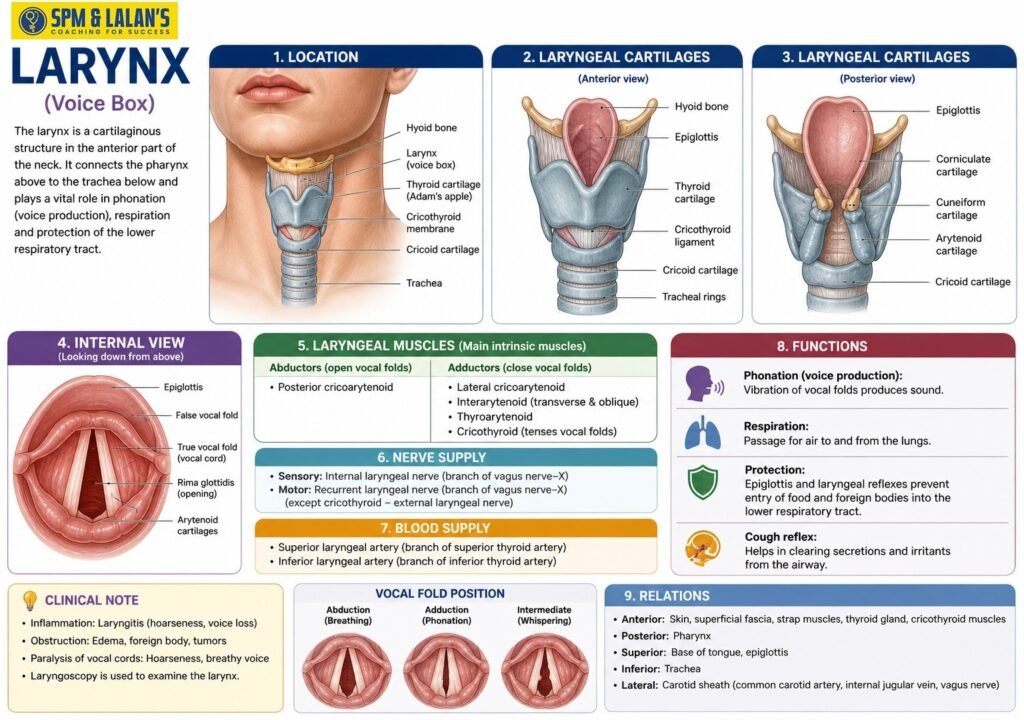
- Larynx (Voice Box) Have you ever wondered how you can speak? Which organ helps in producing sound? It is the larynx that enables us to speak. It contains voice cords and also prevents food entry into the trachea via the epiglottis.
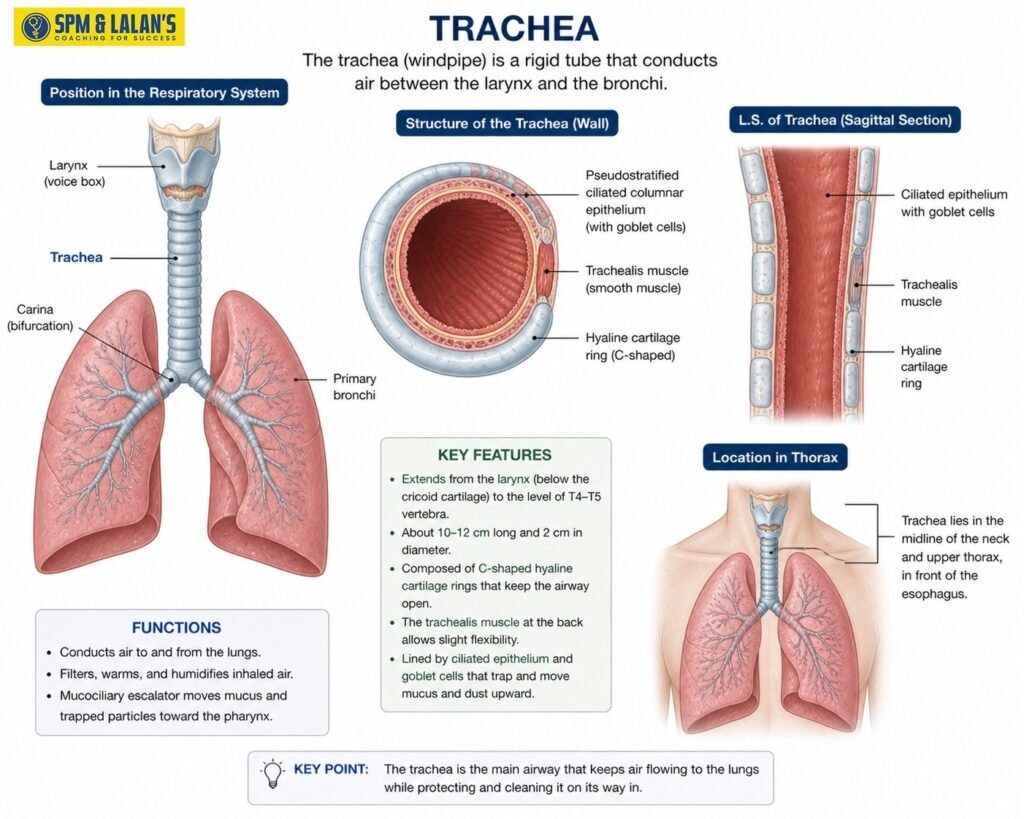
- Trachea (Windpipe)
The trachea is a 10-12 cm long tube supported by a C-Shaped cartilaginous ring.It is lined with ciliated epithelium, which traps dust, microbes, and other foreign particles present in inhaled air. It connects the larynx (voice box) to the primary bronchi, acting as a main airway passage.
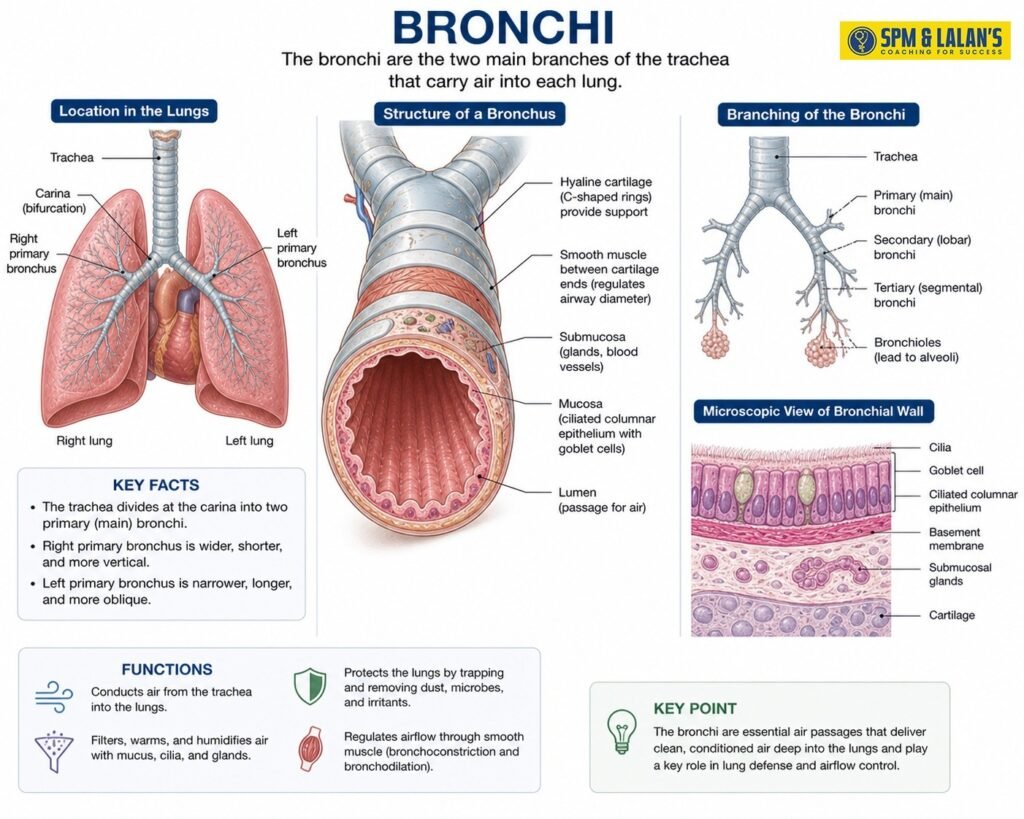
- Bronchi
Do you know that when the trachea reaches the lungs, it is divided into 2 tubes known as the right bronchi and Left Bronchi-One for each lung
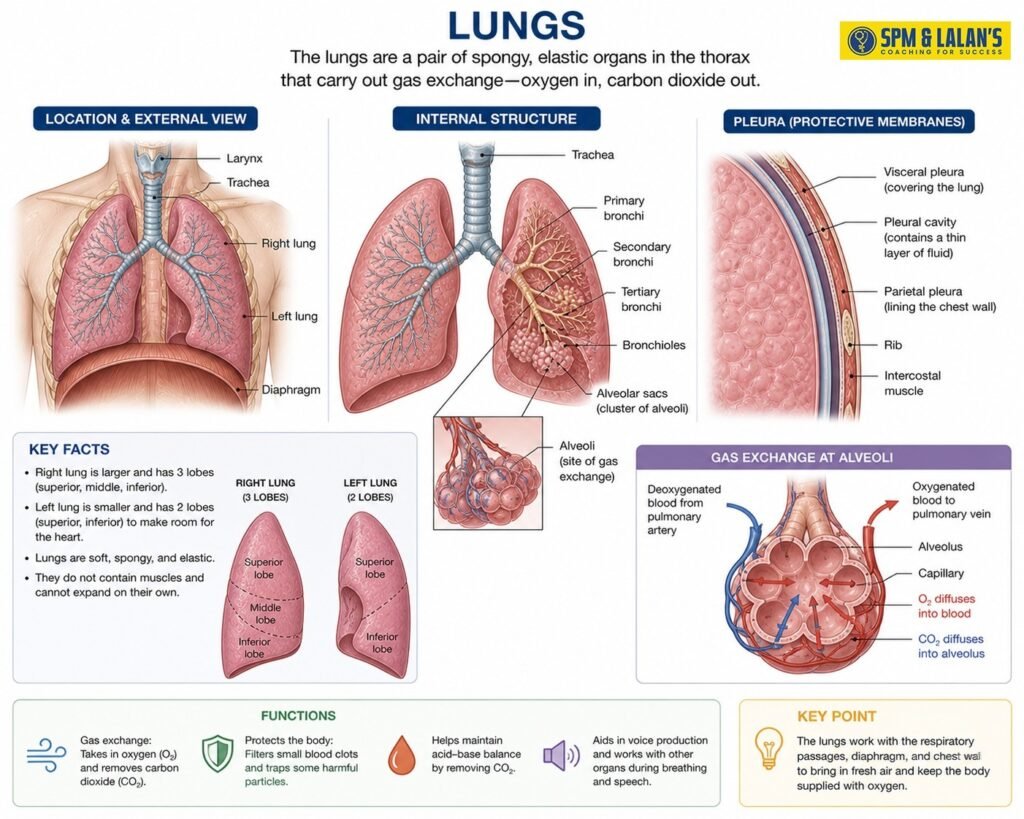
- Lungs
Lungs are a pair of spongy, elastic organs located in the thoracic (chest) cavity on either side of the heart. They are the main site of gas exchange. Each lung is covered with a protective layer known as the pleura
- Alveoli
Alveoli are tiny, balloon-like air sacs present at the ends of bronchioles in the lungs. They are the main site of gas exchange, where oxygen diffuses into the blood and carbon dioxide diffuses out.
Mechanism of breathing
Breathing involves 2 steps—
- Inhalation—
Did you know inhalation involves a complex process mechanism? During inhalation, the diaphragm contracts and moves downward, becoming flat from its original dome-like position. Then the external intercostal muscles contract, lifting the ribs upward and outward, increasing thoracic volume. This lowers lung pressure below atmospheric pressure, so air flows into the lungs.
- Exhalation—
During exhalation, the diaphragm relaxes and moves back to its dome-shaped position. At the same time, the chest cavity becomes smaller because the rib cage moves downward and inward. This decrease in the volume of the thoracic cavity increases the pressure inside the lungs. As the pressure inside the lungs becomes higher than the outside air pressure, air is pushed out of the lungs and expelled from the body.
Respiratory Volumes and Capacities
| Respiratory Volumes | Capacities |
| Tidal Volume | 500mL |
| Inspiratory Reserve Volume | 2500–3000 mL |
| Expiratory Reserve Volume | 1000–1100 mL |
| Residual Volume | 1100–1200 mL |
Disorders of the Respiratory System
| Disorder | What happens | Main cause | Key effects on the body |
| Asthma | Airways become narrow and inflamed | Allergens, dust, pollution | Difficulty in breathing,coughing |
| Bronchitis | Inflammation of the bronchi with excess mucus | Smoking, infection, pollution | Continuous cough and blocked airflow |
| Pneumonia | Alveoli get filled with fluid or pus | Bacterial/viral infection | Fever, chest pain, difficulty in breathing |
| Tuberculosis (TB) | Infection of the lungs, causing tissue damage | Bacteria (Mycobacterium tuberculosis) | Persistent cough, weight loss, and blood in the cough |
| Occupational Lung Diseases | Lung damage due to dust inhalation | Exposure to silica, asbestos, and coal dust | Reduced lung function, chronic breathing issues |
After understanding the theory, practice becomes very important because NEET often tests direct NCERT-based concepts from this chapter. To build a stronger revision plan, you can also read this guide on how to prepare for Biology for NEET before solving PYQs.
If you want complete NEET preparation support with experienced faculty, Biology-focused learning, and regular practice, explore SPM and Lalans for structured guidance.
Now that you have revised the complete theory of the human respiratory system, the next step is to test your understanding with exam-style questions.
NEET PYQ
1. Match List 1 with List 2 (NEET 2024)
| List 1 | List 2 | ||
| A | Expiration Capacity | i | Expiratory reserve volume + Tidal volume + Inspiratory reserve volume |
| B | Functional residual capacity | ii | Tidal volume + Expiratory reserve volume |
| C | Vital capacity | iii | Tidal volume + Inspiratory reserve volume |
| D | Inspiratory capacity | iv | Expiratory reserve volume + Residual volume |
Answer- A-i, B-iv, C-i, D-iii
2. Which of the following factors are favourable for the formation of oxyhaemoglobin in alveoli? (NEET 2024)
Answer- High pO2 and lesser H+ concentration
3. Select the sequence of steps in respiration (NEET 2023)
(A) Diffusion of gases (O2 and CO2) across the alveolar membrane
(B) Diffusion of 02 and C02 between blood and tissues.
(C) Transport of gases by the blood
(D) Pulmonary ventilation by which atmospheric air is drawn in CO2-rich alveolar air is released out
(E) Utilisation of 02 by cells for catabolic reaction and resultant release of CO2
Answer-D, A, C, B, E
4. Vital capacity of the lung is_______(NEET 2023)
(A) IRV+ETR+TV+RV
(B) IRV+ERV+TV-RV
(C) IRV+ERV+TV
(D) IRV+ERV
Answer-(C) IRV+ERV+TV
5. Identify the region of the human brain which has a pneumotoxic centre that alters the respiratory rate by reducing the duration of inspiration (NEET 2022 Phase 2)
(A) Cerebrum
(B) Medulla
(C) Pons
(D) Thalamus
Answer- (C) Pons
6. Which of the following statements are correct with respect to vital capacity? (NEET2022 Phase 2)
(A) It includes ERV, TV and IRV
(B) Total volume of air a person can inspire after a normal expiration
(C) The maximum volume of air a person can breathe in after forced expiration.
(D) It includes ERV, RV and IRV.
(E) The maximum volume of air a person can breathe out after a forced inspiration.
Choose the most appropriate answer from the options given below :
(A) A&E
(B) B, D&E
(C) A, C&D
(D) A, C&E
Answer- A, C&E
7. Under normal physiological conditions in human being every 100mL of oxygenated blood can deliver_________mL of O2 to the tissue (NEET 2022 Phase 1)
(A)2mL
(B)5mL
(c) 4mL
(D)10mL
Answer- (B)5mL
8. Which of the following is not the function of the conducting part of the respiratory system? (NEET 2022 Phase 1)
(A)It clears inhaled air from foreign particles
(B)Inhaled air is humidified
(C) The temperature of inhaled air is brought to body temperature
(D)Provides a surface for diffusion
Answer-(D) Provides
9. The partial pressures (in mm Hg) of oxygen (O2) and carbon dioxide (CO2) at alveoli (the site of diffusion) are: (NEET 2021)
(A)pO2=159 and pCO2 = 0.3
(B)pO2=104 and pCO2=40
(C) pO2=40 and pCO2=45
(D)pO2=95 and pCO2=40
Answer-(B)pO2=104 and pCO2=40
10. Frogs respire in water by skin and buccal cavity and on land by skin, buccal cavity and lungs(NEET 2025)
(A)The statement is false for water but true for land
(B)The statement is false both the statement
(C) The statement is true for water but false for land
(D) The statement is true for both the environment
Answer- (A)The statement is false for water but true for land
11. Assertion (A): A person goes to a high altitude and experiences ‘altitude sickness’ with symptoms like breathing difficulty and heart palpitations.
Reason (R): Due to low atmospheric pressure at high altitude, the body does not get sufficient oxygen. In light of the above statements, choose the correct answer from the options given below. [NEET 2021]
(A) Both (A) and (R) are true, and (R) is the correct explanation of (A)
(B)Both (A) and (R) are true, but (R) is not the correct explanation of (A)
(C)(A) is true, but (R) is false
(D) (A) is false, but (R) is true
Answer- (A)Both (A) and (R) are true, and (R) is the correct explanation of (A)
12. Select the correct events that occur during inspiration. (i) Contraction of diaphragm (ii) Contraction of external intercostal muscles (iii) Pulmonary volume decreases (iv) Intrapulmonary pressure increases [2020]
A. (iii) and (iv)
B. (i), (ii), and (iv)
C. Only (iv)
D. (i) and (ii)
Answer-D. (i) and (ii)
Want more practice after solving these respiratory system PYQs? Download previous year question papers and continue your revision topic-wise.

This article is written by the SPM & LALAN’S Content Team, a group of skilled writers, researchers, and content strategists passionate about creating accurate, reliable, and student-friendly educational content. Every article is thoroughly researched, fact-checked, and updated to ensure readers receive trustworthy and relevant information. The goal is to help students make informed academic decisions through clear, well-researched, and easy-to-understand content.