Joint Entrance Examination stands as one of the most important national-level engineering entrance exams in India. Every year, lakhs of students appear for this exam with a single goal in mind—securing admission into top engineering institutes such as IITs, NITs, IIITs, and GFTIs. Because of its competitive nature, the JEE plays a decisive role in shaping engineering careers across the country.
The Joint Entrance Examination evaluates students on Physics, Chemistry, and Mathematics while also testing their analytical thinking and problem-solving ability. As a result, this exam acts as a gateway for students who dream of becoming engineers and studying in India’s premier institutions.
Students planning structured JEE Main preparation course can explore our comprehensive classroom program designed for concept clarity and exam success.
JEE Full Form
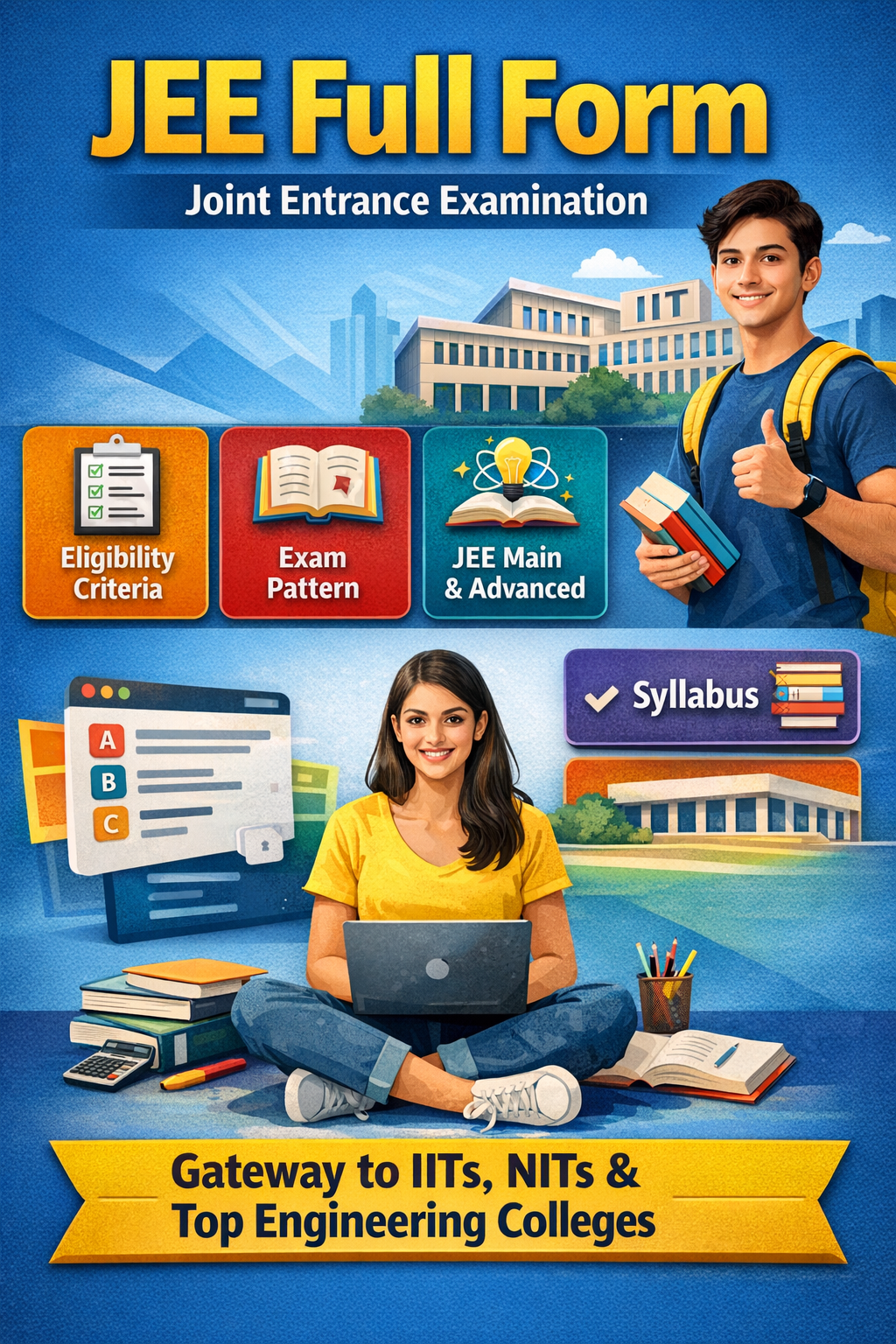
The Joint Entrance Examination is the full form of JEE. It is a national-level engineering entrance test conducted in India to offer admission to undergraduate engineering programs such as B.Tech, B.E, B.Arch, and B.Plan.
Moreover, the Joint Entrance Examination follows a two-stage structure,JEE Main 2026 and JEE Advanced. While JEE Main acts as the first screening test, JEE Advanced serves as the final step for admission into the Indian Institutes of Technology.
Basic Information About JEE
The Joint Entrance Examination is conducted by the National Testing Agency (NTA) and ranks among the toughest entrance exams in the country. Every year, more than 10 lakh students register for this exam, which highlights its massive scale and importance.
Additionally, the Joint Entrance Examination includes two papers, which is JEE Main and JEE Advanced. JEE Main qualifies students for JEE Advanced and also offers direct admission into NITs, IIITs, and other centrally funded technical institutions.
The exam pattern of the JEE includes questions from Physics, Chemistry, and Mathematics based on the Class 11 and 12 NCERT syllabus. Furthermore, the exam takes place in Computer-Based Test (CBT) mode and includes multiple-choice as well as numerical-value questions.
Types of JEE Examination
The Joint Entrance Examination is divided into two main exams:
- JEE Main
- JEE Advanced
Firstly, JEE Main offers admission to NITs, IIITs, and other government engineering colleges. Secondly, JEE Advanced is meant only for students who qualify JEE Main and wish to study in IITs. Therefore, both exams together complete the full structure of the Joint Entrance Examination system.
History of the JEE
The journey of the Joint Entrance Examination reflects the evolution of India’s engineering admission system. Over the years, the exam transformed from a single-level test into a structured two-tier system.
History of the JEE Examination
| Year | Event / Change in JEE Examination |
| 1960 | IITs introduced their own entrance exam to admit engineering students. |
| 1997 | The All India Engineering Entrance Examination (AIEEE) was launched for NITs and other institutions. |
| 2012 | AIEEE was replaced by JEE Main, while the IIT-JEE became JEE Advanced. |
| 2013 | The first-ever JEE Main and JEE Advanced exams were officially conducted by CBSE. |
| 2018 | The National Testing Agency (NTA) was established to conduct JEE Main. |
| 2019 | JEE Main switched to Computer-Based Test (CBT) mode and began being conducted twice a year. |
| 2021 onwards | JEE Main continued to be held multiple times a year, improving fairness and accessibility for students across India. |
As a result, the Joint Entrance Examination became more transparent, student-friendly, and fair.
JEE Main 2026 Eligibility Criteria
To appear for JEE Main 2026 under the Joint Entrance Examination, candidates must satisfy specific eligibility conditions.
| Eligibility Parameter | Criteria |
| Age Limit | There is no age limit to appear for JEE Main. |
| Qualifying Examination | Must have passed Class 12 or an equivalent exam. |
| Year of Passing | Candidates who passed in 2024, 2025, or are appearing in 2026 are eligible. |
| Subject Requirements | – For B.Tech (Paper 1): Physics and Mathematics are mandatory, along with one of Chemistry/Biology/Technical Vocational Subject.- For B.Arch (Paper 2A): Physics, Chemistry, and Mathematics are required.- For B.Plan (Paper 2B): Mathematics is compulsory. |
| Minimum Marks | Candidates must secure at least 75% marks in Class 12 or be in the top 20 percentile of their board (for admission to NITs, IIITs, and CFTIs). |
| Number of Attempts | A candidate can attempt JEE Main six times over three consecutive years after qualifying Class 12.A maximum of two attempts per year is allowed. |
Thus, the Joint Entrance Examination offers multiple chances for students to improve performance.
Joint Entrance Examination: JEE Main vs JEE Advanced
The Joint Entrance Examination consists of two distinct exams with different purposes.
JEE Main is conducted by NTA and offers admission into NITs, IIITs, and GFTIs. On the other hand, JEE Advanced is conducted by one of the IITs and allows admission only into IITs.
The IIT JEE Full Form is Indian Institute of Technology Joint Entrance Examination. While JEE Main acts as the qualifying stage, JEE Advanced determines final IIT admission. Additionally, JEE Advanced has a higher difficulty level and stricter eligibility rules.
About JEE Advanced 2026
JEE Advanced 2026 represents the second stage of the Joint Entrance Examination. Only the top 2,50,000 candidates from JEE Main qualify for this exam.
Moreover, JEE Advanced focuses heavily on analytical thinking and deep problem-solving skills. The JEE at this level tests conceptual clarity rather than memory-based learning.
Eligibility Criteria for JEE Advanced
Candidates must meet the following conditions to appear for JEE Advanced under the JEE system.
| Criteria | Description |
| Qualification | Must be among top 250,000 candidates in JEE Main. |
| Attempts | A maximum of two consecutive attempts in two years. |
| Age Limit | Candidates should be born on or after October 1, 2000 (age relaxation for reserved categories). |
| Subjects | Must have studied Physics, Chemistry, and Mathematics in Class 12. |
Why Joint Entrance Examination Is Important
The Joint Entrance Examination opens doors to India’s best engineering institutions. It ensures a fair, merit-based admission process and identifies students with strong technical aptitude.
Furthermore, the JEE encourages conceptual learning, discipline, and analytical thinking, which are essential skills for future engineers.
What is the Expected JEE Advanced 2026 Difficulty Level?
The expected difficulty level of JEE Advanced 2026 remains a point of discussion among aspirants. We conducted a poll to understand students’ perceptions, and the responses clearly show mixed expectations among candidates.
Poll Responses from Aspirants
- 31 percent believe JEE Advanced 2026 difficulty level will remain similar to 2025.
- 31 percent feel the exam is unpredictable, making it difficult to estimate the pattern for this year.
- 27 percent expect JEE Advanced 2026 to be tougher than last year.
- 8 percent think difficulty varies from student to student, depending on preparation levels.
These results indicate that most students are preparing for similar or higher difficulty, while also acknowledging the unpredictable nature of the exam set by IITs each year.
Preparation Tips for JEE 2026
Here are some strategic preparation tips for boosting you up.
- Revise JEE 2026 concepts using standard books like H.C. Verma, Irodov, and previous IIT papers to strengthen fundamentals.
- Practice previous year papers of JEE 2026 level difficulty to understand the pattern of conceptual and application-based questions.
- Focus on accuracy while solving JEE 2026 mock tests because negative marking can significantly reduce your score.
- Build subject-wise balance for JEE 2026, ensuring Physics, Chemistry, and Mathematics get equal revision time every week.
- Strengthen problem-solving stamina for JEE 2026 by practicing long sessions with minimal breaks to imitate actual exam conditions.
- Maintain short notes of key formulas for JEE 2026 revision and revise them daily to boost retention and speed.
- Solve integer-type and matrix-match questions regularly because JEE 2026 is expected to continue focusing on higher-order thinking.
- Create weekly goals based on the JEE 2026 syllabus weightage and track completion honestly to avoid last-minute pressure.
- Avoid excessive guesswork during JEE 2026 practice because logical elimination works better than random attempts.
- Stay updated with official announcements related to JEE 2026 to avoid missing deadlines, syllabus changes, or guidelines.
What is the Expected JEE Advanced 2026 Difficulty Level?
The expected difficulty level of JEE Advanced 2026 remains a point of discussion among aspirants. We conducted a poll to understand students’ perceptions, and the responses clearly show mixed expectations among candidates.
Poll Responses from Aspirants
- 31 percent believe JEE Advanced 2026 difficulty level will remain similar to 2025.
- 31 percent feel the exam is unpredictable, making it difficult to estimate the pattern for this year.
- 27 percent expect JEE Advanced 2026 to be tougher than last year.
- 8 percent think difficulty varies from student to student, depending on preparation levels.
These results indicate that most students are preparing for similar or higher difficulty, while also acknowledging the unpredictable nature of the exam set by IITs each year.
What Is the JEE Main 2026 Photo Verification Deadline?
The final JEE Main 2026 Photo Verification for uploading the attested form is January 7, 2026, and this deadline will not be extended. Because the JEE Main 2026 Photo Verification is crucial for application validation, every candidate who needs this certificate must finish the process early to avoid technical delays or last-minute errors.
How to Download the JEE Main 2026 Photo Verification Form
Since downloading the form is the first step toward the JEE Main 2026 Photo Verification, follow these steps through your login dashboard:
- Visit jeemain.nta.nic.in
- Click Candidate Login
- Enter Application Number and Password
- Locate the JEE Main 2026 Photo Verification Certificate tab
- Download and print the PDF
Once again, remember that the JEE Main 2026 Photo Verification applies only to candidates who used PAN or Passport details, not Aadhaar.
Steps to Complete and Upload the Verification Form
You must complete all tasks before the JEE Main 2026 Photo Verification, and every step matters:
- Fill the Form: Enter details exactly as listed in your JEE Main application.
- Photograph: Paste a recent passport-size photograph in the assigned space.
- Attestation: Get the form signed and stamped by your School/College Principal or Headmaster.
- Digitize: Scan the filled and attested form clearly.
- Upload: Use the upload link in the candidate portal before the JEE Main 2026 Photo Verification.
Since the JEE Main 2026 photo verification occurs before the first exam session, completing everything early can help reduce stress.
Subject-Wise Syllabus for JEE Main 2026
It is important to understand the subject-wise distribution of topics, as it helps students to prepare in a structured way. Although the official syllabus is not yet published, you can check the previous year’s syllabus, which gives a clear idea of what to expect.
Paper 1 Syllabus (Physics, Chemistry, Mathematics)
The JEE Main Syllabus 2026 covers topics from Classes 11 and 12.
Physics
The Physics syllabus includes areas such as mechanics, thermodynamics, electromagnetism, optics, and modern physics.
Chemistry
Chemistry covers Physical Chemistry, Organic Chemistry, and Inorganic Chemistry, with topics like solutions, equilibrium, and chemical kinetics.
Mathematics
Mathematics includes algebra, calculus, coordinate geometry, trigonometry, and probability.
Paper 1 Highlights
| Subject | Key Topics |
| Physics | Mechanics, Thermodynamics, Electromagnetism, Optics, Modern Physics |
| Chemistry | Physical, Organic, Inorganic Chemistry; Solutions; Chemical Kinetics |
| Mathematics | Algebra, Calculus, Coordinate Geometry, Trigonometry, Probability |
Hence, it is recommended to refer to the official PDF once released for complete chapter-wise details.
Paper 2A (B.Arch) Syllabus
The JEE Main B.Arch Syllabus 2026 includes mathematics, aptitude tests, and drawing assessments. Students must focus on sketching, 3D visualization, architectural drawing, and reasoning. Hence, practicing consistently will help to strengthen creativity as well as numerical accuracy.
Paper 2B (B.Planning) Syllabus
The B.Planning syllabus focuses on planning aptitude, reasoning, and mathematics. So, students should build strong analytical skills and practise interpretation-based questions to score well.
Deleted or Reduced Syllabus for JEE Main 2026
It is important to understand the deleted or reduced topics as it helps students to avoid unnecessary study load. Based on previous trends and NCERT updates, the following topics have been removed or reduced:
Deleted Syllabus for JEE Main 2026 (Reference Based)
| Topic | Status |
| P Block Elements | Deleted |
| Solid State | Deleted |
| Trigonometric Equations | Deleted or Reduced |
| Some Complex Organic Reactions | Reduced |
Hence, these changes are based on earlier updates. So, students are highly recommended to verify the final list once NTA releases the official syllabus PDF.
JEE Main 2026 Syllabus PDF Download
Students can download the JEE Main Syllabus 2026 PDF once NTA activates the link. The PDF will include complete chapters for Physics, Chemistry, and Mathematics, along with Paper 2 sections.
JEE Main Syllabus 2026 PDF Link
Chapter-Wise Weightage in JEE Main Syllabus 2026
Knowing chapter-wise weightage helps students plan their preparation more efficiently.
Mathematics Weightage
Topics such as Calculus, Algebra, and Coordinate Geometry usually carry higher marks. Moderate topics include Probability, Trigonometry, and Matrices.
Physics Weightage
Physics includes high-weightage chapters like:
- Mechanics
- Electrostatics
Moderate-weightage chapters include:
- Optics
- Thermodynamics
Lower-weightage topics include:
- Modern Physics
Chemistry Weightage
In Chemistry:
- Physical and Inorganic Chemistry carry a higher weightage
- Organic Chemistry comes under moderate weightage
- Numerical and conceptual questions from Physical Chemistry appear frequently
Conclusion
The JEE exam plays a crucial role in shaping the engineering journey of students across India. It not only tests knowledge in Physics, Chemistry, and Mathematics but also builds analytical thinking and discipline. With a well-structured system through JEE Main and JEE Advanced, the Joint Entrance Examination ensures fair access to top engineering institutes like IITs, NITs, and IIITs. Therefore, when students understand the exam structure, eligibility, and purpose clearly, they prepare with better confidence and direction. Ultimately, success in the JEE opens doors to quality education and a strong engineering career.
Frequently Asked Questions (FAQ)
What is the full form of JEE?
The full form of the JEE is the Joint Entrance Examination.
What is the JEE exam?
The JEE Examination is a national-level engineering entrance test for undergraduate admissions.
When was JEE started?
The modern structure of the JEE started in 2012.
What is the full form of IIT JEE?
IIT JEE stands for Indian Institute of Technology JEE.
Who conducts the JEE Examination?
NTA conducts JEE Main, while IITs conduct JEE Advanced.
JEE Full Form in English?
JEE Full Form in English is JEE.