

The JEE Main Result 2026 has become the most-awaited update for lakhs of engineering aspirants across India. The National Testing Agency has officially revised the result date for JEE Main 2026 Session 1. Initially, NTA planned to release the JEE Main Result 2026 by February 12. However, as per the latest update, NTA has now confirmed that the Main Result will be declared by February 16. Students are now closely tracking every update from the official website. Since this announcement, students have started checking the official website regularly. The delay has increased curiosity, but NTA has assured candidates that the result will be released on or before the revised date.
Students searching for JEE Main Result 2026 Session 1, JEE Main result link 2026, or jeemain.nta.nic.in result 2026 should note that the official result will be available only on the NTA portal. Candidates can check the JEE Main result by application number through the official JEE Main result login 2026 window using their credentials. The JEE Main 2026 scorecard download link will be activated soon after the declaration.
JEE Main Result 2026 Date and Time LIVE Update

As per the latest official update released on February 12, NTA has postponed the JEE Main Result for Session 1. NTA has clearly stated that candidates can now expect the Main Result anytime on or before February 16. This means the result may come earlier than February 16 as well. Students should remain alert and keep checking the official website regularly.
At the same time, the JEE Main Final Answer Key 2026 PDF is still awaited. Students can also check how to download and calculate marks using the official JEE Main Response Sheet here: Usually, NTA releases the final answer key just before announcing the result. Therefore, candidates can expect the final answer key first, followed by activation of the JEE Main 2026 result link shortly after.
Students are advised to regularly check:
- nta.ac.in
- jeemain.nta.nic.in
Joint Entrance Exam JEE Main Result 2026: Highlights
The result plays a key role in admissions to NITs, IIITs, GFTIs, and eligibility for JEE Advanced Registration Date 2026.
Below are the official highlights related to the result.
| Particulars | Details |
| Conducting Body | National Testing Agency (NTA) |
| JEE Main 2026 Session 1 Exam Dates | January 21, 22, 23, 24, 28, and 29, 2026 |
| JEE Main Session 1 Result Date | February 16, 2026 |
| NTA JEE Main Result Time | Around 6 PM |
| JEE Result Link | To be updated |
| Session 1 Result Status | To be declared |
| Credentials Required | Application Number and Password |
Candidates must keep their login details ready to check the JEE Main 2026 scorecard PDF download without delay.
JEE Main Result 2026 Cut Off Percentile (Expected)
NTA will announce the official JEE Main 2026 cutoff percentile along with Session 2 results. However, last year’s trends help in estimating the expected cutoff for JEE Advanced eligibility.
| Category | JEE Main 2025 Cut Off Percentile |
| General (UR) | 93.10 |
| EWS | 80.38 |
| OBC-NCL | 79.43 |
| SC | 61.15 |
| ST | 47.90 |
| PwD | 0.0079 |
This cutoff gives students an idea about qualifying for JEE Advanced 2026 and participating in JoSAA counselling 2026.
How to Check JEE Main Result 2026 Online
Candidates can easily check the JEE Main Result 2026 by following the steps given below.
- Visit the official website jeemain.nta.nic.in
- Click on the JEE Main 2026 Session 1 Result link
- Enter your application number and password
- Click on the “View Result” option
- The JEE Main Result 2026 will appear on the screen
- Download the scorecard and save it for future use
Candidates should download multiple copies of their scorecard for JoSAA counselling, state counselling, and private engineering college admissions.
👉 If you faced issues earlier, you can read about the JEE Main Correction Window 2026 here:
Students who haven’t checked exam updates can refer to the JEE Main Exam Calendar here:
JEE Main Result 2026 Session 1 Marks vs Rank (Expected)
The JEE Main 2026 marks vs rank analysis helps candidates understand admission chances in NITs and IIITs.
| Marks | Expected Rank |
| 300 | 1 |
| 271–280 | 56–25 |
| 260–270 | 115–55 |
| 241–259 | 402–115 |
| 222–240 | 978–401 |
| 201–222 | 2001–978 |
| 180–200 | 3901–2001 |
| 161–180 | 7003–3901 |
| 141–160 | 12200–7003 |
| 119–140 | 21000–12200 |
| 100–119 | 35000–21010 |
| 80–100 | 61104–35199 |
Separate Rank Cards for Each Paper in JEE Main Result 2026
NTA prepares separate rank lists for different papers under the Main Result. Candidates must clearly understand this structure.
| Paper | Course |
| Paper 1 | BE / BTech |
| Paper 2A | BArch |
| Paper 2B | BPlan |
Candidates who appear for more than one paper will receive separate scorecards.
Validity of JEE Main Result 2026
The Main Result remains valid only for the current academic year. Candidates cannot use previous year scores for admission in 2026. Students planning to take a drop year must prepare again and appear for the exam next year.
Rechecking of JEE Main 2026 Results
The National Testing Agency has clearly stated that it does not allow rechecking or re-evaluation of the Main Result. Before declaring the final result, NTA provides candidates with an opportunity to challenge the provisional answer key by paying a prescribed fee. Subject experts carefully review all valid objections submitted by candidates. After this process, NTA releases the final answer key and prepares the result accordingly. Once NTA declares the Main Result, the scores become final and binding, and no further requests for correction are accepted.
Is Percentile Equal to Percentage in JEE Main Result ?
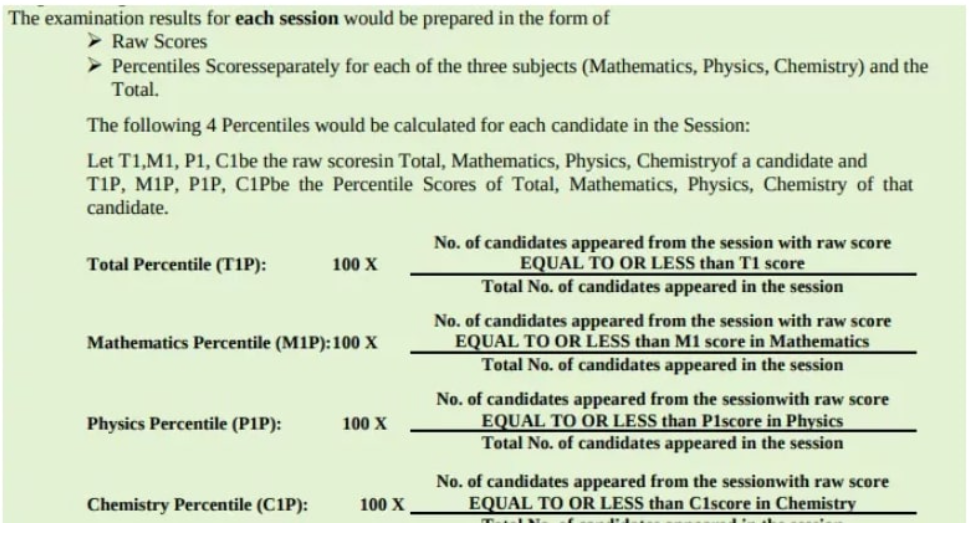
No, percentile and percentage are not the same in the Main Result. The percentage represents the marks obtained out of the total marks, while the percentile shows the relative performance of a candidate compared to others. A percentile score indicates the percentage of candidates who scored equal to or less than a particular candidate in the same session. NTA uses the percentile system to ensure fairness and normalization because JEE Main is conducted in multiple shifts and sessions with different difficulty levels.
JEE Main 2026 Percentile Calculator Formula
NTA calculates the Main Result using a standardized percentile formula. This method ensures that no candidate gets an unfair advantage or disadvantage due to variation in exam difficulty.
NTA Score (Percentile) =
(100 × Number of candidates in the session with raw scores equal to or less than the candidate’s score) ÷ Total number of candidates in that session
This formula ranks candidates within their respective sessions and helps NTA prepare the overall merit list accurately.
What Is a Good Score in JEE Main 2026 Session 1?
A score above 180 marks in Main Result for Session 1 is considered very good and can help candidates secure seats in top NITs, IIITs, and GFTIs, especially in popular branches. A score between 140 and 170 marks is also considered decent and may fetch good colleges depending on category, home state quota, and cut-off trends. However, the final admission outcome depends on factors such as exam difficulty, number of candidates, and seat availability.
Students aiming to improve their performance in Session 2 can join our JEE Main 2026 Crash Course designed for targeted score improvement.
Is 120 Marks a Good Score in JEE Main 2026 Session 1?
Scoring 120 marks in JEE Main falls in the average to good range. With this score, candidates can expect a percentile between 90 and 94, depending on session difficulty. This score may help candidates qualify for JEE Advanced, especially for reserved categories. However, admission to top NITs may remain challenging. Candidates with 120 marks should aim to improve their score in Session 2 to increase their chances of getting better colleges and branches.
NTA JEE Main Final Answer Key 2026 Expected Soon
Candidates are eagerly waiting for the NTA JEE Main Final Answer Key 2026. NTA usually releases the final answer key shortly before announcing the Main Result . The final answer key reflects all corrections made after reviewing objections raised against the provisional key. If NTA finds any question incorrect or ambiguous, it may drop the question or award full marks to all candidates who attempted it. Once released, the final answer key becomes the basis for result calculation, and no further challenges are allowed.
What Is Normalised Score in JEE Main 2026?
The normalised score in JEE Main 2026 refers to the adjusted score calculated by NTA after accounting for differences in difficulty levels across multiple shifts. Since the JEE Main examination is conducted in several sessions and shifts, each question paper may not be of exactly the same difficulty. Therefore, comparing raw marks directly would be unfair to candidates who appeared in tougher shifts.
To address this issue, NTA applies a normalisation process using statistical methods. In this process, a candidate’s raw marks are converted into a percentile score based on their relative performance within the same shift. This percentile score is what appears as the NTA Score in the JEE Main Result 2026.
The normalised score ensures that:
- No candidate is disadvantaged due to a tougher question paper
- Performance is compared fairly across all shifts
- Merit ranking is based on relative performance, not absolute marks
It is important to note that a normalised score is not an average of marks, nor is it a scaling of raw marks. Instead, it reflects how well a candidate has performed compared to others who appeared in the same session. This system has been adopted by NTA to maintain transparency and fairness in large-scale competitive examinations like JEE Main.
Difference Between Raw Marks, Percentile, and Normalised Score
Many candidates confuse these three terms. However, they serve different purposes in JEE Main 2026:
- Raw Marks: Actual marks obtained out of 300
- Percentile Score: Relative performance indicator within a shift
- Normalised Score: Percentile score used to compare candidates across all shifts
Admissions, rankings, and eligibility for JEE Advanced are decided only on the basis of percentile scores, not raw marks.
What If the Official Website Crashes on Result Day?
On the JEE Main 2026 result day, heavy traffic is expected on the official website due to lakhs of candidates trying to check their scores simultaneously. This may lead to slow loading, server errors, or temporary unavailability of the website.
If the website crashes or does not open:
- Candidates should remain calm and avoid panic
- Continuous refreshing should be avoided, as it increases server load
- It is advisable to wait for some time and try again later
- Using different browsers or checking during non-peak hours may help
NTA generally restores access quickly, and results remain available for download for several days. Candidates must rely only on the official website and avoid third-party platforms claiming to provide early access or leaked results, as these can be misleading.
JEE Main 2026 Scorecard Link Update: Not Live Yet
As of now, the JEE Main 2026 scorecard download link is not live. Although the backend result link has been generated, it has not yet been activated on the official portal jeemain.nta.nic.in. Candidates attempting to log in may encounter errors or inactive pages.
Additionally, the result declaration has been rescheduled to February 16, which explains the delay in scorecard availability. Once the link is officially activated, candidates will be able to download their scorecard using:
- Application number
- Date of birth or password
The scorecard will contain details such as:
- Candidate name and roll number
- Session-wise percentile scores
- Overall percentile
- All India Rank (if applicable)
- Qualification status for JEE Advanced
Candidates are advised to download and save multiple copies of the scorecard for future admission processes and counselling rounds.
Importance of JEE Main 2026 Scorecard for Admissions
The JEE Main scorecard plays a crucial role in the admission process for engineering colleges across India. It is required for:
- JEE Advanced eligibility
- JoSAA counselling for NITs, IIITs, and GFTIs
- State-level engineering counselling
- Admission to private and deemed universities accepting JEE Main scores
Since the result is valid only for the current academic year, candidates planning to improve their performance must appear again in the next examination cycle.
Latest Update: What the Delay Means for Students
NTA has officially delayed the Main Result and final answer key by February 16. This means:
- Expect the result anytime on or before February 16
- The result link is already generated
- The final answer key may be released anytime
- Students must keep checking nta.ac.in and jeemain.nta.nic.in
Conclusion
The JEE Main Result 2026 is a crucial milestone for every engineering aspirant. With the revised result date set to February 16, students must stay calm and prepared. Regularly checking official websites and understanding marks, percentiles, and rank trends will help students plan their next steps wisely. Proper awareness and timely action can make a big difference in the admission process.
Frequently Asked Questions (FAQ)
What is CRL in the JEE Main cutoff?
CRL stands for Common Rank List, and it represents the overall rank secured by a candidate in JEE Main among all test-takers, regardless of their category. The CRL is prepared after the normalisation process and is based on the candidate’s best percentile score. This rank is used as the primary reference during counselling for unreserved category seats and also acts as a benchmark for comparing performance across categories. While reserved category candidates may have separate category ranks, the CRL remains important because many institutes, scholarships, and eligibility criteria refer specifically to the Common Rank List. Therefore, a strong CRL significantly improves the chances of admission into top NITs, IIITs, and GFTIs through JoSAA counselling.
What is the JEE Main cutoff for IIITs?
The JEE Main cutoff for IIITs varies every year depending on factors such as the number of applicants, seat availability, difficulty level of the exam, and popularity of specific branches. Generally, older and more reputed IIITs like IIIT Hyderabad, IIIT Bangalore, and IIIT Allahabad demand higher ranks, often within the top 10,000 to 25,000 in the Common Rank List for core branches such as Computer Science and Electronics. Newer IIITs or less preferred branches may allow admission at comparatively higher ranks. Category-wise cutoffs are also different, with reserved category candidates often having a relaxed cutoff. Since cutoffs change annually, candidates are advised to refer to the previous year’s JoSAA opening and closing ranks to get a realistic understanding of admission chances.
Where can I check my JEE Main percentile vs rank?
Candidates can understand the relationship between their JEE Main percentile and rank by referring to official counselling data released by JoSAA, along with previous year rank versus percentile trends published after result declaration. Although NTA does not release an exact conversion chart, past year data provides a reliable estimate of expected ranks at different percentile ranges. Coaching institutes and academic platforms also analyse these trends using official sources to give approximate rank predictions. However, it is important to remember that the exact rank may vary slightly every year due to changes in the number of candidates and overall performance. Therefore, percentile vs rank analysis should be used only as a guidance tool while planning college preferences during counselling.