


Securing a seat in a top-tier engineering college in India requires more than just hard work; it demands a deep understanding of the admission landscape. As we look ahead, the JoSAA Cutoff serves as a vital benchmark for students aiming for the 2026 academic cycle. This data helps aspirants set realistic targets and plan their preparation journey with precision. For structured preparation and expert guidance, students can explore platforms like SPM & Lalans to strengthen their JEE strategy. Whether you are aiming for an NIT, IIIT, or GFTI, knowing the expected opening and closing ranks is the first step toward success.
What is JoSAA Cutoff?
The JoSAA Cutoff represents the minimum percentile or marks a candidate must secure to move forward in the admission process. This score determines whether you qualify for JEE Advanced or become eligible for the seat allotment process across various engineering colleges. National agencies decide these scores every year based on a variety of dynamic factors. Because competition levels shift, the cutoff acts as a filter to ensure that only the most prepared students reach the next stage of their engineering career.
Key Factors Influencing the JoSAA Cutoff 2025 and 2026
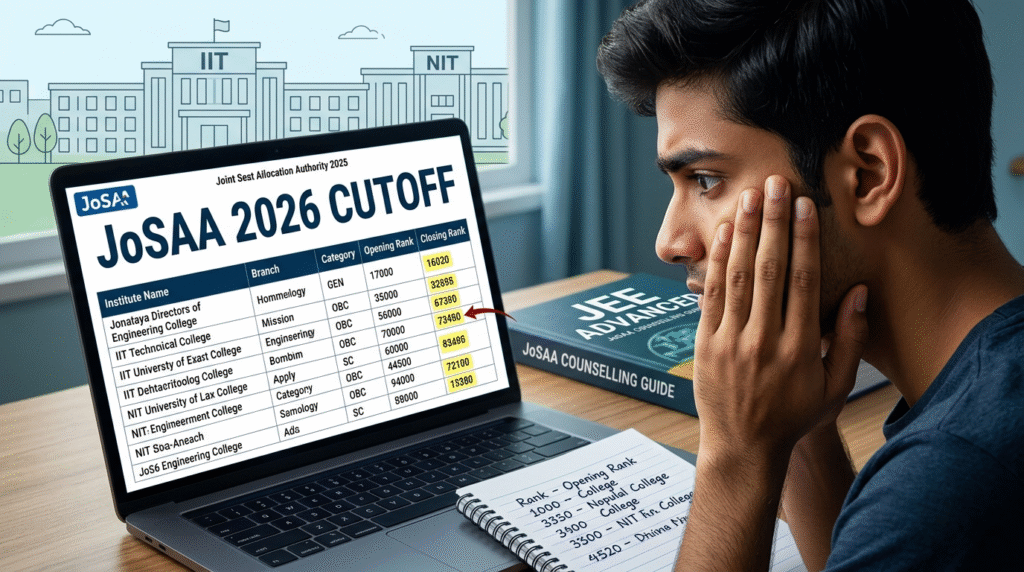
Several core elements decide the final numbers each year. These factors make the JoSAA Cutoff 2025 variable and unique to every session:
- Total Candidates: The sheer number of aspirants appearing for the exam directly affects the level of competition.
- Difficulty Level: If the exam paper is exceptionally tough, the cutoff marks generally drop.
- Seat Availability: The total number of seats in participating NITs, IIITs, and other colleges remains a fixed constraint.
- Reservation Criteria: Specific category-wise seats for SC, ST, OBC-NCL, EWS, and PwD influence the final closing ranks.
- Branch Preference: High demand for Computer Science and AI often drives the JoSAA Cutoff much lower (stricter) for those specific streams.
Expected Cut-Off for 2026: Category-Wise Breakdown
While we analyze the JoSAA Cutoff 2025, expert predictions for 2026 help students set their sights on specific goals. Here is the estimated range:
| Category | Expected Percentile | Expected Marks Range |
| General | 88 – 90 | 90 – 95 |
| EWS | 78 – 80 | 70 – 75 |
| OBC-NCL | 74 – 76 | 70 – 73 |
| SC | 54 – 56 | 40 – 45 |
| ST | 44 – 46 | 30 – 35 |
| PwD | 44 – 46 | 30 – 35 |
Note: These ranges are predictions based on past trends. The NTA will release official figures after the results.
Important Dates for JEE Main 2026 (Tentative)
Before talking more about JoSAA Cutoff, you must track these essential deadlines:
| Events | Session 1 Dates | Session 2 Dates |
| Online Application Submission | 31 Oct 2025 to 27 Nov 2025 | 01 Feb 2026 to 25 Feb 2026 |
| Correction Window | 1 Dec to 2 Dec 2025 | The last week of Feb 2026 |
| Admit Card Display | 3 days before the exam | 3 days before the exam |
| Exam Date | 21 Jan to 29 Jan 2026 | 02 April to 09 April 2026 |
| Provisional Answer Key | 04 February 2026 | April 2026 |
| Final Answer Key & Result | By 12 February 2026 | April 2026 |
| Counselling Process | July / August 2026 | July / August 2026 |
JoSAA Cutoff 2026: Expected Opening & Closing Ranks
The cutoff trends suggest that top NITs maintain very tight closing ranks. Below is the expected analysis for Computer Science Engineering (CSE) across different tiers of NITs:
Top-Tier NITs
These institutes are the most sought-after and require high ranks.
| NIT | Branch | Opening Rank | Closing Rank |
| NIT Tiruchirappalli | CSE | 600 | 4500 |
| NIT Karnataka Surathkal | CSE | 1000 | 2750 |
| NIT Warangal | CSE | 1200 | 3450 |
Mid-Tier NITs
A great option for students with solid ranks looking for quality placements.
| NIT | Branch | Opening Rank | Closing Rank |
| MNIT Jaipur | CSE | 3000 | 5700 |
| MNNIT Allahabad | CSE | 2400 | 6300 |
| NIT Calicut | CSE | 3000 | 8050 |
Lower / Newer NITs
These colleges generally offer more flexibility with higher closing ranks.
| NIT | Branch | Opening Rank | Closing Rank |
| NIT Patna | CSE | 10450 | 16400 |
| NIT Raipur | CSE | 13000 | 21500 |
| NIT Jalandhar | CSE | 6800 | 14500 |
Branch-Wise and Category-Wise Cutoff Analysis
Your choice of stream significantly affects the JoSAA Cutoff. Popular branches have much more competitive closing ranks.
| Branch | Competition Level | Rank Range |
| CSE | High | 4500 – 6000 |
| ECE | Moderate | 6000 – 8000 |
| Electrical | Moderate | 8000 – 10500 |
| Mechanical | Medium | 10500 – 14000 |
| Civil | Low | 25000 – 30000 |
Similarly, the JoSAA Cutoff varies by category, offering relaxation for reserved candidates:
- General: Up to 50,000
- OBC-NCL: Up to 30,000
- EWS: Up to 15,000
- SC: Up to 10,000
- ST: Up to 8,000
For a deeper breakdown of trends and qualifying marks, refer to this detailed guide on JEE Main OBC cutoff 2026.
Similarly, SC category aspirants can check a detailed analysis of the JEE Main SC cutoff 2026.
Rank vs College Analysis for JoSAA Cutoff Aspirants
Understanding which college you can get into based on your rank is crucial for a successful strategy.
- 1 – 5,000: Aim for CSE in Top-Tier NITs.
- 5,000 – 15,000: Secure CSE or ECE in Mid-Tier NITs.
- 15,000 – 30,000: Look for core branches in established NITs.
- 30,000 – 60,000: Targets lower NITs or specialized branches.
- 60,000+: Consider newer NITs or IIITs.
The JoSAA Counselling Process
To benefit from the JoSAA Cutoff data, you must follow the official counseling steps accurately. First, you must qualify for JEE Main. Next, register on the official JoSAA portal and fill in your college and branch preferences. Once you lock your choices, the system performs seat allotment in multiple rounds. Finally, you must confirm your admission by paying the fee and verifying your documents.
Strategy for NIT Admission in 2026
An effective strategy during the admission rounds can help you get into a better college than you expected. Many aspirants also benefit from enrolling in structured programs such as JEE coaching in Guwahati, which helps in improving rank consistency and exam performance. You should always leverage your home state quota benefit if you live in a state with a high-quality NIT. Furthermore, balance your preferences by listing “dream” colleges along with “safety” options. Most importantly, attend all counseling rounds, including spot rounds, to catch any vacant seats that open up late in the process.
Before the exam, make sure you evaluate your performance with full-length mock tests.
Conclusion
The JoSAA Cutoff plays a foundational role in shaping the future of engineering aspirants. As competition grows, especially in high-demand fields like artificial intelligence, analyzing these opening and closing ranks becomes mandatory. By studying the category-wise trends and branch variations, you can set realistic expectations for your rank. Ultimately, combining these cutoff insights with a smart choice-filling strategy will help you secure a seat in your desired NIT. Use the data from the Cutoff wisely to move closer to your engineering goals and start your career on a strong note.
Frequently Asked Questions (FAQs)
Who finalizes the JEE Main cut-off?
The National Testing Agency (NTA) makes the final call on finalizing the JEE Main cut-off scores each year. They look at several complex parameters before announcing the official numbers. These factors include the previous year’s cut-off trends, the specific difficulty level of that year’s exam paper, and the total volume of candidates who participated in the test. They also cross-reference the number of available seats in participating colleges to ensure the cutoff allows enough students to fill the capacity without overwhelming the next stage of the process.
What is the meaning of cut-off” in the JEE Main exam?
The JEE Main cut-off represents the minimum qualifying score or percentile that a candidate must achieve to remain in the race for admissions. It acts as a gatekeeper for two main paths. Firstly, it determines if a student is eligible to appear for the JEE Advanced exam, which is the gateway to the IITs. Secondly, it serves as the eligibility bar for students aspiring to secure seats in top engineering colleges like NITs and IIITs through the counseling process. Without clearing this cutoff, a student cannot move forward into these premier institutions.
How is the JEE Main cut-off finalized?
Authorities finalize the JEE Main cutoff by examining a combination of historical data and current exam statistics. They analyze the previous year’s cut-off scores and trends to maintain a level of consistency. Additionally, they factor in the total number of students who actually appeared for the exam and how difficult the specific paper was for the average student. Finally, they align these results with the total number of seats currently available across all engineering colleges in India. This comprehensive approach ensures that the cutoff accurately reflects the competition and academic standards of the session.