
If you are preparing for NEET UG 2026, the very first thing you need to get crystal clear about is the NEET exam pattern. Before you touch a single chapter, before you buy a single book, and before you set your first study schedule, knowing the exam structure gives you a roadmap that makes everything else fall into place. The National Testing Agency (NTA) conducts NEET UG every year, and for 2026, the exam is expected to follow the same updated format introduced in NEET 2025: 180 compulsory questions, a 3-hour duration, and a total of 720 marks.
In this blog, we break down the complete NEET Exam Pattern from the number of questions per subject and the marking scheme to subject-wise topic weightage, language options, exam centre rules, and preparation tips. Read this all the way through before you start your preparation.
NEET Exam Pattern 2026: Quick Overview
The NEET will follow the pre-COVID format, which means there are no optional questions, and the entire test will be held in offline pen-and-paper mode using an OMR sheet. Since the exam pattern keeps all questions compulsory, students must master the entire syllabus and revise thoroughly to score well.
| Feature | Details |
| Conducting Body | National Testing Agency (NTA) |
| Exam Mode | Offline (Pen-Paper OMR) |
| Total Questions | 180 (All compulsory) |
| Total Marks | 720 |
| Duration | 3 hours (180 minutes) |
| Subjects | Physics (45), Chemistry (45), Biology (90) |
| Question Type | MCQs (+4 / –1) |
| Languages | 13 (English, Hindi, and regional languages) |
NEET Exam Duration 2026
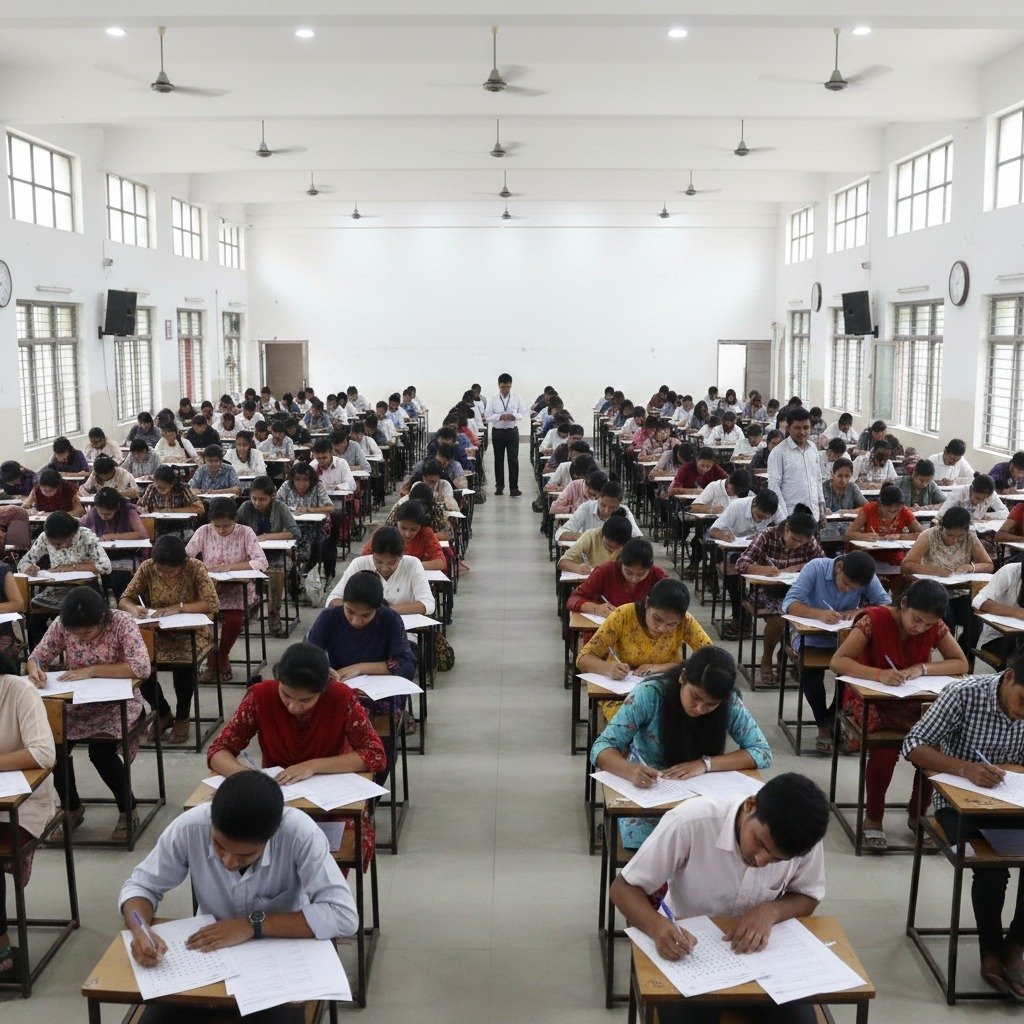
NEET 2026 gives candidates a total of 3 hours (180 minutes) to complete all 180 questions. There are a few important points to keep in mind about how this time works:
- There is no extra time and no sectional timing; the entire 3 hours applies to the full paper as a whole
- Candidates must manage their time across all three subjects on their own
- A good rule of thumb is to budget approximately 1 minute per question for error-free solving
- Since Biology has 90 questions and is generally more scoring, many toppers tackle Biology first, then Chemistry, and leave Physics for last, but your personal strategy matters more than any general advice
Time management, which refers to the ability to use one’s time effectively or productively, is one of the biggest factors that separates average scorers from toppers in NEET. Practice this during your mock tests long before exam day.
Number of Questions in NEET 2026
The NEET Exam Pattern has 180 compulsory MCQs spread across three subjects. Here is the subject-wise question distribution:
| S.No | Subject | No. of Questions |
| 1 | Physics | Section A = 45 |
| 2 | Chemistry | Section A = 45 |
| 4 | Zoology | Section A = 45 |
| 3 | Botany | Section A = 45 |
| Total | 180 | |
All questions must be answered, and there are no internal choices in any section. This structure actually works in a candidate’s favor, since every topic in the syllabus has an equal chance of being tested, it encourages thorough preparation across the board and makes chapter coverage planning much more straightforward.
NEET Section-wise Total Marks 2026
Here are the section wise Total marks
| Sl. No. | Subject | No. of Questions | Total Marks |
| 1 | Physics | Section A = 45 | 180 |
| 2 | Chemistry | Section A = 45 | 180 |
| 4 | Zoology | Section A = 45 | 180 |
| 3 | Botany | Section A = 45 | 180 |
| Total | 180 | 720 | |
Each correct answer carries +4 marks, which means the maximum possible score is 720 marks. All four sections carry equal weight at 180 marks each.
NEET 2026 Marking Rule
Understanding the marking rule is just as important as knowing how many questions the paper has. Here is a clear breakdown:
| Response Type | Marks awarded |
| Correct answer | +4 |
| Incorrect answer | -1 |
| Unanswered question | 0 |
| Multiple responses | −1 |
A few important points about the marking rules:
- Once you mark an answer on the OMR sheet, it cannot be changed
- If a question has multiple correct answers after an answer key revision, full marks (+4) are awarded to all valid choices
- Blind guessing is risky, a wrong answer costs you 1 mark, and it takes 4 correct answers to recover those lost marks
NEET 2026 Question Paper Format
The NEET question paper is entirely MCQ-based, where each question has four options and only one correct answer. A few more important details about the paper format:
- Candidates must use a black ballpoint pen to mark answers on the OMR sheet
- Physics is generally considered the most challenging section
- Biology is typically the longest section but is also the most scoring, given that it carries 90 questions
Subject-Wise Marks Distribution & Topic Weightage
Understanding the NEET Exam Pattern, along with weightage, helps students focus correctly.
Physics Weightage
Major topic coverage in the NEET exam pattern for Physics includes mechanics, magnetism, modern physics, optics, and electricity.
| Unit | NEET Physics Topic-Wise Weightage |
| Physical World and Measurement | 2% |
| Kinematics | 7% |
| Laws of Motion | 7% |
| Work, Energy, and Power | 4% |
| System of Particles and Rotational Motion | 4.50% |
| Gravitation | 4.50% |
| Properties of Bulk Matter | 9% |
| Oscillations and Waves | 7% |
| Thermodynamics | 4.50% |
| Behavior of a Perfect Gas and the Kinetic Theory | 2% |
| Electrostatics | 4% |
| Current Electricity | 9% |
| Magnetic Effects of Current and Magnetism | 7% |
| Electromagnetic Induction and Alternating Currents | 4% |
| Electromagnetic Waves | 2% |
| Optics | 4.50% |
| Dual Nature of Radiation and Matter | 4% |
| Atoms and Nuclei | 7% |
| Electronic Devices | 7% |
Physics Important Topics to Prioritise: Laws of Motion, Electromagnetic Waves, Electrostatics, Behaviour of Perfect Gas and Kinetic Theory, Electronic Devices, Dual Nature of Matter and Radiation, Properties of Bulk Matter
Chemistry Weightage
The NEET exam pattern divides chemistry into inorganic, organic, and physical chemistry, each with a different representation in the exam.
| Physical Chemistry | |
| Chapter | No. of Questions |
| Solid state | 2 |
| States of Matter | 2 |
| Thermodynamics | 1 |
| Electrochemistry | 2 |
| Surface chemistry | 1 |
| Solutions | 2 |
| Chemical Kinetics | 2 |
| Nuclear Chemistry | 1 |
| Mole concept | 1 |
| Atomic structure | 1 |
| Ionic equilibrium | 1 |
| Inorganic Chemistry | |
| Chapter | No. of Questions |
| Chemical Bonding | 5 |
| s-block | 2 |
| p-block | 3 |
| d and f block | 2 |
| Metallurgy | 2 |
| Environmental chemistry | 1 |
| Coordination chemistry | 2 |
| Organic Chemistry | |
| Chapter | No. of Questions |
| Some basic principles and techniques | 1 |
| Hydrocarbons | 4 |
| Haloalkanes and Haloarenes | 2 |
| Alcohol, Phenol, and Ether | 1 |
| Carbonyl compound | 3 |
| Amine | 2 |
| Biomolecules | 1 |
| Polymers | 1 |
| Chemistry in Everyday Life | 1 |
Chemistry Important Topics to Prioritise: Hydrogen, Equilibrium, Alcohols, Electrochemistry, P-Block Elements, Surface Chemistry, Phenols and Ethers
Biology Weightage
Biology carries the highest weightage in the NEET exam pattern with 90 questions, equally split between Botany and Zoology.
| Class XI | ||
| Unit | Chapters | Weightage (approximate) |
| I | Diversity of Living Organisms | 12% |
| II | Structural Organisation in Plants & Animals | 9% |
| III | Cell: Structure and Function | 8% |
| IV | Plant Physiology | 8% |
| V | Human Physiology | 16% |
| Class XII | ||
| Unit | Chapters | Weightage |
| VI | Reproduction | 11% |
| VII | Genetics and Evolution | 13% |
| VIII | Biology and Human Welfare | 9% |
| IX | Biotechnology and Its Applications | 4% |
| X | Ecology and Environment | 10% |
Biology Important Topics to Prioritise: Human Physiology, Reproduction, Plant Physiology, Cell Structure and Function, Ecology & Environment, Diversity in the Living World, Biology and Human Welfare
NEET 2026 Expected Difficulty Level
Based on trends from previous years, here is what candidates can expect in terms of difficulty across subjects:
| Subject | Expected Difficulty Level |
| Physics | Tough |
| Chemistry | Moderate |
| Biology | Easy but Lengthy |
Physics is consistently the most challenging section for most NEET aspirants. Chemistry is in the middle manageable with solid conceptual preparation. Biology is generally accessible but requires a strong reading speed and memory since it has 90 questions to get through in the same 3-hour window.
NEET 2026 Language Options
The NEET Exam Pattern provides 13 language options:
English, Hindi, Tamil, Telugu, Bengali, Gujarati, Marathi, Odia, Assamese, Kannada, Malayalam, Punjabi, and Urdu.
Language Selection Rules
- Candidates select their preferred medium while filling out the NEET 2026 application form.
- Candidates who choose English receive a question paper only in English
- Candidates who choose Hindi receive a bilingual booklet in Hindi and English
- Candidates who choose any regional language receive a bilingual booklet in that regional language and English
- In case of any conflict between the regional language version and the English version, the English version is treated as final
- Vernacular language options are also provided
NEET 2026 Question Paper Medium – Exam Centre-Wise
| Medium Available | Exam Centre Location |
| English and Hindi | All exam centres in all cities |
| English and Assamese | Centres in Assam |
| English and Bengali | Centres in West Bengal, Tripura, and Andaman & Nicobar Islands |
| English and Gujarati | Centres in Gujarat, Daman & Diu, Dadra & Nagar Haveli |
| English and Marathi | Centres in Maharashtra |
| English and Tamil | Centres in Tamil Nadu, Puducherry, and the Andaman & Nicobar Islands |
| English and Telugu | Centres in Andhra Pradesh and Telangana |
| English and Odia | Centres in Odisha |
| English and Kannada | Centres in Karnataka |
| English and Urdu | All exam centres in all cities |
| English and Malayalam | Centres in Kerala and Lakshadweep |
Reservation Policy in Relation to the NEET Exam Pattern
The NEET exam pattern allocates seats with reservations as per government rules:
- SC: 15%
- ST: 7.5%
- OBC-NCL: 27%
- EWS: 10%
- PwD: 5% horizontal reservation
Reservation works alongside the NEET exam pattern to provide equal opportunity.
How to Avoid Negative Marking in NEET 2026
Since the NEET exam pattern follows strict negative marking, accuracy decides the rank.
- Avoid blind guessing
- Attempt questions you are confident in
- Read every question carefully
- Focus on accuracy before speed
- Attempt easy ones first
How Mock Tests Help Students Master the Exam Pattern
Mock tests convert syllabus knowledge into applied performance under the exam pattern.
- Students learn stamina for 3 hours
- Speed and accuracy improve naturally
- OMR (Optical Mark Recognition) filling practice reduces negative marking, which is the penalty for incorrect answers on a test.
Each mock test makes the exam pattern more familiar and less stressful.
Time-Management Strategy for Exam Pattern
Because the Exam Pattern gives limited time, smart planning counts:
- Finish easy Biology questions first to boost your score early
- Leave tricky Physics questions for the second round
- Use chemistry for accuracy building.
This routine helps align preparation with the NEET exam pattern.
Common Mistakes Students Make While Following the Exam Pattern
Avoiding these errors increases scores:
- Spending too long on a single question
- Marking without double-checking OMR bubbles
- People often make guesses solely to complete the sheet.
Awareness helps reduce negative marking under the exam pattern.
Difference Between NEET Exam Pattern and AIIMS/JIPMER (Historical View)
Knowing past changes gives clarity on why the Exam Pattern looks the way it does now:
- Earlier exams like AIIMS/JIPMER merged into NEET
- Multiple papers became one national test
- The uniform marking scheme created transparency.
These changes form the current exam pattern.
Expected Cut-Off Trends Connected to Exam Pattern
Cut-offs reflect how scoring patterns behave under the exam pattern:
- Higher Biology scores push cut-offs up
- Tough Physics lowers ranks despite attempts
- Stable Chemistry strengthens toppers.
Cut-off direction becomes predictable through the exam pattern.
Correlating NCERT Books With the Exam Pattern
Every question traces back to NCERT fundamentals:
- Line-by-line reading improves precision
- Diagrams carry direct question value in biology.
- NCERT examples, which are exercises and problems from the National Council of Educational Research and Training, help decode tricky MCQs (multiple-choice questions).
Linking NCERT directly improves understanding of the exam pattern.
Role of Previous Year Papers in Understanding the Exam Pattern

Previous year papers give students a clear picture of how the Exam Pattern behaves in real conditions.
They show:
- Question difficulty trend
- Topic-wise frequency
- Style of distractor options
- How NCERT lines reappear in MCQs
When students solve past papers repeatedly, the NEET Exam Pattern feels predictable and less intimidating.
The Exam Pattern and OMR Sheet Handling Tips
The Exam Pattern depends on accurate OMR marking because one bubble decides four marks.
Practical tips:
- Fill bubbles only after finalizing answers
- Avoid half-filled or double-marked circles
- Keep the OMR sheet clean and dry.
Good handling prevents scoring loss caused by small errors under the exam pattern.
Psychological Preparation for Exam Pattern
Mental calm supports performance because the Exam Pattern demands continuous focus for three hours.
Ways to build mental balance:
- Practice timed papers in a quiet room
- Take breaks while preparing to avoid fatigue
- Learn breathing techniques for exam day
Calm confidence strengthens performance under the exam pattern.
Importance of Revision Cycles in Exam Pattern-Based Preparation
Revision cycles decide memory strength, and memory decides accuracy in the exam pattern.
Students benefit when they:
- Revise short notes weekly
- Attempt full-length mock tests monthly
- Return to weak chapters every fortnight.
Regular revision keeps concepts fresh for the exam pattern.
Best Use of the Last 30 Days Before the Exam Pattern is Tested
The final month determines fine-tuning for the exam pattern.
Students should:
- Revise Biology diagrams daily
- Practice Physics numericals regularly
- Review Chemistry reactions and exceptions
These habits sharpen time management under the exam pattern.
The Exam Pattern and Droppers: What Changes in Strategy
Droppers already know the syllabus, so the Exam Pattern shifts their focus from learning to perfecting.
They improve when they:
- Solve more mocks instead of reading repeatedly
- Track mistakes weekly
- Avoid overconfidence in familiar topics
This approach uses experience to fit the Exam Pattern smoothly.
Why Biology Dominates the Exam Pattern
Biology forms half the paper because the Exam Pattern targets medical readiness.
Reasons:
- Medical studies rely heavily on biological concepts
- NCERT Biology connects directly to the entrance questions
- Diagram-based facts support memory recall.
This dominance shapes preparation according to the Exam Pattern.
How Daily Study Routine Supports the Exam Pattern
A balanced daily routine improves recall and speed, which directly supports the Exam Pattern during the exam. When students divide time among theory, practice questions, and mock tests, they build stamina for the three-hour paper. A routine that spends mornings on biology, afternoons on chemistry revision, and evenings on physics problem-solving creates consistency. This steady rhythm strengthens confidence, sharpens accuracy, and prepares students to handle all 180 questions under the Exam Pattern without feeling rushed or confused.
Top Test-Taking Habits for Mastering the Exam Pattern
Strong habits create strong results under the exam pattern:
- Keep track of time after every 30 minutes
- Mark tricky questions and return later
- Read options twice before selecting.
These habits reduce silly mistakes and improve confidence.
Common Misconceptions About the Exam Pattern
Clearing misconceptions helps students work more accurately under the exam pattern:
- “Speed matters more than accuracy”—wrong; accuracy matters first
- “Guessing can increase ‘marks’—wrong, negative marking reduces scores
- “Hard textbooks outperform NCERT”—wrong. NCERT remains the base
Staying realistic protects students from mistakes under the exam pattern.
NEET 2026 Updates and Changes
As of now, NEET 2026 is expected to follow the same exam pattern as NEET 2025. The NTA has not announced any changes to the structure, number of questions, marking scheme, or duration. If NTA makes any official announcements regarding changes to the NEET Exam Pattern 2026, this blog will be updated immediately. Candidates should also keep a regular check on the official NTA website at neet.nta.nic.in for any new circulars.
NEET 2026 Preparation Tips
Understanding the Exam Pattern is just the starting point. Here are some practical preparation tips that can genuinely help you score better:
- Know the syllabus first. You cannot plan preparation without knowing exactly what is in and what is out. Go through the complete NTA NEET 2026 syllabus before you start studying any chapter.
- Solve ample sample papers. Take regular mock tests to measure your preparation level and identify your weak areas. The more mocks you take, the more comfortable you get with the format and time pressure.
- Seek help when needed. If you are finding it genuinely difficult to study on your own, consider joining a coaching class or an e-learning platform. There is nothing wrong with getting structured guidance.
- Make and maintain notes. Write down important formulas, reactions, diagrams, and points in your own words. Revising through short notes is far more time-efficient than going back to textbooks every time.
- Follow your timetable strictly. Making a schedule only helps if you actually follow it. Plan realistic daily targets and sticking to them consistently over weeks and months is what builds a strong NEET score.
- Prioritise high-weightage topics. Use the topic-wise weightage data shared in this blog to decide where to spend the most time. In biology, human physiology, genetics, and evolution together carry close to 30% of the biology papers as these are non-negotiable.
NEET 2026 – What Happens After the Exam?
Once the NEET exam is over, the process moves through several official stages before final admissions:
- NEET Admit Card — NTA will release the admit card and exam city intimation slip before the exam. Candidates must download this from the official website.
- Provisional Answer Key — NTA will release a provisional answer key along with candidates’ response sheets on its official website after the exam.
- Objection Window — Candidates can raise objections against any answer in the provisional key during the objection window.
- Final Answer Key — After evaluating all objections, NTA will release the final answer key.
- NEET Result 2026—NTA will publish the NEET 2026 result based on the final answer key. The exact result date is not announced yet.
- NEET and Merit List—NTA will also release the NEET Cut Off 2026 and NEET Merit List 2026, based on which candidates will be shortlisted for the NEET 2026 counseling process.
Final Thoughts
The NEET Exam Pattern is straightforward, which is 180 compulsory MCQs, 720 marks, 3 hours, offline mode, and a +4/–1 marking scheme. What makes the difference between students who crack it and those who do not is not just hard work but how well they understand and use this structure to their advantage.
Use the topic weightage data in this blog to prioritize your chapters. Practice enough mock tests to get comfortable with time management. Focus on biology since it carries 90 questions and is generally more scoring. And handling physics with care is tough, but consistent practice with the right resources, such as textbooks and online tutorials, makes it manageable and can significantly improve your understanding of the subject.The NEET 2026 exam is scheduled for May 3, 2026. You have time, but only if you start now.
For structured NEET preparation, expert guidance, and exam-oriented practice aligned with the latest exam pattern, students can explore resources provided by SPM & Lalans Coaching.
FAQs
Has the NEET 2026 exam pattern changed?
As of now, the exam pattern has not changed. NEET 2026 is expected to follow the same structure as NEET 2025, with 180 compulsory questions, a 3-hour duration, and a total of 720 marks. The paper continues in offline OMR mode with no optional questions and no internal choices. NTA has not made any official announcement regarding changes to the pattern for 2026. However, since exam pattern updates can come at any time, candidates should regularly check the official NTA website at neet.nta.nic.in and stay updated through official notifications to make sure they are preparing for the correct structure.
How many questions are there in NEET 2026?
There are 180 questions in total in the NEET 2026 exam. All 180 questions are compulsory, and there are no optional questions and no internal choices. The questions are distributed equally across four sections: Physics (45 questions), Chemistry (45 questions), Botany (45 questions), and Zoology (45 questions). Biology, which includes both botany and zoology, therefore has 90 questions in total, making it the largest and highest-weightage subject on the exam. Since every question is compulsory, candidates must prepare the entire NEET syllabus thoroughly without skipping any chapter or topic.
What is the marking scheme for NEET 2026?
The NEET 2026 marking scheme works as follows: every correct answer earns +4 marks, every incorrect answer results in a deduction of 1 mark, and questions that are left unanswered carry 0 marks. If a candidate marks multiple responses to a single question, that also results in a –1 deduction. Once an answer is marked on the OMR sheet, it cannot be changed, so candidates need to be sure before they mark any response. In cases where a question has multiple valid answers following an answer key revision by NTA, full marks of +4 are given to all valid choices. The negative marking rule is why blind guessing can do more harm than good and one wrong answer wipes out a quarter of the marks earned from one correct answer.
What are the total marks of NEET 2026?
The total marks of NEET 2026 are 720 marks. This comes from 180 questions, each carrying 4 marks for a correct answer. The 720 marks are distributed equally across Physics (180 marks), Chemistry (180 marks), Botany (180 marks), and Zoology (180 marks). The total NEET score out of 720 plays a central role in the final merit list, cutoff calculation, and counseling process for MBBS, BDS, AYUSH, and other medical courses. Candidates aiming for top government medical colleges typically need to score above 650+ to be in a strong position, though the exact cut-off varies every year depending on the difficulty level of the exam and the total number of candidates who appear.
How long is the NEET exam?
The NEET exam duration is 3 hours (180 minutes).