
NEET UG 2026 Exam cancelled. Yes, you read right. India’s biggest medical entrance examination has once again entered the center of a nationwide controversy. In a dramatic and unprecedented development, the National Testing Agency has officially cancelled the NEET UG 2026 examination that was conducted on May 3, 2026, following serious concerns regarding alleged paper leaks and examination irregularities.
The announcement, issued through an official press release dated May 12, 2026, confirmed that the Government of India approved the cancellation after investigative findings and inputs from law enforcement agencies raised concerns about the integrity of the examination process. According to the statement, the examination “could not be allowed to stand” in its present form.
The NTA also confirmed that the NEET UG 2026 examination will now be reconducted on fresh dates that will be notified separately through official channels. Fresh admit card schedules are also expected to be announced soon.
For over 22 lakh medical aspirants across India, the decision has triggered a wave of anxiety, emotional exhaustion, confusion, and renewed uncertainty. Students who had already completed years of preparation and appeared for the examination are now being asked to prepare once again for a fresh national-level test.
The news of NEET UG 2026 Exam cancelled is not merely an educational development. It has become a national conversation about institutional trust, fairness, transparency, and the future of India’s competitive examination system.
Why NEET UG 2026 Exam Cancelled Has Become Such a Massive National Issue?
NEET UG is not just another entrance examination. It is the single gateway for admission into MBBS, BDS, AYUSH, and several allied medical courses across India. Every year, more than 20 lakh students compete in one of the most intense and high-pressure examinations in the country.
For many students, NEET preparation begins years in advance. Aspirants sacrifice school life, social activities, hobbies, and emotional comfort in pursuit of a medical seat. Families invest enormous amounts of money into coaching institutes, hostel accommodation, online programs, and study resources. In countless households, NEET preparation becomes a full-family mission.
The competition itself is extremely brutal. The number of quality government medical seats remains far lower than the number of aspirants appearing every year. Even a small difference in marks can significantly impact ranks and admission opportunities.
Because of this, the credibility of the examination process matters deeply. Students are willing to accept difficult competition, but they expect fairness. Any allegation involving paper leaks, manipulation, or organised malpractice immediately creates national outrage because it attacks the very foundation of meritocracy.
The cancellation of NEET UG 2026 has therefore shaken not just students but also parents, teachers, policymakers, and educational institutions across India.
What Did the Official NTA Press Release Actually Say?
The official press release issued by the National Testing Agency on May 12, 2026, clarified several major decisions regarding the examination.
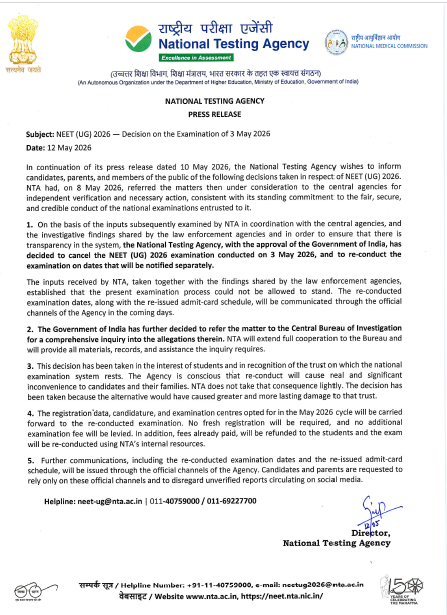
According to the statement, the NTA had already referred concerns related to the examination to central agencies on May 8, 2026, for independent verification and necessary action. After further examination of investigative findings and law enforcement inputs, the agency concluded that the integrity of the examination process had been compromised.
The statement specifically noted that the findings established that “the present examination process could not be allowed to stand.” As a result, the Government of India approved the cancellation of the NEET UG 2026 examination conducted on May 3.
The NTA also confirmed:
- A fresh re-examination will be conducted on new dates
- Re-issued admit cards will be provided separately
- Existing registration data will be carried forward
- Students will not need to register again
- No additional examination fee will be charged
- Fees already paid by students will be refunded
- The matter has been referred to the Central Bureau of Investigation for a comprehensive inquiry
The agency further acknowledged that the re-conducted examination would cause “real and significant inconvenience” to students and families, but stated that allowing the compromised examination to continue would have caused even greater damage to public trust.
How Did Allegations of a Paper Leak Begin Around NEET UG 2026?
The controversy surrounding NEET UG 2026 began after reports emerged regarding the suspicious circulation of examination-related content before and around the examination period.
Initially, discussions surfaced online through Telegram groups, WhatsApp forwards, social media posts, and coaching-related networks claiming that portions of the question paper may have been leaked. At first, many students were uncertain whether these reports were genuine or simply rumours.
However, concerns intensified after investigative agencies reportedly found troubling similarities between mock test material and actual examination questions. Reports suggested that more than 100 questions in certain circulated materials allegedly matched the actual NEET UG 2026 paper.
As these findings gained attention, pressure rapidly mounted on the NTA and the Government of India to investigate the matter thoroughly.
The issue became even more serious because students were already emotionally affected by the NEET 2024 controversy, which had also involved paper leak allegations and widespread public outrage. As soon as fresh rumours emerged in 2026, panic spread quickly across the country.
Students feared that another year of uncertainty, legal battles, counselling delays, and emotional trauma was unfolding before them.
Why NEET UG 2026 Exam Cancelled Is Being Compared With the NEET 2024 Scandal?
The shadow of NEET 2024 continues to dominate public perception of medical entrance examinations in India.
In 2024, allegations involving paper leaks, suspicious score patterns, grace marks, and organised malpractice created one of the biggest education controversies in recent Indian history. Investigations later uncovered alleged paper leak networks operating across multiple states.
The controversy deeply damaged trust in the examination system. Students who had prepared honestly felt betrayed by the possibility that unfair means may have influenced results.
Although the Supreme Court did not order a complete cancellation of NEET 2024, the emotional impact remained enormous. Many aspirants lost faith in the transparency of the system.
As a result, when fresh allegations emerged during NEET UG 2026, students immediately feared a repeat of the previous crisis. The cancellation announcement, therefore, reopened old wounds and intensified anxiety among aspirants nationwide.
For many students, the issue is no longer just about one examination. It is about whether competitive examinations in India can genuinely remain fair in an environment increasingly affected by organised malpractice and corruption.
Why Did the Government Decide To Cancel the Entire Examination?
One of the biggest questions being asked across India is why authorities decided to cancel the entire examination instead of limiting action to selected centres or suspicious candidates.
The official explanation provided by the NTA is rooted in maintaining public trust and transparency. According to the agency, the collective findings shared by investigative and law enforcement agencies suggested that the integrity of the examination process itself had been compromised.
In such a situation, authorities believed that continuing with the existing examination would permanently damage confidence in the national examination system.
The decision reflects an important principle: even the perception of unfairness in a highly competitive national examination can create long-term credibility problems.
The Government of India appears to have concluded that conducting a fresh examination was preferable to allowing doubts to continue regarding rankings, admissions, and merit.
Although the decision may ultimately protect the legitimacy of the process, it has simultaneously created enormous stress for students who now have to mentally prepare for another examination cycle.
How Are Students Reacting to the NEET UG 2026 exam being cancelled?
The emotional response from students has been intense, complicated, and deeply divided.
Some aspirants support the cancellation because they believe fairness must be protected at any cost. According to them, if even a section of the paper was leaked, honest students deserve a completely fresh and transparent examination.
However, many other students are devastated by the decision. Aspirants who spent years preparing for NEET and had finally completed the examination now face another cycle of revision, stress, uncertainty, and emotional exhaustion.
For repeat aspirants and drop-year students, the cancellation feels particularly painful. Many had already spent several years attempting to secure medical admissions and were hoping the 2026 examination would finally end their preparation journey.
The psychological pressure has become enormous. Students are worried about:
- Fresh examination dates
- Counselling delays
- Academic session postponements
- Mental burnout
- Maintaining preparation momentum
- Financial strain on families
Social media platforms are filled with emotional reactions ranging from anger and frustration to complete emotional collapse. Many aspirants have expressed feeling mentally drained and uncertain about how to continue preparing again.
The controversy has once again highlighted the severe emotional burden associated with competitive examinations in India.
How Has This Situation Affected the Mental Health of Aspirants?
The mental health impact of the NEET UG 2026 cancellation is significant and cannot be ignored.
Preparing for NEET is already emotionally exhausting. Students often study for 10 to 14 hours daily while balancing parental expectations, peer competition, fear of failure, and personal insecurity. Many aspirants isolate themselves socially during preparation years.
When an examination gets cancelled after being conducted, students experience a unique form of emotional collapse. They feel as though months or years of intense pressure suddenly become suspended in uncertainty.
Mental health professionals frequently warn that prolonged examination-related stress can contribute to:
- Anxiety disorders
- Depression
- Panic attacks
- Insomnia
- Burnout
- Emotional numbness
- Loss of motivation
For students from financially weaker backgrounds, the situation becomes even harder. Many families invest everything they have into medical preparation. Continued uncertainty increases financial and emotional pressure simultaneously.
The NTA itself acknowledged in its press release that the re-conduct would cause “real and significant inconvenience” to students and families. That statement alone reflects the seriousness of the emotional disruption being caused nationwide.
What Role Will the CBI Play in the Investigation?
The Government of India has officially referred the matter to the Central Bureau of Investigation for a comprehensive inquiry into the allegations connected to NEET UG 2026.
The CBI investigation is expected to examine:
- Possible organised leak networks
- Digital communication trails
- Coaching-related connections
- Distribution channels of leaked material
- Potential insider involvement
- Examination logistics vulnerabilities
The decision to involve the CBI indicates that the government views the matter as a serious national-level issue rather than a localised irregularity.
Public expectations from the investigation are extremely high. Students and parents want strict accountability and visible action against anyone responsible for compromising examination integrity.
At the same time, aspirants also fear prolonged investigations could delay the admission process further if authorities fail to announce fresh examination dates quickly.
The coming weeks will therefore be critical both for the investigation and for restoring confidence among students.
What Will Happen to Student Registrations and Examination Fees?
One of the most important clarifications provided by the NTA relates to registration and fees.
According to the official announcement:
- Existing registrations will remain valid
- Candidate data will automatically carry forward
- Examination centres already selected will remain applicable
- No fresh application process will be required
- No additional fee will be charged for the re-examination
- Previously paid fees will also be refunded to students
This means students will not need to repeat the registration process again.
The NTA also stated that the re-conducted examination will be organised using the agency’s internal resources.
These measures are intended to reduce additional stress and financial burden on candidates already affected by the cancellation.
What Security Reforms Could Be Introduced After This Crisis?
The NEET UG 2026 controversy has once again exposed weaknesses within India’s examination infrastructure.
Authorities are now expected to strengthen security systems through multiple reforms, including:
- Enhanced encryption of question papers
- GPS tracking during transportation
- AI-based monitoring systems
- Increased CCTV surveillance
- Biometric verification systems
- Stricter staff background checks
- Centralised printing and logistics management
- Real-time monitoring of examination centres
However, many experts believe technology alone cannot solve the problem. The real challenge lies in ensuring administrative accountability and eliminating organised corruption networks capable of exploiting vulnerabilities.
Restoring trust will require not just announcements but visible implementation of reforms across every stage of the examination process.
Can Trust in NEET Ever Be Restored Again?
This may ultimately become the defining question after the NEET UG 2026 exam cancelled..
Students across India are not asking for an easy examination. They are asking for a fair one. They want assurance that years of sacrifice, discipline, and honest preparation will not be undermined by paper leaks or systemic failures.
The NEET controversy has become symbolic of larger concerns involving education, governance, institutional transparency, and public trust in India.
Faith in the examination system cannot be restored overnight through press releases alone. It will require transparent investigations, strict punishment of those responsible, strong reforms, and consistent administrative sincerity.
For millions of aspirants, medicine is not merely a career choice. It represents hope, stability, and social mobility. When the credibility of the examination itself collapses, the emotional consequences extend far beyond academics.
As India now prepares for the re-conduct of NEET UG 2026, one reality is clear: the future of the country’s most important medical entrance examination depends not only on conducting another test, but on rebuilding the trust that has been shaken so deeply.

This article is written by the SPM & LALAN’S Content Team, a group of skilled writers, researchers, and content strategists passionate about creating accurate, reliable, and student-friendly educational content. Every article is thoroughly researched, fact-checked, and updated to ensure readers receive trustworthy and relevant information. The goal is to help students make informed academic decisions through clear, well-researched, and easy-to-understand content.