

If you are aiming for the JEE 2027 exam, the most effective strategy is to begin planning early and prepare intelligently. The Joint Entrance Examination (JEE) is one of the most sought-after engineering entrance exams in India, and every year, lakhs of aspirants compete for seats in the top engineering institutes like IITs, NITs, and IIITs. The competition is intense, the syllabus is vast, and the exam demands consistency, strategic preparation, and strong problem-solving skills across physics, chemistry, and mathematics.
Targeting the JEE 2027 exam early gives you a real advantage. Whether you are a Class 11 student just getting started, a Class 12 student building your strategy, or a dropper who wants to make the next attempt count, the time you invest now in understanding the JEE 2027 exam pattern, syllabus, eligibility, and preparation approach will directly shape your result.
JEE 2027 Exam Overview
The JEE is a two-stage examination, which is JEE Main and JEE Advanced. Clearing JEE Main gives you admission into NITs, IIITs, and other centrally funded technical institutions. Clearing both JEE Main and JEE Advanced opens the doors to the prestigious IITs. The exam tests your depth of knowledge in physics, chemistry, and mathematics from Classes 11 and 12.
A strong foundation in all three subjects, consistent hard work, time-based revision, and effective problem-solving techniques are the pillars of any successful JEE preparation. Advance planning, good guidance, and discipline are what separate those who crack it from those who fall short.
Online Coaching for JEE 2027 Exam
Since the JEE exam is the gateway to some of the most prominent engineering colleges in India, students need preparation methods that are both effective and accessible. Online coaching has become one of the most practical and affordable ways to prepare, and it works equally well whether you are a Class 11 student, a Class 12 student, or a dropper targeting JEE 2027.
SPM & Lalan’s Coaching for JEE 2027 exam
SPM & Lalan’s is a well-regarded coaching institute that offers a complete JEE preparation programme through live classes, video lectures, daily doubt-clearing sessions, practice tests, and dedicated mentorship from experienced teachers. For more information about the coaching and how it works for JEE preparation, visit jee coaching in guwahati.
The institute combines structured teaching with personalized guidance to help students stay consistent and focused throughout their JEE journey.
What makes SPM & Lalan’s particularly effective for students targeting the JEE 2027 exam is their integrated approach as here, every topic is taught with exam relevance in mind, and students get regular exposure to the kind of problems that actually appear in JEE Main and JEE Advanced. The combination of good teachers, systematic content, and regular test practice gives students the tools they need to build both speed and accuracy.
SPM & Lalan’s Integrated Batch for JEE
For students who want the most structured and thorough JEE preparation, the SPM & Lalan’s Integrated Batch for JEE is the most comprehensive option. This integrated batch is designed to cover the entire JEE syllabus, both Class 11 and Class 12 in a single, well-paced program that runs alongside the school curriculum.
The integrated batch takes students through every topic across physics, chemistry, and mathematics in a progressive sequence, building concepts from the ground up and reinforcing them through regular tests and practice sessions. Students in this batch benefit from a unified preparation approach where school-level learning and JEE-level depth go hand in hand, saving time and eliminating the confusion of juggling multiple preparation resources. For Class 11 students starting early and serious about the Indian Institutes of Technology (IITs) or the National Institutes of Technology (NITs) in 2027, the SPM & Lalan’s Integrated Batch is the most focused and result-oriented path to follow.
JEE 2027 Exam Pattern
The JEE 2027 exam runs through two stages JEE Main and JEE Advanced. Each stage has a different structure, marking scheme, and level of difficulty. JEE Main 2027 will be conducted for three papers, Paper 1 for B.E./B. Tech, Paper 2A for B.Arch, and Paper 2B for B.Planning. Here is the complete exam pattern for all three papers:
| Aspect | Paper 1 (BE/BTech) | Paper 2A (BArch) | Paper 2B (BPlan) |
| Mode of Exam | Online (Computer-Based Test) | Mathematics & Aptitude: Online; Drawing: Offline | Online (Computer-Based Test) |
| Subjects | Physics, Chemistry, Mathematics | Mathematics, Aptitude Test, Drawing Test | Mathematics, Aptitude Test, Planning-based Questions |
| Total Duration | 3 Hours | 3 Hours | 3 Hours |
| Total Marks | 300 marks (100 per subject) | 400 marks | 400 marks |
| Number of Questions | 75 (25 per subject) | Math – 30 (20 MCQs + 10 NVQs), Aptitude – 50, Drawing – 2 | Math – 25 (20 MCQs + 5 NVQs), Aptitude – 50, Planning – 25 |
| Numerical Value Questions | 5 per subject, all compulsory | 5 in Math, attempt all 5 | 5 in Math, all compulsory |
| Question Types | 20 MCQs + 5 Numerical per subject | MCQs (Math & Aptitude), Drawing Tasks (pen & paper) | MCQs + Numerical Value + Planning-based questions |
| Marking Scheme | +4 correct, -1 incorrect | +4 correct, -1 incorrect, 0 unattempted | +4 correct, -1 incorrect, 0 unattempted |
| Languages Offered | Hindi, English, Assamese, Bengali, Gujarati, Kannada, Marathi, Malayalam, and more | Hindi, English, Assamese, Bengali, Gujarati, Kannada, Marathi, Malayalam, and more | Hindi, English, Assamese, Bengali, Gujarati, Kannada, Marathi, Malayalam, and more |
The JEE exam tests candidates’ depth of knowledge in physics, chemistry, and mathematics. For more insights on the JEE Main exam structure and preparation, check out this JEE Main 2026 Guide.
JEE Advanced 2027 Exam Pattern
JEE Advanced 2027 consists of two compulsory papers Paper 1 and Paper 2. Both papers include questions from Physics, Chemistry, and Mathematics. The exact pattern varies every year, but here is the general format for both papers:
JEE Advanced 2027 – Paper 1 Exam Pattern
| Section | Number and Type of Questions | Marking Scheme |
| 1 | 4 Single Correct MCQs | +3 correct, -1 incorrect, 0 unattempted |
| 2 | 3 Multiple Correct MCQs | +4 if all correct options chosen; +3 if all 4 correct but only 3 chosen; +2 if 3+ correct but only 2 chosen (both correct); +1 if 2+ correct but only 1 chosen (correct); 0 if none chosen; -2 in all other cases |
| 3 | 6 Numerical Answer Type | +4 correct, no negative marking |
| 4 | 3. Match the Following | +4 for fully correct matches, -1 for any incorrect, 0 unattempted |
JEE Advanced 2027 – Paper 2 Exam Pattern
| Section | Number and Type of Questions | Marking Scheme |
| 1 | 4 Single Correct MCQs | +3 correct, -1 incorrect, 0 unattempted |
| 2 | 4 Multiple Correct MCQs | +4 if all correct options chosen; +3 if all 4 correct but only 3 chosen; +2 if 3+ correct but only 2 chosen (both correct); +1 if 2+ correct but only 1 chosen (correct); 0 if none chosen. -2 in all other cases |
| 3 | 8 Numerical Answer Type | +4 correct, no negative marking |
JEE 2027 Exam – Subject-Wise Distribution of Questions and Marks

Understanding how questions and marks are distributed across subjects helps you plan your preparation effectively.
JEE Main Paper 1 – B.E./B.Tech Question Distribution
| Subject | Total Questions (MCQs + Numerical) | Marks Allocation | Notes |
| Physics | 25 (20 MCQs + 5 Numerical) | 100 | All 25 questions are compulsory |
| Chemistry | 25 (20 MCQs + 5 Numerical) | 100 | No internal choice in the numerical section |
| Mathematics | 25 (20 MCQs + 5 Numerical) | 100 | Each correct answer carries 4 marks |
| Total | 75 Questions | 300 Marks | Equal weightage across all subjects |
JEE Main Paper 2A – B.Arch Structure
| Parameter | Details |
| Subjects | Part-I: Mathematics; Part-II: Aptitude Test; Part-III: Drawing Test |
| Type of Questions | Mathematics: MCQs + Numerical Value Questions; Aptitude: MCQs; Drawing: Questions to test drawing aptitude |
| Mode of Exam | Computer-Based Test (except Drawing Test — Pen and Paper Mode) |
| Total Duration | 3 Hours |
| Marking Scheme | +4 for correct answers, -1 for incorrect answers |
JEE Main Paper 2B – B.Plan Structure
| Parameter | Details |
| Subjects | Part-I: Mathematics; Part-II: Aptitude Test; Part-III: Planning-Based Questions |
| Type of Questions | All sections contain objective types (MCQs) + Numerical in Math |
| Mode of Exam | Computer-Based Test |
| Total Duration | 3 Hours |
| Marking Scheme | +4 for correct answers, -1 for incorrect answers |
JEE 2027 Eligibility Criteria
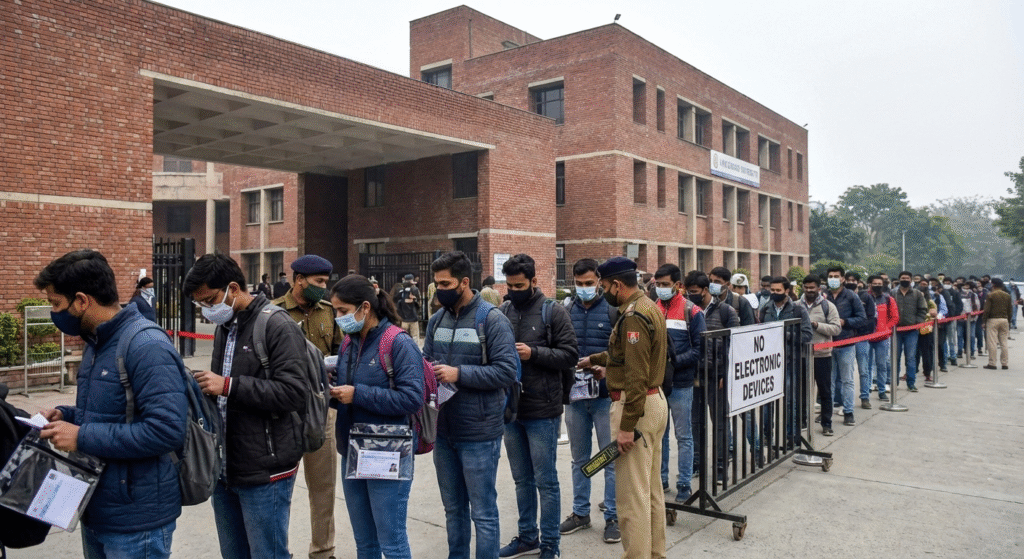
To appear for JEE 2027, candidates must meet the eligibility criteria set by the National Testing Agency (NTA) for JEE Main and by the IITs for JEE Advanced.
JEE Main 2027 Eligibility Criteria
- Educational Qualification: Candidates must have passed Class 12 or an equivalent examination in 2025 or 2026 or be appearing in 2027.
- Subjects in Qualifying Exam: Physics, Mathematics, and one of Chemistry / Biology / Biotechnology / Technical Vocational Subjects.
- Age Limit: There is no age limit for JEE Main. However, candidates must satisfy the age criteria of the specific institute they wish to apply to.
- Number of Attempts: A candidate can appear for JEE Main for three consecutive years, and since the exam is held in two sessions per year, a total of six attempts are allowed.
JEE Advanced 2027 Eligibility Criteria
- Performance in JEE Main: Candidates must be among the top 2.5 lakh qualifiers (including all categories) in JEE Main 2027.
- Age Limit: Candidates should have been born on or after 1st October 2002. A five-year relaxation is given to SC, ST, and PwD candidates.
- Number of Attempts: A candidate can attempt JEE Advanced a maximum of two times in two consecutive years.
- Year of Passing Class 12: Candidates must have passed Class 12 or equivalent in 2026 or 2027.
- Earlier Admission in IITs: Candidates who have taken admission in any IIT in the past, even if they did not continue, are not eligible for JEE Advanced.
JEE 2027 Exam Syllabus
The JEE 2027 syllabus is based on the NCERT curriculum for Classes 11 and 12 and covers Physics, Chemistry, and Mathematics across two broad sections:
- Class 11 Topics: Basic concepts such as Laws of Motion, Chemical Bonding, and Trigonometry—these form the foundational layer of JEE preparation.
- Class 12 Topics: Advanced concepts such as Electromagnetism, Organic Chemistry, and calculus, these carry significant weightage in both JEE Main and JEE Advanced.
Understanding the complete syllabus from both classes helps students plan subject-wise and topic-wise preparation without missing any important area.
JEE 2027 Exam Preparation Strategy
A well-timed and structured preparation plan is what separates students who crack JEE from those who fall just short. It is also important to avoid common mistakes during preparation. Here are the top mistakes to avoid during JEE preparation.
Here is a practical strategy for every type of student targeting JEE 2027:
- Begin Early: Class 11 students should focus on building strong conceptual foundations across all three subjects. Class 12 students and droppers should combine fresh learning with quick revision and mock test practice.
- Plan Your Study Schedule: Allocate daily study hours separately for physics, Chemistry, and Mathematics. Set aside dedicated time for revision and problem practice every single day.
- Practice MCQs Regularly: Solve a large number of MCQs, especially from previous years’ JEE question papers and topic-wise test series. Regular MCQ practice builds both speed and confidence.
- Work on Weak Sections: Identify the topics where you consistently lose marks and allocate extra time to those areas. Avoid ignoring weak topics, as they have the potential to significantly impact your ranking.
- Follow NCERT Books: Use NCERT books as the base for conceptual clarity, particularly in Chemistry and Physics fundamentals. NCERT is the foundation everything else builds on.
- Take Mock Tests Regularly: Solve full-length mock tests under timed conditions to build speed, accuracy, and time management. Review your performance after every mock test and note down every mistake.
- Stay Consistent: Daily effort, regular revision, and a positive approach are what build the momentum needed to crack JEE 2027. Consistency over the months of preparation matters far more than cramming in the final weeks.
Final Thoughts
Targeting the JEE 2027 exam early is the single best decision you can make as an engineering aspirant. With a clear understanding of the exam pattern, a thorough knowledge of the syllabus, the right eligibility information, and a structured preparation strategy backed by quality coaching, your JEE 2027 preparation starts on the strongest possible footing.
The exam is tough, but it is crackable with the right plan. Start now, stay consistent, practise daily, and use every available resource, including our SPM & Lalan’s Integrated Batch for JEE to make your preparation as focused and effective as possible.
2027 is not far away, and the students who start today are the ones who walk into that exam hall fully prepared.
Frequently Asked Questions (FAQs)
Q1. What is the JEE 2027 exam, and who conducts it?
The JEE 2027 exam is the Joint Entrance Examination, which serves as the gateway for admission into India’s top engineering institutes, including the IITs, NITs, IIITs, and other centrally funded technical institutions. The exam runs through two stages: JEE Main, which is conducted by the National Testing Agency (NTA), and JEE Advanced, which is conducted by one of the IITs on a rotational basis. JEE Main determines eligibility for NITs and IIITs and also acts as the qualifying exam for JEE Advanced. JEE Advanced is the exam that determines admission into IITs. The exam tests candidates on physics, chemistry, and mathematics from the Class 11 and Class 12 NCERT curriculum, and it is widely considered one of the most challenging engineering entrance exams in the country because of its vast syllabus, analytical question style, and the high level of competition among lakhs of aspirants every year.
Q2. What are the eligibility requirements for the JEE 2027 ?
The eligibility requirements for the JEE 2027 are different for JEE Main and JEE Advanced. For JEE Main 2027, candidates must have passed Class 12 or equivalent in 2025 or 2026, or be appearing in 2027, with Physics and Mathematics as compulsory subjects along with one of Chemistry, Biology, Biotechnology, or Technical Vocational Subject. There is no age limit for JEE Main, and candidates are allowed up to six attempts (three years, two sessions per year). For JEE Advanced 2027, candidates must first be among the top 2.5 lakh qualifiers in JEE Main 2027. They must have been born on or after 1st October 2002 (with a 5-year relaxation for SC, ST, and PwD candidates); must have passed Class 12 in 2026 or 2027; and must not have previously taken admission in any IIT. JEE Advanced allows a maximum of two attempts in two consecutive years.
Q3. Can online coaching genuinely help in cracking the JEE 2027 ?
Yes, online coaching can genuinely make a real difference in cracking the JEE 2027, especially when the coaching program is well-structured and backed by experienced faculty. A good coaching institute like SPM & Lalans offers live classes, video lectures, daily doubt-clearing sessions, structured practice tests, and mentorship, all of which are essential components of effective JEE preparation. The biggest advantage of joining a coaching program for JEE is that it provides direction students know exactly what to study, in what order, and at what depth, rather than navigating the vast syllabus on their own. The SPM & Lalan’s Integrated Batch for JEE is particularly effective for students starting in Class 11, as it covers the full JEE syllabus progressively alongside the school curriculum, building both conceptual depth and exam readiness in a single organized program. Students who combine coaching with consistent self-study and regular mock test practice put themselves in the strongest possible position for JEE 2027.

This article is written by the SPM & LALAN’S Content Team, a group of skilled writers, researchers, and content strategists passionate about creating accurate, reliable, and student-friendly educational content. Every article is thoroughly researched, fact-checked, and updated to ensure readers receive trustworthy and relevant information. The goal is to help students make informed academic decisions through clear, well-researched, and easy-to-understand content.