
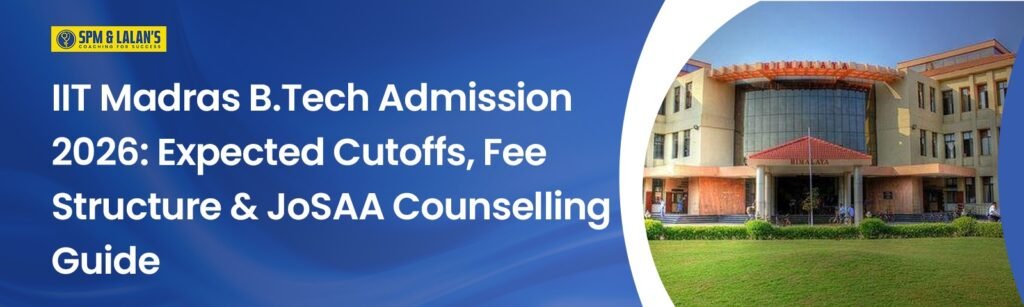
For hundreds of thousands of engineering aspirants across India, securing a B.Tech seat at the Indian Institute of Technology Madras is a significant milestone. Ranked #1 in Engineering by the NIRF Rankings for seven consecutive years, IIT Madras represents the pinnacle of undergraduate engineering education in the country and consistently features among the top IITs in India. As the IIT Madras B.Tech Admission 2026 cycle approaches, competition has intensified. The need for a clear, data-driven strategy is more critical than ever. Platforms like coaching institute guwahati provide structured guidance to help aspirants prepare effectively for IIT admissions.
In this article, we will look at the eligibility requirements and the expected branch-wise cutoffs. We will also discuss the JoSAA 2026 counselling roadmap and provide a transparent fee structure. With this information, you can plan your journey with confidence.
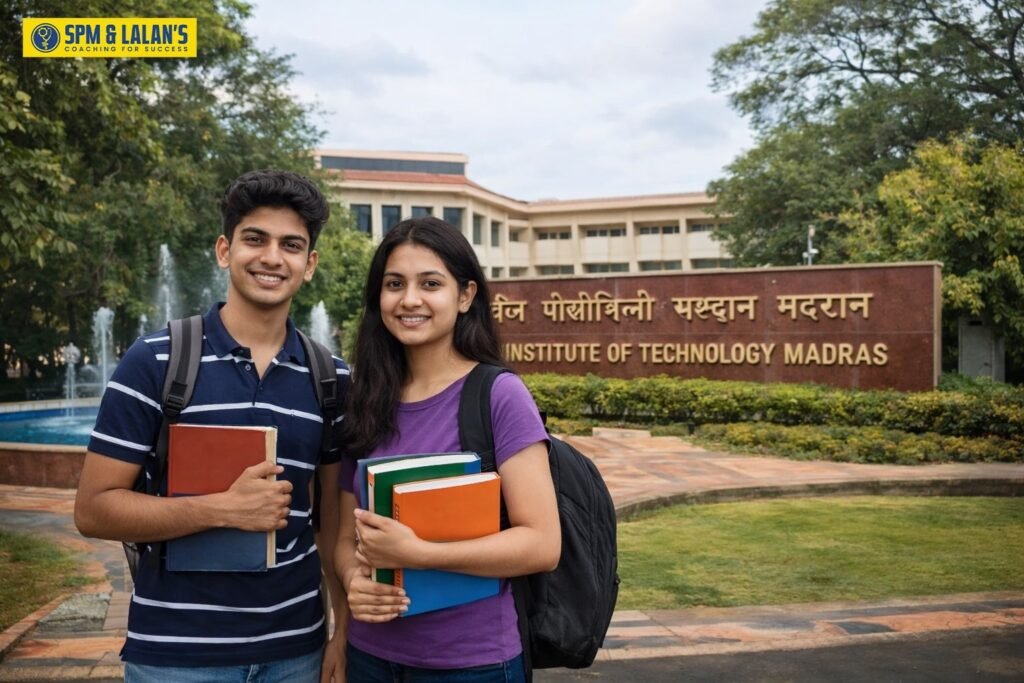
Eligibility Criteria for IIT Madras B.Tech 2026
Before you can even think about cutoffs for IIT Madras B.Tech admission 2026, you must confirm that you meet the baseline eligibility conditions set by the Joint Admission Board (JAB).
1. Academic and Age Requirements
- Class 12 (or equivalent) pass with Physics, Chemistry, and Mathematics as core subjects.
- Minimum 75% aggregate marks in Class 12 (or equivalent), OR a position in the top 20 percentile of their respective board examinations.
- SC/ST/PH candidates are eligible with a minimum of 65% aggregate marks.
- Candidates must have been born on or after October 1, 2001 (General/EWS/OBC-NCL). SC/ST/PH candidates have a five-year age relaxation.
2. JEE Main 2026 Qualifying Criteria
- Appearing in JEE Main 2026 is mandatory as the qualifying gateway to JEE Advanced 2026.
- Only the top 2,50,000 candidates (across all categories) in JEE Main are eligible to register for JEE Advanced 2026.
3. JEE Advanced 2026 Cutoff
- Appearing in JEE Advanced 2026 is compulsory for IIT admissions; JEE Main score alone does not suffice.
- Candidates can attempt JEE Advanced a maximum of two consecutive years.
- Those who were previously admitted to an IIT are not eligible to reappear unless they joined a preparatory course.
To meet these eligibility benchmarks and secure a competitive JEE Advanced rank, many aspirants rely on structured IIT-JEE courses that provide focused preparation, test series, and expert mentorship.
IIT Madras Cutoff Trends: Expected Ranks for 2026
Understanding historical rank trends is the most reliable way to set realistic targets for IIT Madras B.Tech admission 2026. The information below consolidates Opening Ranks (OR) and Closing Ranks (CR) for the General (GEN) category over the past three admission cycles and projects expected ranges for 2026.
1. Branch-Wise IIT Madras Opening and Closing Ranks (General Category – CRL)
| Branch | 2023 OR | 2023 CR | 2024 OR | 2024 CR | 2025 OR | 2025 CR | 2026 Expected CR |
| Computer Science & Engineering (CSE) | 1 | 67 | 1 | 63 | 1 | 60 | 55–70 |
| Electrical Engineering (EE) | 89 | 312 | 95 | 298 | 88 | 285 | 270–315 |
| Engineering Physics | 220 | 520 | 235 | 505 | 218 | 490 | 475–525 |
| Mechanical Engineering | 310 | 680 | 325 | 665 | 308 | 645 | 620–680 |
| Chemical Engineering | 480 | 820 | 495 | 810 | 475 | 795 | 775–835 |
| Civil Engineering | 650 | 1,050 | 670 | 1,030 | 645 | 1,010 | 985–1,060 |
| Aerospace Engineering | 390 | 760 | 405 | 748 | 388 | 730 | 710–770 |
| Data Science & AI (4-year) | 68 | 190 | 72 | 180 | 65 | 172 | 160–195 |
Note: OR = Opening Rank, CR = Closing Rank (CRL – Common Rank List). OBC-NCL, SC, ST, and EWS cutoffs follow category-specific rank lists and are significantly lower. Data is compiled from the JoSAA official seat allotment records. The 2026 projections are indicative estimates based on three-year trend analysis.
2. Key Takeaways from Cutoff Trends
- CSE remains the most competitive branch, with closing ranks tightening by approximately 7–10 ranks year-on-year.
- Data Science & AI has seen rapid improvement in applicant interest, but closing ranks are stabilising as seats have been marginally increased.
- Electrical Engineering continues to show a slight easing in closing ranks due to increased intake at the institute.
- Candidates in the 300–700 rank range have a strong probability of securing Electrical, Engineering Physics, or Aerospace Engineering.
🎯 Attempt Full-Length Mock Test
JoSAA 2026 Counselling: A Step-by-Step Guide
The Joint Seat Allocation Authority (JoSAA) conducts the centralised counselling for all 23 IITs, including IIT Madras, 31 NITs, IIEST Shibpur, 26 IIITs, and 19 other Government-Funded Technical Institutes (GFTIs). For those interested in IIT Madras B.Tech admission 2026, it’s essential to follow the complete process for JoSAA 2026 registration and seat allotment, which will provide guidance on how to secure a seat in this prestigious institution. For a deeper understanding of seat allocation strategies, timelines, and common mistakes to avoid, refer to this complete JoSAA counselling guide.
Step 1: JoSAA 2026 Registration & Login
- The JoSAA portal (josaa.nic.in) typically opens 24–48 hours after JEE Advanced results are declared (expected: June 2026).
- Use your JEE Advanced 2026 roll number and password to log in.
- Verify your personal details, category, and PwD status.
Step 2: Choice Filling & Locking
- This is the most important step of the entire process.
- You can add and arrange up to 25,000 academic programme choices (Institute + Branch combinations) in order of preference.
- Fill choices from most preferred to least preferred. The algorithm allocates the best possible seat from your locked list.
- Lock your choices before the deadline. Unlocked choices are treated as final at closing time, but it is best practice to lock manually.
Step 3: Mock Seat Allotment
- JoSAA typically releases 2 mock allotment rounds before actual allotments begin.
- Use mock rounds to reassess and revise your choices. There is no penalty for editing choices before the final lock.
Step 4: Seat Allotment Rounds (6 Rounds)
- JoSAA 2026 is expected to conduct 6 official allotment rounds.
- After each round, you must choose one of the following:
- Freeze: Accept the allotted seat; no further upgrades.
- Float: Accept the current seat but remain in the pool for a better choice in subsequent rounds.
- Slide: Accept a better branch in the same institute if available in future rounds.
Step 5: Online Reporting & Document Verification
- After accepting a seat, complete online reporting by paying the seat acceptance fee (₹35,000 for General/OBC; ₹15,000 for SC/ST/PH adjusted against tuition fees).
- Upload all required documents: Class 10 & 12 mark sheets/certificates, category certificate (if applicable), PwD certificate (if applicable), and a valid photo ID.
Step 6: Physical Reporting at IIT Madras
- Physical/in-person reporting at the allotted institute (IIT Madras in this case) is mandatory for final seat confirmation.
- Carry original documents and their self-attested photocopies.
- Medical fitness examination may be conducted at the institute.
Pro Tip: Do not wait until the final round to freeze your seat at IIT Madras. If your preferred branch has a closing rank near your rank, floating is a strategic move, but freezing early eliminates the risk of losing an IIT seat to an NIT.
IIT Madras Branch-Wise Fees Structure 2026
Transparency about costs is important for planning. The fees below are applicable for the academic year 2025–26 and are expected to remain largely similar for 2026-27 unless revised by the Senate.
1. Annual Fee Breakdown (Per Academic Year)
| Fee Component | General / OBC-NCL (₹) | SC / ST / PH (₹) |
| Tuition Fee | 1,00,000 | Nil (fully waived) |
| Examination Fee | 1,000 | 1,000 |
| Registration & Enrolment Fee | 3,000 | 3,000 |
| Gymkhana (Student Activities) Fee | 2,000 | 2,000 |
| Medical Fee | 1,500 | 1,500 |
| Hostel Accommodation (per year) | ~15,000–22,000 | ~15,000–22,000 |
| Mess Charges (per year, approx.) | ~50,000–60,000 | ~50,000–60,000 |
| Estimated Annual Cost of Attendance | ~1,75,000–1,90,000 | ~70,000–85,000 |
| Estimated Total (4 Years) | ~7,00,000–7,60,000 | ~2,80,000–3,40,000 |
Hostel and mess charges are approximate and vary by hostel type and meal plan chosen.
2. IIT Madras Scholarships & Fee Waivers
- SC/ST/PH Students: Full tuition fee waiver under the Government of India scheme. Additionally, they are eligible for the Post-Matric Scholarship from their respective state governments.
- EWS (Economically Weaker Section): Candidates from families with annual income below ₹5 lakh are eligible for a full tuition fee waiver under the HEFA-funded scheme introduced in 2018–19, a landmark policy that applies across all 23 IITs.
- Merit-cum-Means (MCM) Scholarship: Available to General and OBC students from families with an income below ₹4.5 lakh per annum. Covers full tuition fee and provides a monthly stipend of ₹1,000.
- Institute Free Studentship: Available to students from low-income families regardless of category, covering hostel and mess charges partially or fully based on assessed need.
Conclusion: Turning Strategy Into a Seat at IIT Madras
Securing admission through IIT Madras B.Tech Admission 2026 requires more than a high JEE Advanced rank. It demands a strategic approach to JoSAA counselling. You also need a realistic understanding of branch-wise cutoffs. Financial planning is essential to make the most of available scholarships.
Begin your JoSAA choice-filling preparation now. Rank your branch preferences. Study the three-year closing rank trends. Simulate multiple allotment scenarios before the counselling window opens.
Remember, a rank in the top 1,000 opens doors to at least six branches at IIT Madras. A rank between 1,000 and 3,000 can still yield a seat in Civil, Chemical, or Aerospace Engineering. These disciplines can launch exceptional careers in research, PSUs, and global companies alike.
Frequently Asked Questions (FAQs)
1. What is the expected JEE Advanced rank for CSE at IIT Madras in 2026?
Based on the past three years of JoSAA allotment data, the closing rank for CSE (General category) at IIT Madras is expected to be between 55 and 70 (CRL). This makes it the most competitive B.Tech programme offered by any IIT. For OBC-NCL, the expected closing rank is approximately 25–35 (category rank), and for SC, it is approximately 15–25 (category rank).
2. Are there any specific reservation quotas for female candidates in IIT Madras B.Tech admissions?
Since 2018, all IITs, including IIT Madras, have been implementing supernumerary seats for female candidates to improve gender diversity. For those interested in IIT Madras B.Tech admission 2026, it’s important to note that under this policy, a minimum of 20% of seats in each program are reserved for female candidates through supernumerary additions. This means these seats are added on top of the approved intake and do not reduce the number of seats available to male candidates. Female candidates will be allotted seats through JoSAA under this separate pool if they are not allotted a seat under the general or category-specific pools first.
3. Can I change my branch after the first year of B.Tech at IIT Madras?
Yes, branch change is permitted at IIT Madras at the end of the first academic year (after completion of two semesters), subject to the following conditions: a minimum CGPA of 8.0 or above, availability of vacancies in the desired branch (the destination branch cannot exceed 110% of its sanctioned strength), and no pending backlogs. Branch change to CSE is extremely competitive, typically requiring a CGPA of 9.5+, as it is the most sought-after branch. Applications are evaluated purely on merit (CGPA at the end of the first year).
4. What is the total four-year fee for a General category student at IIT Madras?
For students interested in IIT Madras B.Tech admission 2026, it’s important to consider the estimated total cost of a four-year B.Tech programme. For General or OBC-NCL category students, this cost is approximately ₹7,00,000 to ₹7,60,000, which breaks down to roughly ₹1,75,000–1,90,000 per academic year. Additionally, students from families with an annual income below ₹5 lakh can benefit from a full tuition fee waiver under the EWS scheme, bringing the total out-of-pocket expense down to around ₹3,00,000–3,40,000 over the four years, accounting only for hostel and living expenses.

This article is written by the SPM & LALAN’S Content Team, a group of skilled writers, researchers, and content strategists passionate about creating accurate, reliable, and student-friendly educational content. Every article is thoroughly researched, fact-checked, and updated to ensure readers receive trustworthy and relevant information. The goal is to help students make informed academic decisions through clear, well-researched, and easy-to-understand content.