
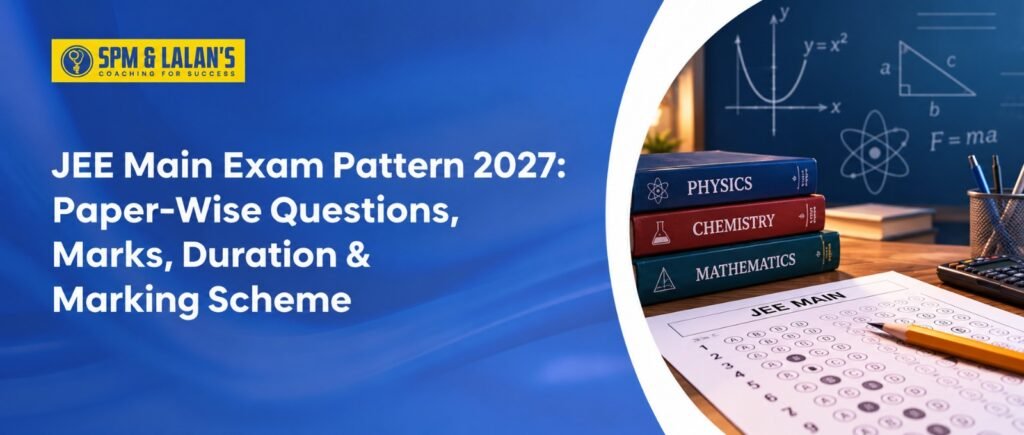
Understanding the JEE Main Exam Pattern helps you prepare with a clear mind. You will know what each paper contains, how many questions you must solve, and where negative marking applies. As a result, you can practise smarter instead of only studying for long hours. For 2027, students should treat the latest available structure as a guide until NTA releases the final information bulletin. Always check the official notice before the exam because NTA can update rules, question counts, or instructions. Along with the paper pattern, check our guide to the JEE Main exam date 2027 to plan your preparation around the expected schedule.

What Is the JEE Main Exam Pattern?
The JEE Main Exam Pattern explains the structure of the entrance test. It covers the papers, subjects, number of questions, marks, exam mode, duration, and marking rules.
JEE Main has two broad papers:
| Paper | Course purpose |
| Paper 1 | B.E./B.Tech admissions |
| Paper 2 | B.Arch and B.Planning admissions |
Paper 2 is divided into Paper 2A for B.Arch and Paper 2B for B.Planning. Therefore, select your paper carefully while filling out the form.
Why You Should Know the Pattern Early
Many students begin preparation without checking the paper structure. Later, they realise that speed, question selection, and accuracy matter as much as concepts.
The JEE Main Exam Pattern tells you how to divide your time between Physics, Chemistry, and Mathematics. It also helps you create mock-test targets. For example, if a section has numerical questions with negative marking, random guessing can hurt your score. So, learn the structure first. Then make your study plan around it.
JEE Main Paper Pattern 2027: Quick Overview
Paper 1 is based on a computer-based test for engineering aspirants. It includes Physics, Chemistry, and Mathematics. Each subject carries equal weightage.
| Feature | Paper 1: B.E./B.Tech |
| Mode | Computer-Based Test (CBT) |
| Subjects | Physics, Chemistry, Mathematics |
| Total questions | 75 |
| Total marks | 300 |
| Duration | 3 hours |
The JEE Main Exam Pattern for Paper 1 usually has two sections in every subject:
- Section A: 20 multiple-choice questions
- Section B: 5 numerical value questions
All questions are compulsory under the current format. Hence, do not assume that you will get optional numerical questions.
JEE Main 2027 Total Marks
For Paper 1, the total score is 300 marks. Physics, Chemistry, and Mathematics carry 100 marks each. This balance means you should not ignore any subject.
| Subject | Questions and marks |
| Physics | 25 questions, 100 marks |
| Chemistry | 25 questions, 100 marks |
| Mathematics | 25 questions, 100 marks |
Chemistry often helps students score quickly if their NCERT basics are strong. Physics needs clear concepts and careful calculations. Mathematics can take more time, so practise selecting the right questions.
The JEE Main Exam Pattern rewards balanced preparation. A very high score in one subject may not fully cover weak performance in the other two.
JEE Main Paper 1 Exam Pattern 2027
Paper 1 is for students aiming for B.E. or B.Tech programmes. It tests your Class 11 and Class 12 knowledge in Physics, Chemistry, and Mathematics.
Each subject has 20 MCQs and 5 numerical value questions. MCQs have four options. In numerical questions, you must enter the correct value using the computer screen.
| Question type | What you should know |
| MCQs | Choose one correct option from four choices |
| Numerical value questions | Enter the correct numerical answer |
The JEE Main Exam Pattern makes accuracy very important in both sections. Therefore, solve only those questions where you understand the method. A rushed answer can cost marks.
For your mock tests, practise sitting for the full three hours. It will build focus and teach you how to handle pressure.
JEE Main Paper 2 Exam Pattern 2027
Paper 2 is for Architecture and Planning aspirants. It has two separate options:
- Paper 2A: B.Arch
- Paper 2B: B.Planning
Paper 2A includes Mathematics, Aptitude Test, and Drawing Test. Paper 2B includes Mathematics, Aptitude Test, and Planning-based questions. The Drawing Test for B.Arch is generally conducted in pen-and-paper mode, while the other sections are computer-based.
| Paper option | Main sections |
| Paper 2A: B.Arch | Mathematics, Aptitude, Drawing |
| Paper 2B: B.Planning | Mathematics, Aptitude, Planning |
Both Paper 2A and Paper 2B generally carry 400 marks. If a candidate chooses both B.Arch and B.Planning, the test duration becomes longer. Check the official bulletin for the final time limit and instructions.
The Exam Pattern for Paper 2 is different from Paper 1. So, do not use only engineering mock tests if you are preparing for Architecture or Planning.
JEE Main 2027 Marking System
The standard marking rule for most questions is simple:
| Response | Marks |
| Correct answer | +4 |
| Wrong answer | -1 mark |
| Unanswered question | 0 marks |
This marking rule applies to MCQs and numerical value questions under the present pattern. That is why blind guessing is risky.
Suppose you answer five questions correctly and two incorrectly. You will get 20 marks for correct answers but lose 2 marks for wrong ones. Your final gain will be 18 marks, not 20.
The JEE Main Exam Pattern is not only about attempting more questions. It is about attempting the right questions. First, solve easy questions. Next, take up moderate ones. Finally, return to tough questions if time remains.
How to Use Negative Marking Wisely
Negative marking can change your final percentile. One careless attempt may not seem serious. However, several such attempts can lower your score a lot.
Use this simple rule during the paper:
- Attempt when you know the concept and method.
- Skip when you have no idea.
- Recheck calculation-based answers.
- Avoid changing answers unless you find a clear mistake.
- Keep the last 10–15 minutes for review.
Also, track your wrong attempts after every mock test. Write down whether the mistake happened due to weak concepts, calculation errors, poor reading, or guessing. Then fix that exact problem.
Duration and Time Management
Paper 1 usually gives you 180 minutes for 75 questions. That is enough time only when you remain calm and follow a plan.
You do not need to give equal time to every question. Instead, give time based on difficulty.
| Stage | What to do |
| First round | Solve easy and familiar questions |
| Second round | Attempt moderate questions |
| Final round | Review marked questions and calculations |
A good student does not fight with one difficult problem for 10 minutes. Move on. You can return later if needed.
The Exam Pattern tests your decision-making under time pressure. Therefore, full-length mock tests are as important as chapter-wise practice.
Paper-Wise Preparation Tips
For Paper 1 Aspirants
Build a strong base in all three subjects. Start with NCERT, class notes, and basic examples. After that, solve chapter-wise questions and previous-year papers.
For Physics, understand formulas and units. For Chemistry, revise NCERT regularly, especially Inorganic Chemistry. For Mathematics, practise daily because speed improves with repetition. For guidance on choosing a preparation programme, explore SPM & LALAN’S.
For Paper 2A Aspirants
Along with Mathematics and Aptitude, practise Drawing often. Learn perspective, scale, shading, shapes, and observation. Keep your drawings neat and easy to understand.
For Paper 2B Aspirants
Focus on Mathematics, Aptitude, and Planning topics. Read about basic planning ideas, buildings, transport, environment, and urban development. Solve sample questions to understand the level of the exam.
JEE Main Question Paper Pattern 2027: Smart Mock-Test Plan
Mock tests help you apply the JEE Main Exam Pattern in real conditions. Do not wait until the last month to start them. For reference, review the JEE Main 2026 exam calendar to understand how registration, exam sessions, and results were scheduled in the previous cycle.
In the beginning, take one test every two weeks. Once your syllabus is mostly complete, take one test every week. During the final revision phase, you can take two tests weekly if you have time to analyse them properly.
After every test, check these points:
- Which subject took too much time?
- Which chapters gave you the most mistakes?
- Did you lose marks due to negative marking?
- Did you leave easy questions unanswered?
- Did your score improve from the previous test?
Analysis matters more than simply giving many tests. One well-analysed mock test can teach you more than three rushed tests.
Important Points to Remember
The JEE Main Exam Pattern may look simple on paper, but your score depends on how well you use it on exam day. Keep these points in mind:
- Paper 1 has Physics, Chemistry, and Mathematics.
- Paper 2A is for B.Arch, while Paper 2B is for B.Planning.
- Correct answers usually get four marks.
- Wrong answers usually lose one mark.
- Numerical questions also need careful solving.
- Accuracy is more valuable than random attempts.
- Read every instruction on the exam screen before starting.
NTA conducts JEE Main for admissions to engineering, architecture, and planning programmes, and Paper 1 is also used as the eligibility test for JEE Advanced.
Conclusion
The JEE Main Exam Pattern gives you a clear map for your preparation. Know your paper, understand the question types, respect negative marking, and practise timed mock tests. Most importantly, build accuracy before chasing speed. Use the present format as a preparation guide, but confirm all final details from the 2027 NTA information bulletin once it is released. A clear strategy, regular revision, and calm question selection can make a big difference on exam day.
Planning to visit us for course enquiries? Find our coaching centre location on Google Maps.
Frequently Asked Questions (FAQs)
Q1. How many questions are expected in JEE Main Paper 1 in 2027?
JEE Main Paper 1 is expected to have 75 questions from Physics, Chemistry, and Mathematics. Each subject has 25 questions, including 20 MCQs and 5 numerical value questions. However, students must check the official 2027 NTA bulletin because the final rules can change.
Q2. Is there negative marking in JEE Main numerical value questions?
Under the current pattern, wrong answers in numerical value questions also attract negative marking. A correct answer gives four marks, while an incorrect answer loses one mark. Therefore, do not guess numerical answers. Solve carefully, recheck calculations, and attempt only when you feel reasonably confident.
Q3. What is the best way to manage time in JEE Main?
Begin with easy questions from your strongest subject. Then solve moderate questions and keep difficult ones for later. Do not spend too long on one problem. Take regular full-length mock tests, analyse every mistake, and slowly improve your speed, accuracy, and question-selection skills.
READ MORE:

This article is written by the SPM & LALAN’S Content Team, a group of skilled writers, researchers, and content strategists passionate about creating accurate, reliable, and student-friendly educational content. Every article is thoroughly researched, fact-checked, and updated to ensure readers receive trustworthy and relevant information. The goal is to help students make informed academic decisions through clear, well-researched, and easy-to-understand content.