
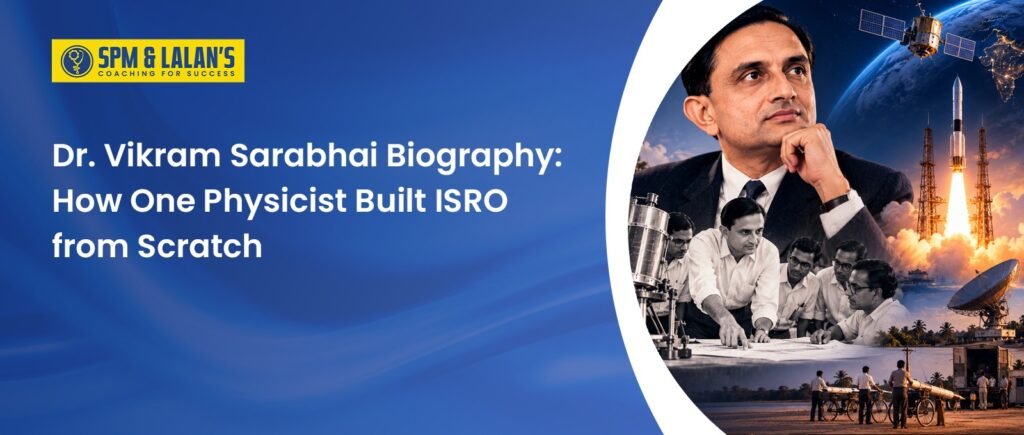
The Dr. Vikram Sarabhai biography is the story of a physicist who laid the foundation for India’s space program. He believed that advanced science and technology could help a developing country solve practical problems. His vision eventually led to the growth of India’s space research program and the establishment of ISRO. Known as the “Father of the Indian Space Programme,” Sarabhai also contributed to education, nuclear science, industry, and scientific research.
Who Was Dr. Vikram Sarabhai?
Dr. Vikram Ambalal Sarabhai was born into a prominent Gujarati industrialist family. He studied at Gujarat College before moving to the University of Cambridge. His doctoral research focused on cosmic rays in tropical latitudes. After returning to India, he continued his research at the Indian Institute of Science, Bengaluru, under Nobel laureate Dr. C. V. Raman.
| Particular | Details |
| Full Name | Vikram Ambalal Sarabhai |
| Field | Physics and Space Science |
| Major Research | Cosmic rays |
| Doctoral Institution | University of Cambridge |
| Major Organization | ISRO |
| Popularly Known As | Father of the Indian Space Programme |
| Died | December 1971 |
| Age at Death | 52 |
How Did Vikram Sarabhai Begin India’s Space Research?
A major milestone in the Dr. Vikram Sarabhai biography came in 1947 when he established the Physical Research Laboratory (PRL) in Ahmedabad. It became one of India’s early centres for research in space science and related fields. Sarabhai understood that space technology could benefit India beyond scientific research. He believed satellites could support communication, education, weather forecasting, and resource management. His vision helped convince the government to invest in a national space research program.
How Did Sarabhai Help Establish ISRO?
The Dr. Vikram Sarabhai biography is closely connected with the birth of ISRO. In 1969, the Indian Space Research Organisation (ISRO) was established, building on the space research activities that Sarabhai had helped develop.
He also worked with Dr. Homi J. Bhabha to establish India’s first rocket launching station at Thumba near Thiruvananthapuram. The early launch activities were conducted from the St. Mary Magdalene Church premises. Sarabhai’s approach focused on using space technology for national development rather than treating space exploration as an isolated scientific activity. His vision continues to inspire young students interested in space science. Students who want to pursue a similar career can explore how to join ISRO after 12th to understand the educational qualifications, courses, and career pathways involved.
What Were Vikram Sarabhai’s Major Contributions?
The Dr. Vikram Sarabhai biography includes contributions across several areas of science, education, and industry.
- Established the Physical Research Laboratory in Ahmedabad.
- Played a leading role in developing India’s space research program.
- Helped establish ISRO in 1969.
- Supported the development of the Thumba rocket launching station.
- Promoted satellite-based communication and education.
- Worked on the use of remote sensing for natural resource management.
- Contributed to India’s nuclear energy development after Homi Bhabha’s death.
- Promoted science and mathematics education among students and the public.
- Institution/Organizationole in establishing several educational and research institutions.
Which Institutions Did Vikram Sarabhai Establish?
Sarabhai’s influence extended far beyond ISRO. He was involved in establishing or developing several important organisations.
| Institution/Organisation | Major Area |
| Physical Research Laboratory | Space and physical sciences |
| ISRO | Space research |
| IIM Ahmedabad | Management education |
| Operations Research Group | Market research |
| ATIRA | Textile research |
| CEPT | Architecture and planning |
| VASCSC | Science education |
| Darpana Academy | Performing arts |
He also founded the Vikram A. Sarabhai Community Science Centre (VASCSC) to encourage interest in science and mathematics among students and the general public.
What Was Sarabhai’s Role in Education and National Development?
The Dr. Vikram Sarabhai biography also highlights his belief that science should reach ordinary people. He supported the use of satellites to provide educational content to children, particularly in remote areas. His ideas contributed to the development of satellite-based educational initiatives. He also supported the use of space technology for communication and remote sensing. Sarabhai was involved in organisations connected with industry, management, environmental planning and scientific research, showing that his vision extended well beyond space exploration.
Which Awards and Honours Did Vikram Sarabhai Receive?
The Dr. Vikram Sarabhai biography includes several major honours recognising his contribution to Indian science.
| Award/Honour | Year/Details |
| Shanti Swarup Bhatnagar Award | 1962 |
| Padma Bhushan | 1966 |
| Padma Vibhushan | 1972, posthumously |
| President, Physics Section, Indian Science Congress | 1962 |
| President, IAEA General Conference | 1970 |
| Vice-President, UN Conference on Peaceful Uses of Atomic Energy | 1971 |
The Vikram Sarabhai Space Centre (VSSC) in Thiruvananthapuram was named in his honour. A lunar crater was also named Sarabhai crater by the International Astronomical Union.
What Happened to Vikram Sarabhai?
Dr. Vikram Sarabhai died in December 1971 at Kovalam, Thiruvananthapuram, at the age of 52. His death came when India’s space and scientific programs were still developing. However, his ideas continued to influence India’s space program. The institutions he helped establish and the scientific vision he promoted became important foundations for India’s later achievements in space research.
What Can Students Learn From Vikram Sarabhai?
The Dr. Vikram Sarabhai biography offers several useful lessons for students and science aspirants:
- Think beyond immediate goals: Sarabhai imagined how science could solve social and national problems.
- Build strong fundamentals: His career began with deep research in physics.
- Connect science with society: He wanted scientific progress to improve communication, education, and resource management.
- Encourage young minds: His work in science education reflected his belief in developing future generations.
- Build institutions: His legacy includes organizations that continue to contribute to science and education.
Students inspired by Vikram Sarabhai’s scientific journey can also explore how to become a scientist in ISRO, DRDO, or BARC to understand the qualifications, educational pathways, and skills needed to pursue a research career in India.
Building a strong foundation in physics, chemistry, and mathematics is an important step for aspiring scientists and engineers. Students preparing for competitive entrance examinations can explore our JEE, NEET, and foundation preparation courses to strengthen their academic fundamentals.
Download CBSE & CEBA PYQs here
NEET & JEE Mock Test
Conclusion
The Dr. Vikram Sarabhai biography shows how one scientist’s vision helped shape India’s scientific future. From cosmic ray research to the development of ISRO, Sarabhai connected science with national development. His focus on education, research, and practical applications of technology continues to influence India’s scientific institutions and inspires students to use knowledge for larger social goals.
Vikram Sarabhai’s journey shows how strong scientific fundamentals can lead to meaningful achievements. Students aspiring to pursue careers in science, research, and engineering can explore academic guidance and competitive exam preparation at SPM & LALAN’S Coaching in Guwahati. Students and parents in Guwahati who wish to explore classroom coaching options can also find SPM & LALAN’S Coaching Centre on Google Maps for location details and directions.
Frequently Asked Questions
Why is Vikram Sarabhai called the Father of the Indian Space Programme?
Vikram Sarabhai played a leading role in developing India’s early space research activities and helped establish ISRO. He also supported the creation of India’s first rocket launching station at Thumba.
What was Vikram Sarabhai’s main field of research?
Sarabhai was a physicist whose early research focused on cosmic rays. His doctoral work at Cambridge examined cosmic ray activity in tropical latitudes.
Which organization was founded by Vikram Sarabhai?
Sarabhai played a key role in establishing ISRO in 1969. He had earlier founded the Physical Research Laboratory in Ahmedabad in 1947.

This article is written by the SPM & LALAN’S Content Team, a group of skilled writers, researchers, and content strategists passionate about creating accurate, reliable, and student-friendly educational content. Every article is thoroughly researched, fact-checked, and updated to ensure readers receive trustworthy and relevant information. The goal is to help students make informed academic decisions through clear, well-researched, and easy-to-understand content.