
Just like a building is made of bricks, your body is made up of tiny units called cells. These cells are so small that we cannot see them with our naked eyes, but they play an important role in the functioning of life. Cell Structure and Function for NEET is an important chapter because it builds the base of biology. Many questions in exams come directly from this chapter. Students preparing seriously for medical entrance exams can strengthen such important biology concepts through expert-guided NEET Coaching Guwahati program.
What is a Cell?
A cell is considered to be the structural and functional unit of life. In Cell Structure and Function for NEET, students first learn what a cell is and why it is important. All living beings are made up of cells. They may be made up of a single cell(unicellular) or many cells(multicellular). The smallest known cell is known as Mycoplasma. The number of cells varies from organism to organism. Human have more cell as compared to that of bacteria. The cell was discovered by Robert Hooke in 1665.
In Cell Structure and Function for NEET, cells and their components are studied because they perform important functions in living organisms. They also vary in size from small, medium, and large. They are like building blocks of a building. A cell comprises various cellular organelles, which perform specific tasks to carry out life processes. Each orgnalle has its own specific structure.
Why is a cell called the structural and functional unit of life?
A cell is called the structural unit of life because every living organism is made of cells. It can be small like bacteria, or large, like humans. These cells come together to form tissues. Then tissues form organs, and at the end, organs make up the body. The body would not have a proper structure without cells. This is why Cell Structure and Function for NEET is an important topic for understanding the basics of life. Students should also carefully follow the updated NEET Biology Syllabus 2026 to understand the important topics and weightage from cell biology.
A cell is called the functional unit because all important life processes take place in it. Activities like respiration, digestion, excretion, and growth take place at the cellular level. Each cell performs specific functions that help the entire organism survive and function properly.
What are the types of Cells?
In Cell Structure and Function for NEET, cells are mainly divided into two types based on their structure.
- Prokaryotic Cells
- Eukaryotic Cells
Prokaryotic Cell structure and functions-
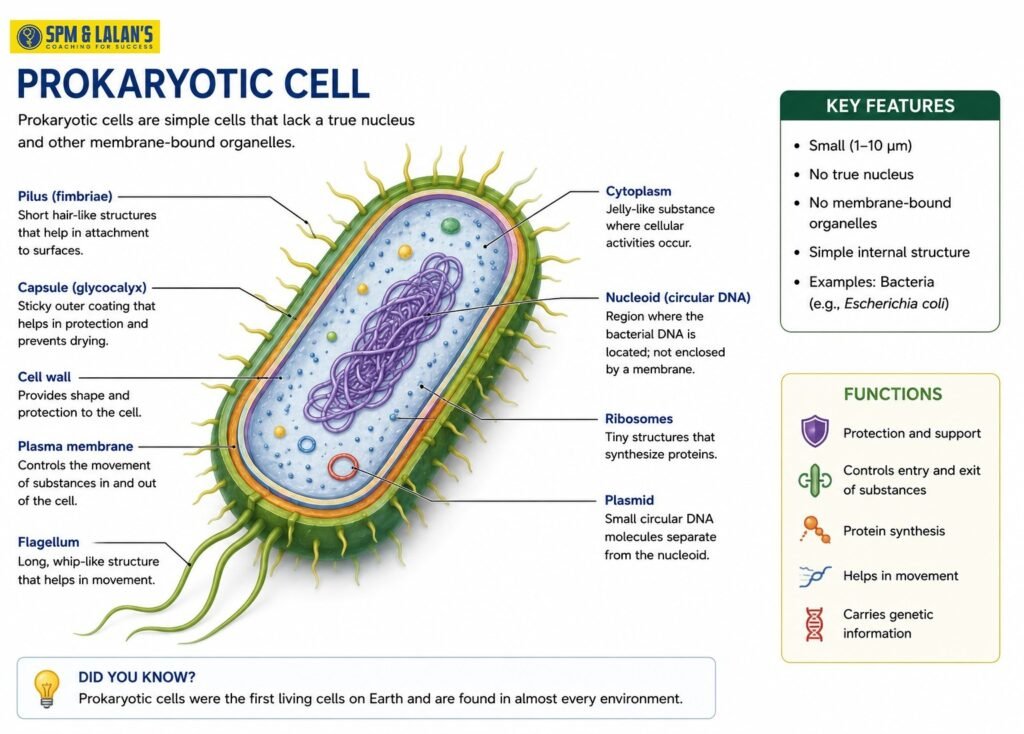
Have you ever wondered how the simplest cells manage to live and perform all life processes? They are single-celled microorganisms. Cell Structure and Function for NEET explains how these simple cells carry out life processes without a true nucleus. Prokaryotic cells are found in organisms like bacteria. They do not have a true nucleus. Their genetic material lies freely in the cytoplasm. They also lack membrane-bound organelles like mitochondria and the Golgi apparatus
They have a cell membrane. It controls the movement of substances and forms a cell wall that provides shape and protection. The cytoplasm contains tiny ribosomes that help in protein synthesis. Some prokaryotic cells have a flagellum, which helps in movement.
Eukaryotic cell structure and functions-
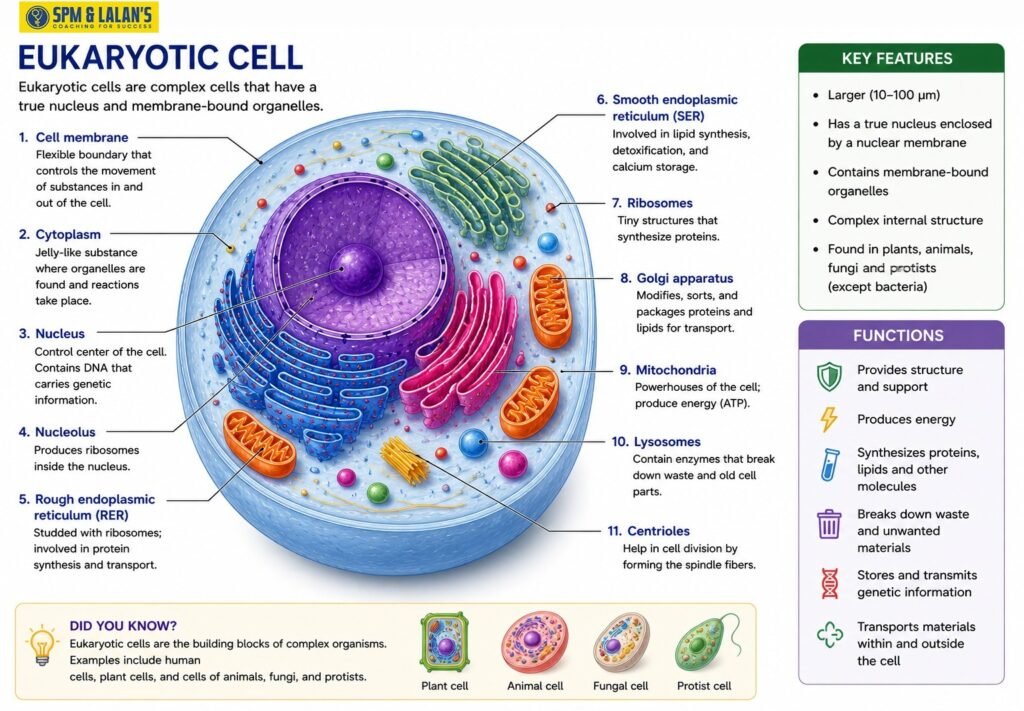
Eukaryotic cells are larger cells. They have a true nucleus that stores genetic material and controls all cell activities. This part of Cell Structure and Function for NEET helps students understand plant, animal, and other complex cells. They are found primarily in plants, animals, and protozoa. They also contain several membrane-bound organelles like mitochondria, Golgi apparatus, endoplasmic reticulum, and lysosomes.
They produce sexually as well as asexually.
Difference between Prokaryotic and Eukaryotic cells
| Point of Difference | Prokaryotic Cells | Eukaryotic Cells |
| Size | Very small | Larger |
| Nucleus | No true nucleus | Nucleus is true |
| Organalles | No membrane bound organalees | Many membrane-bound organelles |
| Structure | Simple | Complex |
| DNA | Circular | Linear |
| Examples | Bacteria | Plants, Animal, Fungi |
| Ribosomes | Smaller | Larger |
| Cell Type | Unicellular | Muticellular |
| Organisation | Less organised | Well organised |
What is Cell structure?
Have you ever wondered what makes up a cell and how it is organized inside? The cell structure are essential in carrying out life processes. They include –
- Cell Wall
- Cell Membrane
- Cytoplasm
- Nucleus
- Cell Oranalee
Cell Wall
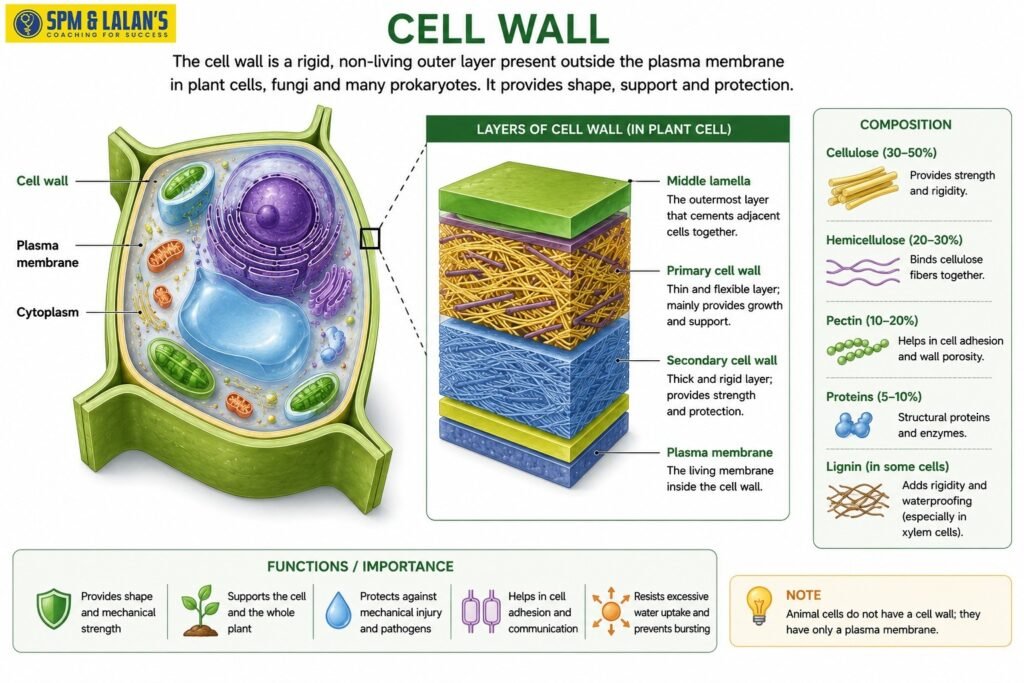
It is present only in Plant Cell and is absent in animal cells. It is made up of cellulose, hemicellulose, and pectin. It is the outermost layer of a plant cell. The main function of the cell wall is to provide shape and support to cells.
Cell Membrane
The cell membrane is the outer covering of the cell. It is thin and flexible in shape. One of the important characteristics is that it is selectively permeable(allows some substances to pass and blocks others). It is made up of lipids and fats.
Cytoplasm
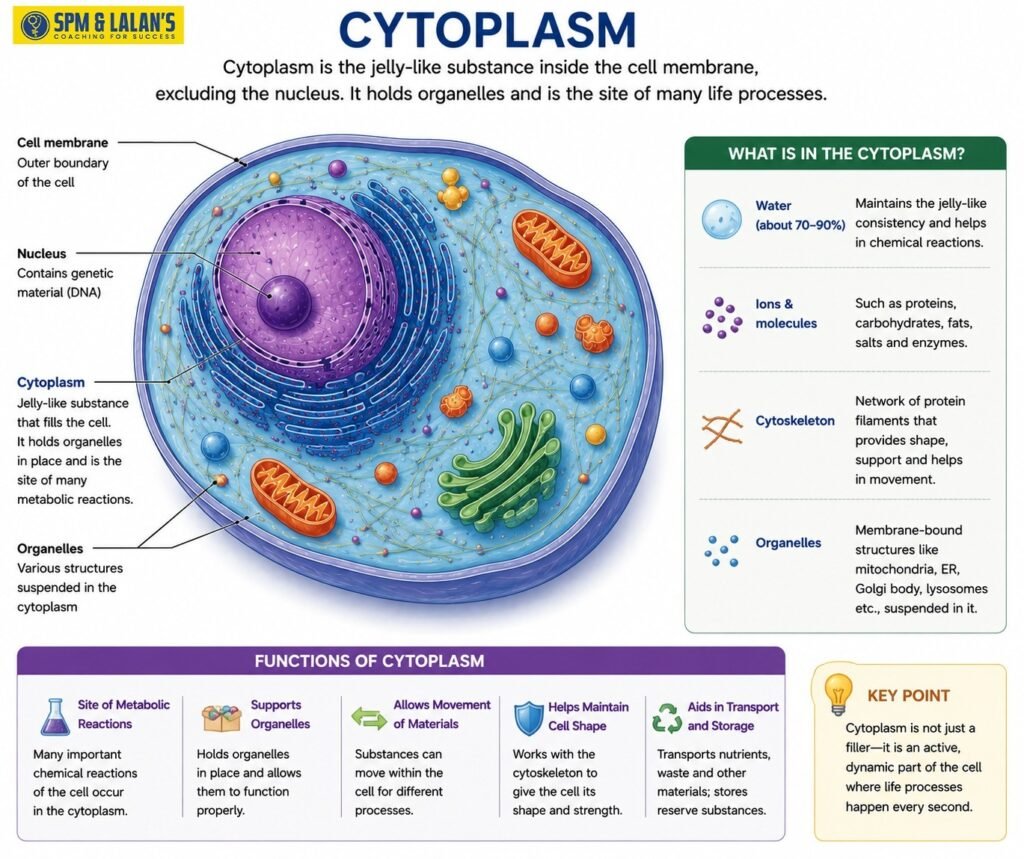
It is the jelly-like substance inside the cell. It is present between the cell membrane and the nucleus. It is also the site of all the cell organalee and helps in the movement of materials inside the cell. Cell organelles such as the endoplasmic reticulum, vacuole, mitochondria, and ribosomes are suspended in the cytoplasm
Nucleus
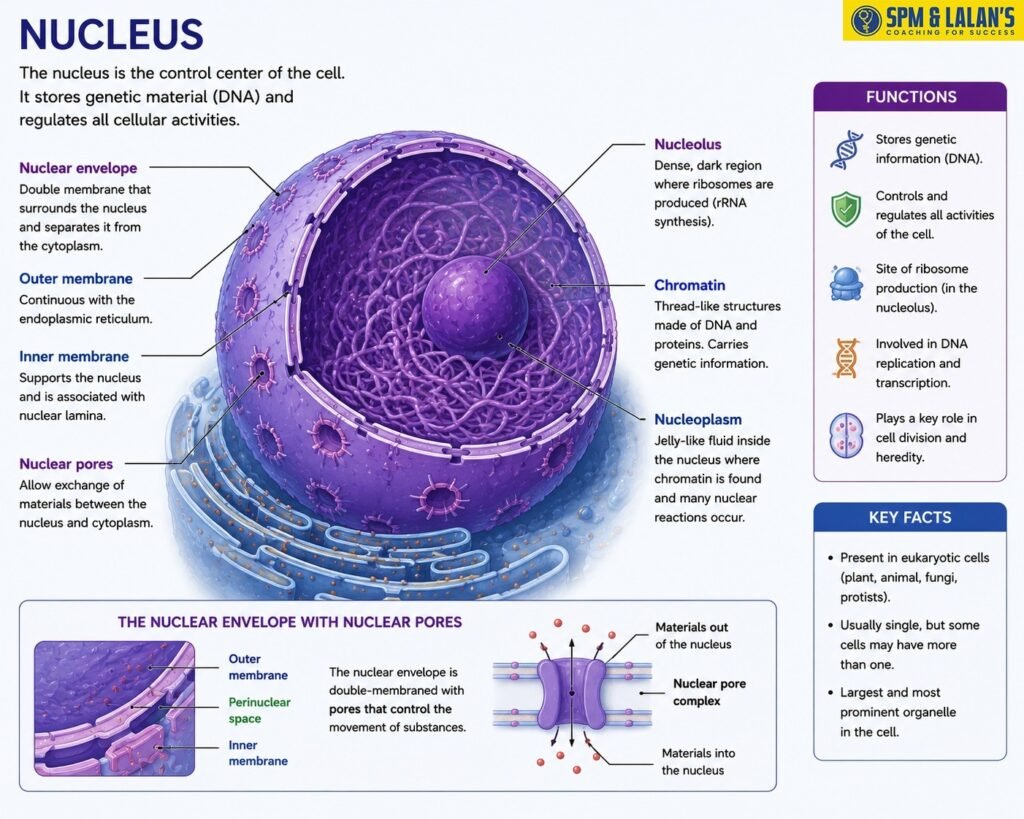
It contains the hereditary material of the cell, the DNA. The DNA instructions for all cell activities. It performs the function of sending signals to the cell to grow, mature, divide, and die. It contains a small structure known as the nucleolus
Cell Organelle
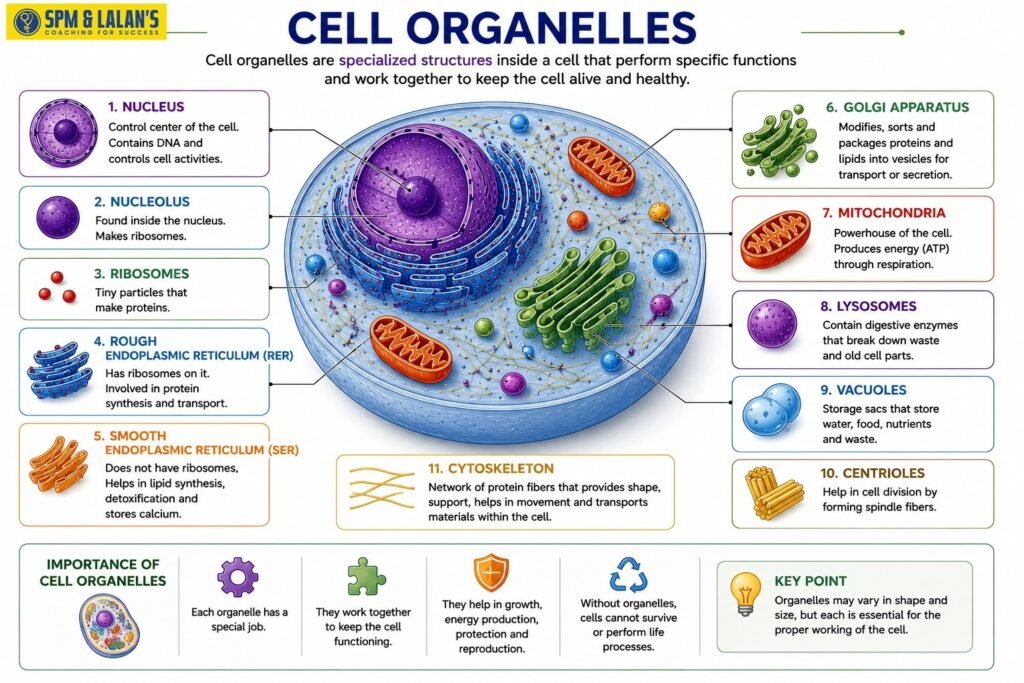
Cell organelles are a very important part of Cell Structure and Function for NEET. They perform certain specific functions to carry out life’s processes. The functions of each cell organelle are given in the table below
| Cell Organalee | Functions |
| Nucleas | Controls all activities of cells and stores DNA |
| Mitocondria | Produces energy for the cell(the power house of the cell) |
| Ribosomes | Helps in making protein |
| Endoplasmic Reticulum | Transports materials |
| Golgi Apparatus | Modifies, packages, and sends materials |
| Lysosomes | Breaks down wastes and unwanted materials |
| Vacuole | Stores food, water and wastes |
| Choloroplast | Helps in photosynthesis (only in plant cells) |
| Cell Membrane | Controls the entry and exit of the substances |
| Cell Wall | Gives shape and support |
What is cell theory? Who proposed the cell theory?
Cell Theory was proposed by the German scientists Theodor Schwann, Matthias Schleiden, and Rudolf Virchow. The cell theory states that all living species on Earth are composed of cells. A cell is the basic unit of life. All cells arise from pre-existing cells.
A modern version of the cell theory was eventually formulated, and it contains the following postulates: Energy flows within the cells, Genetic information is passed on from one cell to the other, The chemical composition of all the cells is the same.
Before solving previous year questions, students should understand the right strategy to prepare for Biology for NEET effectively and improve conceptual clarity.
After understanding the concepts of cells and organelles, students should regularly practice chapter-wise tests to improve accuracy, speed, and exam confidence for NEET and JEE preparation.
NEET PYQs from Cell Structure and Functions
NEET 2022
Q1. Which of the following statements with respect to the endoplasmic reticulum is incorrect
(a) SER is devoid of ribosomes
(b) In Prokaryotes only the RER is present
(c) SER are the sites for lipid synthesis
(d) RER has ribosomes attached to the ER
Q2. If the pH is lysosomes is increased to alkaline, what will be the outcome
(a) Lysosomal enzymes will be more active
(b) Hydrolytic enzymes will function more efficiently
(c) Hydrolytic enzymes will be more inactive
(d) Lysosomal enzymes will be released into the cytoplasm
NEET 2021
Q1. When the centromere is situated in the middle of two equal arms of chromosomes, the chromosome is referred to as:
(a) Sub-metacentric
(b) Acrocentric
(c) Metacentric
(d) Telocentric
Q2. Match List-I with List-II:
List-I | List-II
A. Cristae | (i) Golgi apparatus
B. Thylakoids | (ii) Centromere
C. Cisternae | (iii) Mitochondria
D. Primary constriction | (iv) Plastids
Choose the correct answer:
(a) A-iii, B-iv, C-i, D-ii
(b) A-ii, B-iii, C-iv, D-i
(c) A-iv, B-iii, C-ii, D-i
(d) A-i, B-iv, C-iii, D-ii
Q3. Which of the following is an incorrect statement?
A. The perinuclear space forms a barrier between the nucleus and cytoplasm.
B. Nuclear pores allow the passage of proteins and RNA.
C. Mature sieve tube elements possess a conspicuous nucleus.
D. Microbodies are present in both plant and animal cells.
Q4. The organelles that are included in the endomembrane system are:
(a) Golgi complex, mitochondria, ribosomes, lysosomes
(b) Golgi complex, ER, mitochondria, lysosomes
(c) ER, mitochondria, ribosomes, lysosomes
(d) ER, Golgi complex, lysosomes, vacuoles
NEET 2020
Q1. Which of the following statements about inclusion bodies is incorrect?
(a) They lie free in the cytoplasm
(b) They represent reserve material
(c) They are not membrane-bound
(d) They are involved in the ingestion of food
Q2. Which is the important site of formation of glycoproteins and glycolipids in eukaryotic cells?
(a) Golgi bodies
(b) Polysomes
(c) Endoplasmic Reticulum
(d) Peroxisomes
NEET 2019
Q1. Which of the following pairs of organelles does not contain DNA?
(a) Nuclear envelope and mitochondria
(b) Mitochondria and chloroplasts
(c) Lysosome and vacuole
(d) Chloroplast and mitochondria
NEET 2017
Q1. Which of the following cell organelles is responsible for extracting energy from carbohydrates to form ATP?
(a) Ribosome
(b) Chloroplast
(c) Mitochondrion
(d) Lysosome
NEET 2016
Q1. A cell organelle containing hydrolytic enzymes is
(a) a lysosome.
(b) Microsome
(c) Ribosome
(d) Mesosome
Q2. Select the wrong statement:
(a) The bacterial cell wall is made of peptidoglycan.
(b) Pili and fimbriae are involved in motility.
(c) Cyanobacteria lack flagella.
(d) Mycoplasma is wall-less
Q3. Mitochondria and chloroplasts are:
(A) Semi-autonomous organelles
(B) Formed by division and lacks protein synthesis machinery
Choose the correct answer:
(a) A true, B false
(b) Both false.
(c) Both true
(d) B true, A false
Q4. Which one of the following organelles is enclosed by a single membrane?
(a) Lysosomes
(b) Nucleus
(c) Mitochondria
(d) Chloroplast
Solving Previous Year Questions regularly helps students understand important concepts, question patterns, and the level of difficulty asked in NEET, CBSE, and CEBA examinations.
Conclusion
Understanding Cell Structure and Function for NEET is the foundation of biology for every medical aspirant. Starting from the basic definition of a cell to the complex roles of organelles. This chapter builds your conceptual clarity for many advanced topics. Whether it is the difference between prokaryotic and eukaryotic cells, the working of cell organelles, or the principles of cell theory. Every concept is directly linked to exam-oriented questions
In short, mastering cells means mastering the basics of life itself—and that’s a smart step toward cracking NEET
For more NEET preparation resources, biology notes, mock tests, and exam strategies, visit SPM and Lalans.

This article is written by the SPM & LALAN’S Content Team, a group of skilled writers, researchers, and content strategists passionate about creating accurate, reliable, and student-friendly educational content. Every article is thoroughly researched, fact-checked, and updated to ensure readers receive trustworthy and relevant information. The goal is to help students make informed academic decisions through clear, well-researched, and easy-to-understand content.