


If you are preparing for NEET 2026 with reliable guwahati coaching centre, one thing that trips up almost every student is understanding percentage and percentile in NEET. At first glance, both words look similar, and honestly, that is exactly why so many aspirants mix them up. But here is the truth, they mean two completely different things, and confusing the two can seriously affect how you read your results and predict your rank.
So let us break this down in the simplest way possible, step by step.
What Is a Percentage?
Let us start with something familiar. You have been dealing with percentages since middle school. A percentage simply tells you how many marks you scored out of the total marks, expressed on a scale of 100.
Here is a quick example: if a student scores 450 marks out of 500, the percentage works out to (450 ÷ 500) × 100 = 90%. In NEET, however, your score is calculated out of NEET Total Marks 2026, which is the foundation for understanding your percentage accurately That is it. Clean and straightforward.
The important thing to remember here is that a percentage is an absolute number. It only reflects your individual performance. It does not tell you anything about how the rest of the students performed on the same day. Whether 10 students appeared or 10 lakh students appeared, your percentage stays the same, 90%.
In the context of percentage and percentile in NEET, percentage is the starting point, but it is not the deciding factor for your rank or college admission.
What Is a Percentile?
Now, this is where things get more interesting, and more important for NEET aspirants. A percentile is not about your marks at all. Instead, it tells you how your performance compares to every other student who appeared in the same exam.
The formula is straightforward:
Percentile = (Number of students who scored less than you ÷ Total number of candidates) × 100
Let us put real numbers to this. Say 950,000 students appeared for NEET 2026, and 900,000 of them scored below you. Your percentile would be:
(900,000 ÷ 950,000) × 100 = 94.7 Percentile
Notice that this number has nothing to do with how many marks you got. It purely reflects where you stand among all the candidates who wrote the exam. That is the fundamental idea behind percentage and percentile in NEET, one measures your marks, the other measures your position.
The higher your percentile, the better your rank, and the stronger your chances during counseling. You can also estimate your standing using a NEET Percentile Calculator, Colleges, merit lists, and admission bodies look at your percentile rank, not your raw score.
Difference Between Percentage and Percentile in NEET 2026
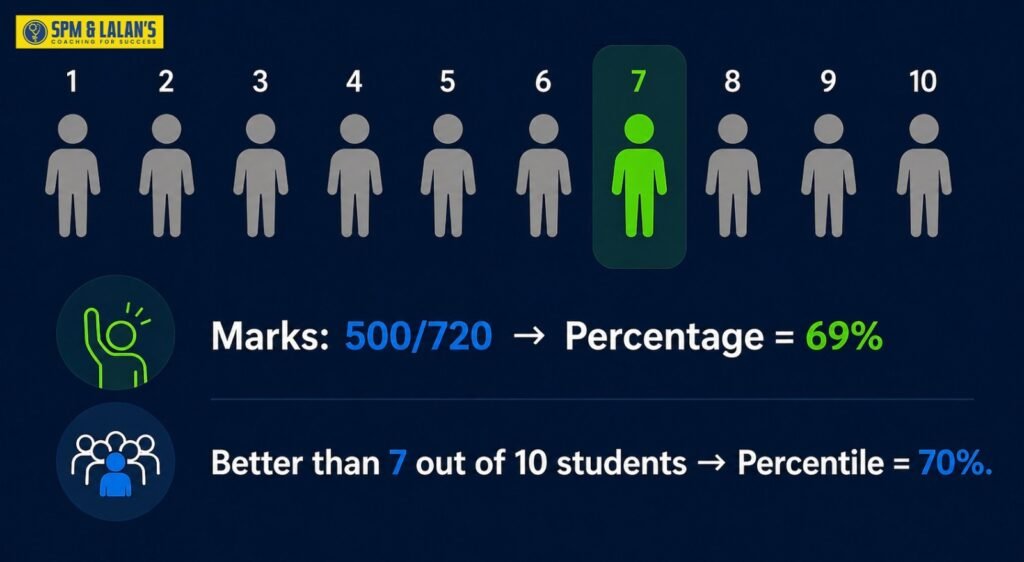
To make things crystal clear, here is a side-by-side comparison of both:
| Feature | Percentage | Percentile |
| Definition | Marks obtained out of total marks | Rank of a candidate relative to others |
| Calculation | (Marks Obtained ÷ Total Marks) × 100 | (Candidates Scoring ≤ Yours ÷ Total Candidates) × 100 |
| What it shows | How much did you score | How many people scored less than you |
| Nature | Absolute measure | Relative measure |
| Example | 50% if you score 360 out of 720 | The 90th percentile means you scored higher than 90% of candidates |
| Use in NEET | Not directly used for ranking | Used for ranking and cut-off determinations |
This data makes the percentage and percentile in NEET distinction easy to grasp at a glance.
Why Two Students with the Same Percentage Can Have Different Percentiles
This is the part that genuinely surprises most students when they hear it for the first time. Consider Riya and Arjun,.both scored exactly 360 out of 720, which means they both have a 50% score. Their percentage is identical. However, Riya appeared in a session where the competition was particularly tough, and many students scored above 360. Arjun’s session, on the other hand, had a larger proportion of lower scorers.
The result? Riya might end up at the 65th percentile, while Arjun lands at the 75th, even though both scored the same number of marks.
This is precisely why understanding percentage and percentile in NEET matters so much. A percentile is dynamic. It shifts depending on who appears alongside you and how they perform. A percentage, however, stays fixed no matter what.
Furthermore, this is also the reason NEET uses percentile-based normalization when the exam runs across multiple shifts. It levels the playing field and ensures fairness across all sessions, regardless of which slot a student appeared in.
How NEET Uses Percentile for Rank Calculation
Many students wonder how the final NEET rank actually gets calculated. The answer lies entirely in percentile scores. Once the exam concludes and results are processed, the National Testing Agency assigns each student a percentile based on how they performed compared to the entire candidate pool. This percentile score then directly determines the All India Rank.
Students with a higher percentile receive a better rank, and students with lower percentiles receive a higher rank number. Since NEET can attract over 20 lakh registered candidates in a single year, even a small difference in percentile can translate into thousands of rank positions. That is why a student moving from the 85th to the 90th percentile can see their rank improve dramatically, sometimes by 30,000 to 50,000 positions in one go.
This is also why preparing strategically matters as much as studying hard and choosing the right NEET coaching in Guwahati can significantly improve your competitive edge. Since the percentile measures relative performance, you need to score better than the majority of candidates, not just clear a fixed threshold. Truly understanding the competitive nature of percentage and percentile in NEET helps you set much smarter preparation goals going forward.
Since percentile depends on outperforming other candidates, smart preparation matters just as much as hard work. Practicing previous year questions can significantly strengthen your exam readiness.
How Normalization Works in NEET
Since NEET sometimes runs across multiple shifts or sessions in a given year, there is always a chance that one shift has a tougher paper than another. To handle this situation fairly, NTA applies a normalization process based on percentile scores.
Here is how it works in simple terms. If you appeared in a tough shift and scored 400 marks, your raw score gets adjusted based on the performance of candidates in your shift compared to other shifts. The idea is straightforward, scoring 400 in a harder paper is not the same as scoring 400 in an easier one. Normalization accounts for this difference and converts raw scores into comparable percentile values.
As a result, your final percentile may look slightly different from what you would calculate using only your raw marks. This is completely normal and is part of a system designed to ensure no student gets unfairly disadvantaged simply because of which session they appeared in. So, when you track percentage and percentile in NEET, always remember that the official percentile on your scorecard is the one that matters for rank and counseling, not a self-calculated estimate based on the answer key.
Category-Wise Expected Percentile and Marks for NEET 2026
To qualify for counseling, every student must meet the minimum percentile requirement set for their category. Based on expected data for NEET 2026, here is what aspirants from different categories can anticipate:
| Category | Expected Percentile | Predicted Marks Range |
| General / UR | 50th Percentile | Around 144 and above |
| EWS | 50th Percentile | Around 144 and above |
| OBC | 40th Percentile | Around 113–143 |
| SC | 40th Percentile | Around 113–143 |
| ST | 40th Percentile | Around 113–143 |
| UR-PwD | 45th Percentile | Around 127–143 |
This table gives you a solid starting point to understand where you need to be in terms of the NEET 2026 expected percentile score based on your category.
NEET 2026 Cutoff and Qualifying Marks
The cutoff is the minimum score you need to qualify for the counseling process. Importantly, this cutoff is decided based on percentile, not raw percentage. Here are the expected qualifying criteria for NEET 2026:
| Category | Cutoff Percentile | Expected Marks |
| UR / EWS | 50th Percentile | Around 144 |
| OBC / SC / ST | 40th Percentile | Around 113 |
| UR PwD | 45th Percentile | Around 127 |
Keep in mind that these numbers may shift slightly depending on the difficulty level of the exam and the total number of candidates who appear. Therefore, treat these as educated estimates rather than final figures.
NEET Percentile for 500 Marks, 2026
A lot of students set 500 marks as their target, and it is a reasonable goal. Students targeting this range should also explore NEET 500–600 Marks Rank Prediction and Top Colleges for realistic admission possibilities. The NEET percentile for 500 marks in 2026 is expected to fall in a moderate range. While it may not unlock seats in top government medical colleges directly, it can open up opportunities in courses like BDS, AYUSH, and other allied health fields, especially when you factor in category benefits and different counseling rounds. So, do not lose heart if 500 is where you land, there are still strong options available.
NEET Percentile for 600 Marks, 2026
Scoring around 600 marks puts you in a genuinely strong position. The NEET percentile for 600 marks in 2026 is expected to be quite high, and it can seriously improve your chances of securing a seat in a government medical college. Of course, this also depends on your category and the specific round of counseling. Nevertheless, 600 and above is a score range that opens doors in a meaningful way.
Common Mistakes Students Make When They Confuse the Two
Even well-prepared students fall into some predictable traps when they do not fully understand percentage and percentile in NEET. Here are the most frequent ones:
- Assuming a high percentage guarantees a good rank—it simply does not. Your rank comes from your percentile, not your percentage. Two students can have the same percentage but very different ranks.
- Using percentages to estimate college admission chances leads to completely wrong conclusions. Always use percentile and rank predictors when checking your admission eligibility.
- Panicking unnecessarily after a tough paper—a student who scores 65% in a particularly difficult exam might still land in the 85th or even 90th percentile, because the rest of the candidates struggled just as much. Context matters enormously here.
- Ignoring percentiles in board exams—even outside NEET, some university admissions factor in percentile-equivalent metrics. So it is a concept worth understanding broadly, not just for this one exam.
When you truly get the distinction between percentage and percentile in NEET, you save yourself from all of these avoidable mistakes.
Why Percentile Matters More Than Percentage in NEET
To put it plainly, NEET is a competitive exam. It is not a test you pass or fail based on how many marks you get in isolation. Instead, it ranks every single student against every other student. That is exactly why percentage and percentile in NEET play such different roles, the percentage tells you how hard you studied, while the percentile tells you where you stand in the race.
Colleges, medical councils, and counseling authorities such as the Medical Counselling Committee (MCC) base their entire merit list on percentile ranks. So even if your percentage looks modest, a strong percentile can still get you into a good institution.
Understanding percentile is only the first step—improving it requires consistent practice, strategy, and real exam simulation.
Conclusion
Understanding the difference between percentage and percentile in NEET is not just an academic exercise, it is genuinely essential for every student who wants to plan their NEET 2026 journey smartly. To sum it up simply: percentage shows you how many marks you scored, while percentile shows you how many students you outperformed. One is fixed; the other is relative. One tells your story alone; the other places you in the bigger picture.
Moreover, knowing this distinction helps you stay calm after the exam, interpret your results accurately, predict your rank realistically, and make informed decisions during counseling. Instead of fixating only on your score, pay equal attention to where you stand relative to the entire candidate pool. That shift in thinking can make a significant difference in how you approach both preparation and results.
So, the next time someone asks you about percentage and percentile in NEET 2026, you will not just know the answer, you will understand exactly why it matters.
Frequently Asked Questions (FAQs)
Can percentage and percentile ever be the same value?
While the numbers might occasionally match by coincidence, percentage and percentile are calculated using completely different methods and represent completely different things. The percentage measures how much you scored out of the total marks. Percentile measures how you ranked relative to other candidates. So even when the numbers look the same on paper, they carry entirely different meanings. You should never treat them as interchangeable.
Does “90th percentile” mean the same as “90%”?
No, these two are not the same at all, and this is one of the most common misunderstandings among students. A 90th percentile means you performed better than 90% of all the students who appeared in the exam, it says nothing about your actual marks. You could have scored 60% of the total marks and still be at the 90th percentile if the majority of students scored even lower. The percentile is entirely about relative standing, not absolute marks.
What carries more weight in NEET, percentage or percentile?
Without any doubt, percentile holds far greater importance in NEET. The entire ranking system, the cutoff qualification, the merit list for counseling, and the final seat allotment, everything runs on percentiles. A percentage is useful to understand your own performance, but it plays no direct role in determining your rank or your chances at a particular college. So, while both are worth knowing, percentile is what you should focus on when predicting outcomes and planning your next steps.

This article is written by the SPM & LALAN’S Content Team, a group of skilled writers, researchers, and content strategists passionate about creating accurate, reliable, and student-friendly educational content. Every article is thoroughly researched, fact-checked, and updated to ensure readers receive trustworthy and relevant information. The goal is to help students make informed academic decisions through clear, well-researched, and easy-to-understand content.