
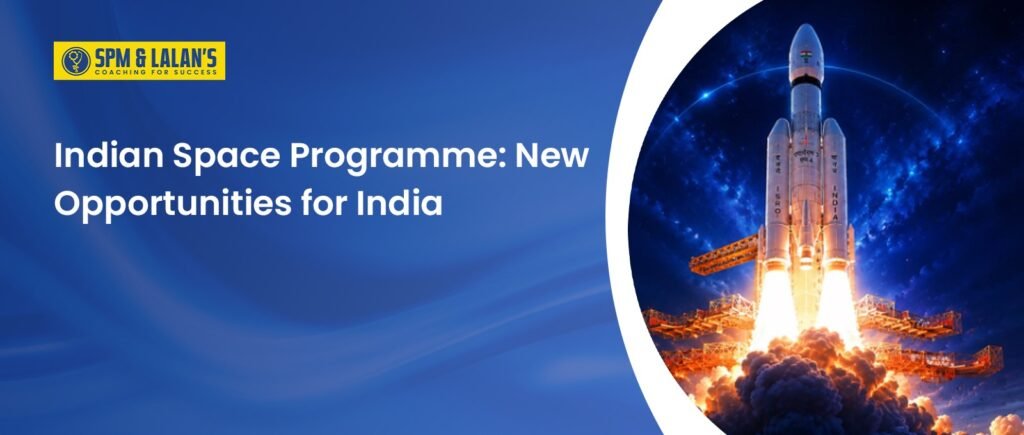
The Indian Space Programme began in the 1960s with a modest budget and limited resources. However, it carried a strong and purposeful vision—to support India’s national development. Since then, the programme has achieved major milestones and expanded beyond scientific missions. Today, space technology touches everyday life through communication, navigation, weather forecasting and disaster management. Moreover, it is creating fresh opportunities for students, researchers, startups and skilled professionals across the country.
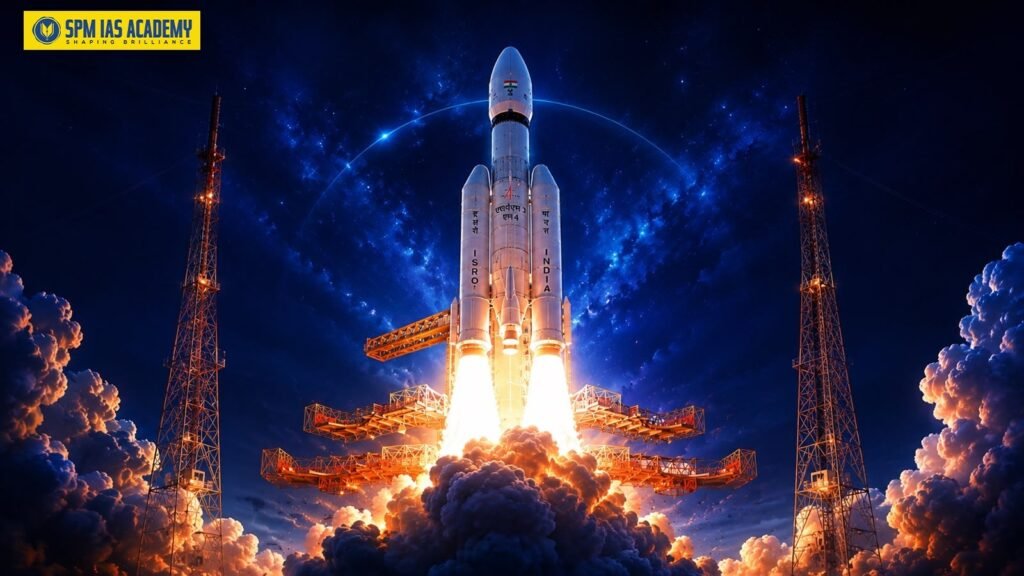
How India’s Space Programme Has Evolved
The Indian Space Programme has grown from a small research initiative into one of the world’s leading space programmes. Its evolution can be understood through the following stages:
- A modest beginning: India started its space activities with the establishment of INCOSPAR in 1962. Later, ISRO was formed in 1969 to use space technology for national development.
- Development of satellites: Aryabhata, India’s first satellite, was launched in 1975. Subsequently, India developed satellites for communication, television broadcasting, navigation, weather forecasting and Earth observation.
- Building indigenous launch vehicles: The successful launch of SLV-3 in 1980 demonstrated India’s ability to place a satellite into orbit. Later, ISRO developed the PSLV, GSLV and LVM3 to carry different types of satellites and spacecraft.
- Affordable launch capabilities: Over time, India earned recognition for its reliable and cost-effective launch services. The PSLV has carried Indian as well as foreign satellites into space, helping India strengthen its position in the commercial launch market.
- Beginning of planetary exploration: Chandrayaan-1, launched in 2008, marked India’s first mission to the Moon. This was followed by the Mars Orbiter Mission in 2013, which demonstrated India’s ability to complete an interplanetary mission with limited resources.
- Success of Chandrayaan-3: In August 2023, Chandrayaan-3 successfully demonstrated safe landing and rover operations on the lunar surface. The achievement strengthened India’s position in lunar exploration.
- Studying the Sun: Aditya-L1, India’s first dedicated solar mission, expanded the programme’s scientific reach. It was designed to study the Sun’s atmosphere, solar activity and their effects on space weather.
Government Reforms Opening India’s Space Sector
Earlier, activities under the Indian Space Programme were mainly managed by ISRO. However, the government introduced major reforms in 2020 to allow private companies and startups to participate in the sector
- Entry of private companies: Private businesses can now build satellites, rockets, and other space equipment. They can also provide launch and satellite-based services.
- Formation of IN-SPACe: The government created IN-SPACe as a single-window agency. It guides, promotes, and authorises the space activities of private companies.
- Role of NSIL: NewSpace India Limited helps commercialise ISRO’s technology and services. It also connects India’s space capabilities with commercial customers.
- Indian Space Policy 2023: Moreover, this policy clearly explains the roles of ISRO, IN-SPACe, NSIL and private companies. It encourages greater private participation across the space sector.
- Access to ISRO facilities: Private companies can also use selected ISRO facilities, technical knowledge and testing centres after receiving approval.
New Career Opportunities in the Indian Space Sector
The growth of the Indian Space Programme is creating many new career paths. Earlier, most space-related jobs were available mainly within ISRO. However, private companies and startups now employ scientists, engineers, technicians and researchers to develop rockets, satellites and other space technologies.
Moreover, the sector needs software developers, data analysts and experts in remote sensing. These professionals study satellite data for weather forecasting, agriculture, navigation and disaster management. Young people can also work in satellite communication, electronics, robotics and artificial intelligence.
Young people can also work in satellite communication, electronics, robotics and artificial intelligence. Students interested in research and government science careers can also learn how to become a scientist in ISRO, DRDO or BARC, including the educational qualifications and career pathways involved.
Space careers are no longer limited to technical roles. Private companies also need project managers, designers, accountants, lawyers and marketing professionals. Therefore, students from different educational backgrounds can find suitable opportunities in India’s growing space sector.
Build a Strong Foundation for a Career in Science
Guidance for Aspiring Science Students
Students interested in building careers in science, engineering or medicine need strong academic foundations and expert guidance. SPM & LALAN’S Coaching supports students preparing for competitive examinations through experienced faculty, structured learning and regular assessments. Students aiming for medical entrance examinations can also explore its dedicated NEET coaching in Guwahati.
Students who prefer digital learning may also read whether online study is sufficient for NEET preparation and understand when additional mentoring, testing and doubt-solving support may be necessary.
Opportunities in Satellite Manufacturing and Launch Services
The growth of the Indian Space Programme has created new opportunities in satellite manufacturing. Private companies can now design satellites and produce important parts such as sensors, communication systems, solar panels and electronic equipment. As a result, small businesses can also become suppliers to larger space companies.
Moreover, India’s demand for communication, navigation and Earth-observation satellites is growing. This creates work in satellite assembly, software development, testing and ground-control services. It also allows Indian companies to offer satellite-based solutions to farmers, businesses and government departments.
India is also expanding its commercial launch services. Therefore, private companies can develop rockets, launch small satellites and build testing facilities. This growth can attract investment, strengthen local manufacturing and create skilled jobs for engineers, technicians and researchers.
How Space Technology Is Supporting Other Sector
The Indian Space Programme does more than help scientists study the universe. It also supports many important sectors and makes everyday services safer and more effective.
- Agriculture: Satellite images help farmers and government agencies monitor crops, soil moisture and drought conditions. Moreover, they support crop planning and yield estimation.
- Weather forecasting: Weather satellites track clouds, rainfall and cyclones. As a result, authorities can issue early warnings and help people prepare for severe weather.
- Disaster management: Satellites provide images of areas affected by floods, landslides, forest fires and cyclones. Therefore, rescue teams can locate damaged areas and plan relief work faster.
- Communication: Communication satellites support television broadcasting, telephone services and internet connectivity. They are especially useful in remote and difficult areas.
- Navigation: India’s NavIC system provides location and timing services. It supports transport, mapping, fishing activities and emergency services.
- Environment protection: Satellite data helps monitor forests, rivers, glaciers, coastlines and air quality. Thus, authorities can identify environmental changes and take suitable action.
- Urban planning: Finally, satellite maps help governments plan roads, cities, water systems and public facilities more effectively.
India’s Growing Role in the Global Space Economy
The global growth of the Indian Space Programme is helping India become an important part of the space market. Its reliable technology and cost-effective services allow the country to work with foreign governments, space agencies and companies.
- Commercial launch services: India uses launch vehicles such as the PSLV to place Indian and foreign satellites into orbit. Moreover, NSIL markets India’s launch services to commercial customers.
- International partnerships: ISRO and Indian space companies work with other countries on research, satellite development and space missions. These partnerships help India exchange knowledge and enter new markets.
- Export opportunities: Indian companies can export satellites, rocket parts, software and space-based services. IN-SPACe aims to increase global demand for products and services made in India.
- Growing private sector: Furthermore, Indian startups are working in satellite manufacturing, launch systems, Earth observation and data services. This gives India more chances to compete globally
Challenges Facing India’s Emerging Space Sector
Although the Indian Space Programme is growing, it still faces several challenges:
- Limited funding: Space projects require substantial investments and may take years to yield returns. Therefore, many startups struggle to raise sufficient funds
- High technological risk: Building rockets and satellites is complex. Even a small technical mistake can delay or damage an entire mission.
- Shortage of skilled workers: The sector needs trained engineers, scientists, technicians and data experts. However, India must expand specialised education and practical training.
- Limited testing facilities: Private companies need advanced laboratories, launch sites and testing centres. Moreover, access to such facilities can be costly or limited.
Prepare for Your Next Examination
A strong foundation in science and mathematics can help students pursue careers in medicine, engineering, research and space technology. Test your preparation with mock examinations or practise using previous years’ board question papers.
Take Free NEET & JEE Mock Test
Download CBSE & SEBA PYQs
Conclusion
India’s space journey now goes far beyond rockets and scientific missions. The Indian Space Programme is creating jobs, supporting businesses and improving essential services across the country. Moreover, government reforms and private participation are opening new paths for innovation. However, India must address funding, skills and infrastructure gaps to build a competitive, responsible and inclusive space economy.
Visit SPM & LALAN’S Coaching
Students and parents seeking in-person academic guidance can view our coaching centre location in Guwahati and plan a campus visit.

This article is written by the SPM & LALAN’S Content Team, a group of skilled writers, researchers, and content strategists passionate about creating accurate, reliable, and student-friendly educational content. Every article is thoroughly researched, fact-checked, and updated to ensure readers receive trustworthy and relevant information. The goal is to help students make informed academic decisions through clear, well-researched, and easy-to-understand content.