
Many students dream of studying at an IIT, NIT, IIIT or another leading engineering institute in India. However, turning this dream into reality begins with understanding the Joint Entrance Examination (JEE). Known as India’s premier engineering entrance exam, JEE has two stages: JEE Main and JEE Advanced. Both stages have different purposes, eligibility rules, and difficulty levels.
Therefore, engineering aspirants should understand the complete process before starting their preparation. This IIT admission guide explains the exam stages, patterns, JoSAA counselling, and preparation tips in simple language. Whether students are beginning in Class 11 or revising for the exam, early planning can make their journey easier and less stressful.
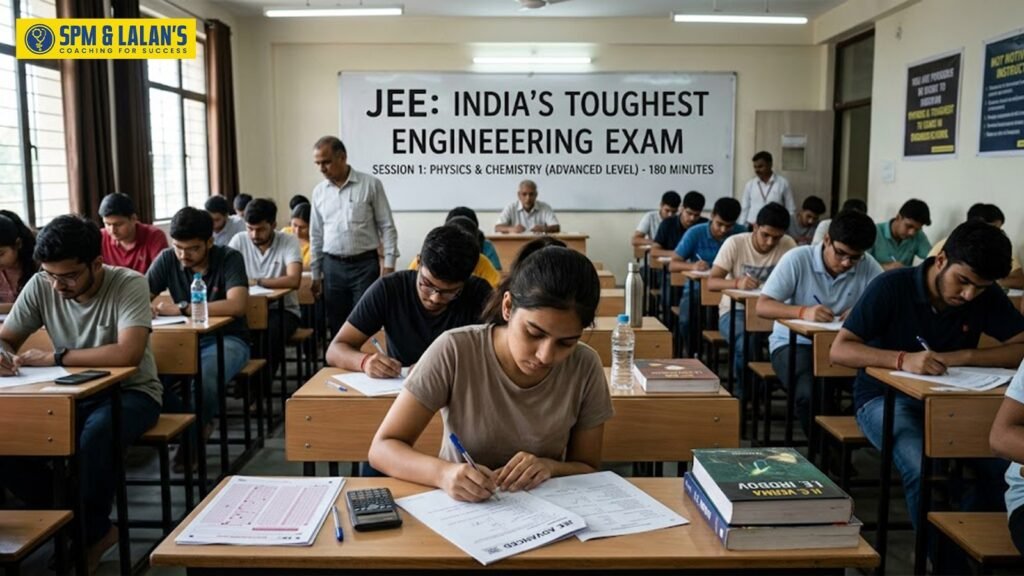
What Is the JEE Exam?
JEE stands for the Joint Entrance Examination. It is India’s premier engineering entrance exam for undergraduate courses. Through this exam, students can seek admission to many leading engineering institutes.
The JEE exam has two stages:
- JEE Main
The National Testing Agency (NTA) conducts JEE Main. Its scores are used for admission to NITs, IIITs, and other participating institutes. Moreover, eligible Indian students must qualify for JEE Main before appearing for JEE Advanced.
- JEE Advanced
One of the IITs conducts JEE Advanced under the Joint Admission Board. The IIT JEE Advanced examination is used for admission to undergraduate programmers at the IITs. In addition, IISc Bengaluru uses JEE Advanced ranks for eligible BTech admissions through JoSAA
Why Is JEE Considered India’s Premier Engineering Entrance Exam?
JEE is one of the toughest engineering entrance exams in India. This is because many students compete for a limited number of seats. Moreover, the exam requires strong knowledge and regular practice. Here are the main reasons why JEE is highly competitive:
- A Large Number of Candidates
Lakhs of students appear for JEE Main every year. Therefore, even a small difference in marks can affect a student’s percentile and rank.
- Limited Seats
The number of seats at top institutes is limited. However, the number of students applying for these seats is very high. As a result, the competition becomes intense.
- A Wide Syllabus
Students must study Physics, Chemistry, and Mathematics from Classes 11 and 12. Therefore, they need enough time to complete and revise the syllabus.
- Concept-Based Questions
Many JEE questions do not test memory alone. Instead, they check whether students can understand and apply a concept correctly.
- Speed and Accuracy
Students must solve many questions within a fixed time. At the same time, they must avoid careless errors and unnecessary negative marks.
JEE Main vs JEE Advanced: What Is the Difference?
This premier engineering entrance exam has two different stages. Therefore, the following exam overview explains the main differences between JEE Main and JEE Advanced.
- Conducting Body
The National Testing Agency conducts JEE Main. On the other hand, one of the IITs conducts JEE Advanced under the Joint Admission Board.
- Main Purpose
JEE Main is used for admission to NITs, IIITs, and other participating institutes. It also helps eligible students qualify for JEE Advanced. Meanwhile, JEE Advanced is mainly used for admission to undergraduate courses at the IITs.
- Frequency
JEE Main is generally held in two sessions during the year. However, JEE Advanced is held only once a year.
- Number of Papers
Students seeking admission to B.E. or B.Tech courses take one paper in JEE Main. It covers Physics, Chemistry and Mathematics. In contrast, JEE Advanced has two compulsory papers. Both papers include questions from Physics, Chemistry and Mathematics.
- Skills Tested
JEE Main tests subject knowledge, speed, accuracy, and problem-solving ability. JEE Advanced places greater emphasis on conceptual depth, analytical thinking and multi-step problem-solving.
- Result
A suitable JEE Main rank can help candidates secure admission to participating institutes or become eligible for JEE Advanced. A qualifying JEE Advanced rank allows candidates to participate in the IIT seat-allocation process, provided they satisfy all admission requirements.
What is the JEE Eligibility Criteria
The two stages of this premier engineering entrance exam have different eligibility rules. Therefore, students should understand the requirements for JEE Main and JEE Advanced. The rules may also change from year to year. So, students should always check the latest official notice before applying.
Eligibility for JEE Main 2026
- Class 12 Year
Students who passed Class 12 or an equal exam in 2024 or 2025 could apply for JEE Main 2026. Students appearing for their Class 12 exam in 2026 were also eligible.
- Required Subjects
For B.E. or B.Tech admission, students need Physics and Mathematics in Class 12. They must also study an eligible third subject. This subject may be Chemistry, Biology, Biotechnology or a Technical Vocational subject. However, the final requirements may depend on the rules of each institute.
- Age Limit
The NTA does not set an age limit for appearing in JEE Main. However, some institutes may have their own age rules for admission. Therefore, students should check the rules of their preferred institutes.
- Number of Attempts
Students can appear for JEE Main for three years in a row. This period begins in the year they pass Class 12. Moreover, if JEE Main is held in two sessions, students can appear in both sessions during an eligible year.
Eligibility for JEE Advanced 2026
- JEE Main Performance
Indian students must first perform well in the B.E./B.Tech paper of JEE Main 2026. They must be among the top 2,50,000 successful candidates across all categories.
- Age Requirement
Students should have been born on or after 1 October 2001. However, SC, ST and PwD candidates receive a relaxation of five years.
- Number of Attempts
A student can attempt JEE Advanced a maximum of two times. These attempts must be in two consecutive years.
- Class 12 Appearance
Students must follow the official rule about the year in which they first appeared for Class 12 or an equal exam.
- Previous IIT Admission
In general, a student should not have been admitted to an IIT earlier. However, the official rules allow a few special exceptions.
Class 12 Marks for IIT Admission
Students must meet one of the following conditions:
- They must score at least 75% in Class 12.
- They must be within the category-wise top 20 percentile of their board
However, the minimum mark requirement is 65% for SC, ST, and PwD students. It is important to understand that exam eligibility and admission eligibility are not always the same. Therefore, students should check both sets of rules before applying.
JEE Main Exam Pattern
JEE Main is the first stage of this premier engineering entrance exam. It has separate papers for B.E./B.Tech, B.Arch and B.Planning. Therefore, students should choose the paper that matches their preferred course.
| Particular | JEE Main 2026 Exam Pattern |
| Paper 1 | B.E. and B.Tech |
| Paper 1 subjects | Mathematics, Physics and Chemistry |
| Paper 1 questions | 75 questions |
| Paper 1 maximum marks | 300 marks |
| Paper 2A | B.Arch |
| Paper 2A subjects | Mathematics, Aptitude Test and Drawing Test |
| Paper 2A questions | 77 questions |
| Paper 2A maximum marks | 400 marks |
| Paper 2B | B.Planning |
| Paper 2B subjects | Mathematics, Aptitude Test and Planning-Based Questions |
| Paper 2B questions | 100 questions |
| Paper 2B maximum marks | 400 marks |
| Examination mode | Computer-Based Test (CBT). However, the B.Arch Drawing Test is conducted offline on paper. |
| Duration for one paper | 3 hours |
| Duration for both B.Arch and B.Planning | 3 hours and 30 minutes |
| Correct answer | +4 marks |
| Incorrect answer | −1 mark |
| Unanswered question | 0 marks |
JEE Advanced 2026 Exam Pattern
JEE Advanced is the second stage of this premier engineering entrance exam. It has two compulsory papers: Paper 1 and Paper 2. Students must appear for both papers to be considered for a rank.
| Particular | JEE Advanced 2026 Exam Pattern |
| Number of papers | Two papers: Paper 1 and Paper 2 |
| Compulsory papers | Students must appear for both papers to be considered for a rank. |
| Subjects | Physics, Chemistry and Mathematics |
| Examination mode | Computer-Based Test (CBT) |
| Duration of Paper 1 | 3 hours |
| Duration of Paper 2 | 3 hours |
| Total examination time | 6 hours |
| Question types | Single-correct, multiple-correct and numerical-answer questions |
| Skills tested | Conceptual understanding, reasoning, analysis and problem-solving |
| Marking scheme | Full or partial marks may be awarded, depending on the question type. |
| Negative marking | Some questions may carry negative marks, while others may not. |
| Question languages | English and Hindi |
How Does JoSAA Counselling Work?
Qualifying an examination does not automatically secure a seat. Candidates must participate in the Joint Seat Allocation Authority counselling process and meet the admission rules of the participating institutes. After qualifying for this premier engineering entrance exam, students must complete the JoSAA counselling process. However, getting a rank does not automatically guarantee a seat.
This part of the IIT admission guide is especially important because the order in which candidates arrange their choices can directly influence the seat allotted to them.
Step 1: Check Eligibility
Candidates with an eligible JEE Advanced rank can register for IIT programmes and other notified options. Candidates with a valid JEE Main rank can compete for seats at NITs, IIITs, IIEST and other participating institutes.
Step 2: Register Online
Eligible candidates must register on the official JoSAA portal using the required examination details. Appearing for JEE Main or JEE Advanced does not replace JoSAA registration.
Step 3: Fill and Arrange Choices
Candidates can select their preferred institutes and programmes. These options should be placed in their genuine order of preference.
A desirable programme should not be placed lower simply because its previous closing rank appears difficult to reach. The system considers the candidate’s preference order while allocating a seat.
Step 4: Review and Lock Choices
Candidates should check every selected option carefully and lock their choices before the deadline. Once the choice-filling window closes, they cannot freely add, delete or rearrange their options.
Step 5: Check Seat Allotment
JoSAA conducts multiple seat-allotment rounds. A seat is allotted based on the candidate’s rank, category, eligibility, order of choices and seat availability.
Step 6: Select Freeze, Float or Slide
After receiving a seat, the candidate must select one of the following options:
• Freeze: Accept the allotted seat and stop participating in further upgrades.
• Float: Accept the allotted seat while remaining open to a higher-preference programme at the same or another institute.
• Slide: Accept the allotted seat while remaining open to a higher-preference programme within the same institute.
Step 7: Pay the Seat-Acceptance Fee
Candidates receiving a seat for the first time must pay the required seat-acceptance fee within the deadline. Failure to complete the payment may lead to cancellation of the allotted seat.
Step 8: Upload Documents
Candidates must upload the required certificates and documents for verification. These may include Class 10 and 12 mark sheets, identity proof, category certificates and a medical certificate.
Step 9: Participate in Later Rounds
A candidate choosing Float or Slide may receive a higher-preference seat in a later round. If upgraded, the new allotment replaces the previously accepted seat.
Step 10: Complete Admission at the Institute
After seat allocation, candidates must follow the allotted institute’s instructions regarding the remaining fees, document verification, and online or physical reporting.
How to Prepare for JEE Effectively
Preparing for this premier engineering entrance exam requires regular effort and clear planning. Therefore, a useful preparation strategy should include concept building, question practice, revision, and test analysis. Students who need structured classroom guidance, regular assessments and doubt-solving support can also consider joining a reliable JEE coaching centre in Guwahati.
- Build the Basics First
Divide the Classes 11 and 12 syllabus into realistic weekly targets. Understand the underlying idea before attempting advanced problems. NCERT textbooks are particularly useful for learning fundamental concepts and studying Chemistry. Suitable problem books and teacher-provided materials can then help students progress towards JEE-level applications.
- Practise in Stages
After completing a concept, begin with straightforward questions and gradually move towards mixed and advanced problems. Whenever an answer is wrong, identify the actual reason. It may be a weak concept, an incorrect method, a calculation error or a rushed reading of the question. Understanding the cause of an error is more valuable than simply checking the correct answer.
- Use Previous Years’ Questions and Mock Tests
Previous years’ questions help students understand how familiar concepts are tested in the examination. Chapter-wise tests are useful while covering the syllabus, while full-length mock tests become more valuable after most topics have been studied.
The objective should not be limited to collecting test scores. Students should use every test to improve question selection, speed, accuracy and time management.
Students can use previous years’ papers to understand question patterns, practise important topics and strengthen their examination preparation.
Ready to evaluate your preparation? Attempt a structured mock examination and identify the subjects and chapters that need further improvement.
- Maintain a Mistake Notebook
Students can record recurring calculation errors, forgotten concepts, incorrect assumptions and avoidable guesses in a separate notebook. Reviewing this notebook before the next test can prevent the same mistakes from becoming habits.
- Revise Throughout the Year
Students should prepare concise notes containing formulas, reactions, exceptions and useful problem-solving methods. Weekly and monthly revision should be part of the study plan. Postponing all revision until the entire syllabus is completed can make retention more difficult.
- Practice Consistency
A sustainable routine is more effective than occasional and exhausting study sessions. Adequate sleep, short breaks and light physical activity can support concentration. Students should also clear their doubts promptly instead of allowing confusion to accumulate.
Common JEE Preparation Mistakes to Avoid
- Ignoring foundational concepts and moving too quickly to advanced questions
- Memorising formulas without understanding where or why they apply
- Neglecting Class 11 chapters while focusing only on the current school syllabus
- Avoiding weak chapters because they feel difficult or uncomfortable
- Switching repeatedly between too many books, courses or teachers
- Taking mock tests but failing to analyse mistakes and time usage
- Guessing unnecessarily in sections carrying negative marks
- Revising irregularly and forgetting previously completed chapters
Students looking for academic guidance, structured preparation programmes and information about engineering entrance coaching can explore the courses and learning support available at SPM & Lalan
Conclusion
JEE may seem challenging, but the journey becomes easier with clear planning and regular effort. Therefore, students should understand the exam stages, follow a practical preparation strategy, and revise often. Most importantly, they should stay consistent, learn from mistakes, and check official updates before beginning the admission process.
Students and parents who would like to visit the institute can find our Guwahati centre on Google Maps for directions and location details.
Frequently Asked Questions (FAQs)
Q1. Can a Student Prepare for JEE Without Coaching?
Yes, a student can prepare independently by following the official syllabus, choosing reliable resources, practising questions consistently, and analysing mock tests. However, the study plan must be realistic, and the student should have a dependable way to resolve difficult concepts and doubts without delay.
Q2. Is Qualifying JEE Advanced Enough to Secure an IIT Seat?
No. A qualifying rank makes a candidate eligible to participate in the relevant admission process, but seat allotment depends on rank, category, programme preferences, seat availability, and fulfilment of all admission criteria. Candidates must also complete JoSAA registration, payment, document verification and institute reporting within the prescribed deadlines.

This article is written by the SPM & LALAN’S Content Team, a group of skilled writers, researchers, and content strategists passionate about creating accurate, reliable, and student-friendly educational content. Every article is thoroughly researched, fact-checked, and updated to ensure readers receive trustworthy and relevant information. The goal is to help students make informed academic decisions through clear, well-researched, and easy-to-understand content.