
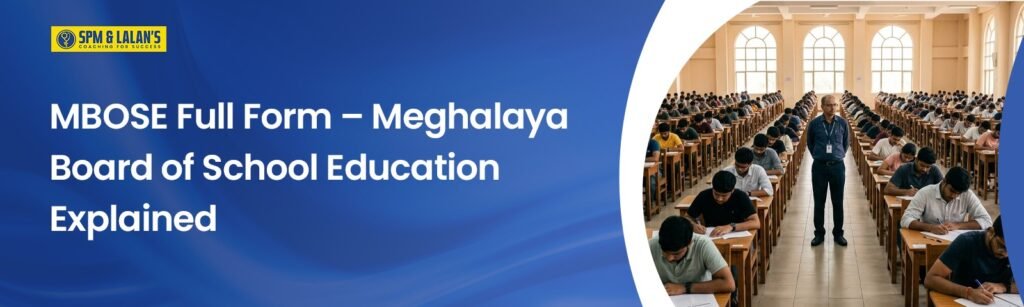
The Meghalaya Board of School Education, widely known as MBOSE, has been a cornerstone of academic governance in Meghalaya since its establishment in 1973. Headquartered in Tura, the board was set up under the 1973 MBOSE Act, with the goal of regulating, supervising, and maintaining educational standards in the state. Over the decades, the board has not only administered school examinations but has also played a crucial role in framing syllabi, publishing textbooks, and providing distance education to students across the state.
Understanding the Meghalaya Board of School Education is essential for students, parents, and educators For more academic guidance and resources, students can explore platforms like SPM & Lalans. because it directly impacts the academic journey from middle school to senior secondary levels. From SSLC (Class 10) to HSSLC (Class 12), every academic aspect is influenced by the board’s policies, syllabus design, and examination guidelines.
Overview of Meghalaya Board of School Education (MBOSE)
The Meghalaya Board of School Education (MBOSE) is a state governmental board of education responsible for school-level education in Meghalaya. Its formation in 1973 aimed to standardize education, ensuring consistent learning outcomes across all affiliated schools. The board functions in English, and its official website is mbose.in, which provides essential updates regarding exams, syllabus, results, and notifications.
| Feature | Details |
| Full Form | Meghalaya Board Of School Education (MBOSE) |
| Formation | 1973 |
| Headquarters | Tura, India |
| Official language | English |
| Type | State Governmental Board of Education |
| Website | mbose.in |
Exams Conducted by MBOSE
The MBOSE conducts two major examinations every year:
1. MBOSE SSLC (Class 10)
The SSLC exam is administered to Class 10 students across Meghalaya. The board supervises, regulates, and ensures smooth execution of the exams. Students appearing for these exams must familiarize themselves with the MBOSE syllabus, marking scheme, and previous years’ question papers to perform well.
MBOSE SSLC Exam Statistics:
| Year | Overall Pass % | Girls % | Boys % | No. of Students Appeared |
| 2018 | 83.89 | 83.41 | 84.49 | 50,077 |
| 2017 | 54.10 | 79.12 | 80.84 | 50,974 |
2. MBOSE HSSLC (Class 12)
The HSSLC exam is designed for Class 12 students. It ensures that students from Science, Arts, and Commerce streams are assessed accurately based on their academic preparedness.
MBOSE HSSLC Pass Percentage Pattern:
| Year | Class 10 (SSLC) | Class 12 (HSSLC) |
| 2018 | 83.89 | 74.58 (Science)81.62(Arts)79.84 (Commerce) |
| 2017 | 54.04 | 76.76 (Science)75.38 (Arts)71.87 (Commerce) |
By analyzing these statistics, students can identify trends in exam performance and plan their preparation accordingly.
MBOSE Textbooks
The Meghalaya Board of School Education is committed to delivering high-quality education to students. Textbooks are meticulously prepared by subject experts, keeping in mind the latest curriculum and examination trends. These textbooks ensure conceptual clarity and provide a structured learning path for students from Class 1 to Class 12.
Transitioning from textbooks to exam preparation, students are advised to follow the MBOSE syllabus strictly, as it forms the backbone of exam readiness and helps in strategic revision.
MBOSE Syllabus 2026
The Meghalaya Board of School Education designs the syllabus for all affiliated schools, which must be strictly followed. MBOSE ensures that every academic topic, chapter, and unit aligns with learning objectives and examination requirements.
1. MBOSE HSLC Syllabus 2026 (Class 10)
Students can download the MBOSE HSLC Syllabus 2026 to know all the subjects, units, and chapters for exam preparation. The syllabus includes:
- Mathematics: Algebra, Geometry, Statistics, Probability
- Science: Physics, Chemistry, Biology
- English: Reading Skills, Writing Skills, Textbook, Supplementary Reader
- Social Science: History, Geography, Civics, Economics
2. MBOSE HSSLC Syllabus 2026 (Class 12)
The MBOSE HSSLC Syllabus 2026 is more comprehensive. It includes:
- Mathematics: Sets, Functions, Trigonometry, Calculus, Statistics, Probability
- Physics: Electrostatics, Current Electricity, Magnetic Effects, Optics, Atomic Structure
- Chemistry: Solid State, Electrochemistry, Chemical Kinetics, Organic Chemistry, Biomolecules
- Biology: Genetics, Ecology, Biotechnology, Human Welfare
- English: Reading, Writing, Literature
- History: Ancient, Medieval, Modern, Map Work
Additionally, MBOSE has introduced new subjects for Class 12 students:
| Subject | Syllabus links |
| Horticulture | Click to download |
| Informatics Practices | Click to download |
| Music | Click to download |
| Physical Education | Click to download |
| Psychology | Click to download |
| Sociology | Click to download |
| Travel & Tourism | Click to download |
MBOSE Exam Routine 2026
The Meghalaya Board of School Education released the official exam routine for SSLC and HSSLC 2026.
- SSLC Exams: January 30 to February 11, 2026
- HSSLC Exams: February 18 to March 13, 2026
The routine contains detailed exam dates, subject codes, and day-wise instructions, which help students plan their study schedule effectively.
MBOSE Exam Routine 2026
The Meghalaya Board of School Education released the official exam routine for SSLC and HSSLC 2026.
- SSLC Exams: January 30 to February 11, 2026
- HSSLC Exams: February 18 to March 13, 2026
The routine contains detailed exam dates, subject codes, and day-wise instructions, which help students plan their study schedule effectively.
MBOSE Previous Years’ Question Papers 2026
Practicing previous years’ question papers is essential for effective preparation. It helps students:
- Understand the exam structure
- Revise topics thoroughly
- Improve speed and accuracy
Students can download the MBOSE previous years’ papers from the official website.
How to download:
- Visit mbose.in
- Scroll down to year-wise links
- Click on the respective class and year
- Download PDF or take a printout
To further improve your performance and exam confidence, students can also practice advanced mock tests.To further improve your performance and exam confidence, students can also practice advanced mock tests.
MBOSE Admit Card 2026
The MBOSE admit card is mandatory for appearing in exams. Regular students collect it from their schools, while private candidates can download it online.
The admit card contains:
- Exam dates and day
- Subject names and codes
- Personal details (DOB, father’s name)
- Exam guidelines
Students must carry it to the exam center to avoid any last-minute issues.
MBOSE Result 2026
The Meghalaya Board of School Education will release SSLC results in March 2026, while HSSLC results will be declared in May 2026 for all streams.
- Results are available on mbose.nic.in and megresults.nic.in
- Students need credentials like an admit card number to check results
- Any discrepancies must be reported to the respective schools immediately
Scholarships by Meghalaya Board
The Vidyadhan Scholarship Program 2025–26 supports meritorious students from economically disadvantaged backgrounds:
- Eligibility: 75% marks in Class 10 (60% for PwD students), annual family income ≤ Rs 3 lakh
- Scholarship Amount: Rs 10,000 per year for Classes 11 and 12
- Coverage: Tuition, books, study materials
This initiative encourages deserving students to continue their education without financial stress.
MBOSE 2026 Preparation Tips
Students can maximize their scores by following these tips:
- Go through the MBOSE syllabus 2026 thoroughly and prioritize high-weightage topics
- Set weekly targets and track progress consistently
- Solve sample papers and previous years’ papers with a timer
- Stay in touch with teachers to clarify doubts
- Revise regularly to ensure long-term retention
More About MBOSE
1. Role of MBOSE in Holistic Development
- MBOSE emphasizes not only academics but also co-curricular activities like debates, quizzes, sports, and cultural events.
- Schools under MBOSE are encouraged to develop life skills, critical thinking, and creativity in students.
- Highlight the importance of extracurricular performance in scholarships and admission considerations.
2. Digital and Online Resources
- MBOSE now promotes digital learning platforms for students in remote areas.
- Previous years’ question papers, syllabus PDFs, and notifications can be accessed online.
- Encourage students to use online mock tests, video lectures, and e-books for better preparation.
3. Stream-Specific Preparation Tips
- Science Stream: Focus on practicals, numerical problem-solving, and diagrams. Practice past HSSLC papers carefully.
- Arts Stream: Pay attention to essays, map work, and history timelines. Prepare for descriptive answers.
- Commerce Stream: Practice case studies, accountancy problems, and business calculations thoroughly.
4. Time Management Tips
- Create a weekly timetable prioritizing subjects and topics by difficulty and weightage.
- Include short revision sessions every day to retain important formulas, dates, and concepts.
- Allocate separate practice time for practicals and theory.
5. Exam-Day Strategies
- Read all questions carefully and attempt the easy questions first.
- Allocate time according to the marks distribution to avoid a last-minute rush.
- Keep all stationery ready, along with the admit card and ID, a day before.
6. Importance of Internal Assessment
- MBOSE includes internal assessment marks (e.g., SSLC: 20 marks, HSSLC: 30 marks).
- Encourage consistent performance in assignments, projects, and class participation, as they can significantly boost final scores.
7. Tips for Using Previous Years’ Papers Effectively
- Solve papers under exam conditions to improve speed and accuracy.
- Analyze mistakes and maintain an error log to avoid repeating them.
- Identify trending topics that frequently appear in exams.
8. Scholarship and Financial Support
- Highlight other scholarship opportunities besides Vidyadhan, if available.
- Emphasize how scholarships reduce financial stress and encourage continued studies.
9. Importance of Time-Bound Revision
- Suggest revision cycles: first revision after finishing a chapter, second after finishing the subject, third during the last 10 days.
- Use techniques like flashcards, mind maps, and self-quizzes for effective recall.
10. Career Guidance and Post-HSSLC Options
- Mention that MBOSE results impact college admissions, entrance exams, and professional courses.
- Students planning for medical careers should also understand state quota eligibility. You can check detailed guidelines on Meghalaya NEET State Quota Eligibility.
11. Parent and Teacher Involvement
- Encourage parents to monitor study schedules and provide emotional support.
- Teachers can give extra guidance sessions, doubt-clearing classes, and mock tests to improve student performance.
12. MBOSE for Private Candidates
- Include tips for private or repeat candidates on registration, syllabus coverage, and exam preparation.
- Stress the importance of timely admit card download and adherence to rules.
13. Frequently Overlooked Tips
- Maintain good health, proper sleep, and diet during preparation.
- Practice writing skills, diagrams, and labelling to improve presentation marks.
- Join study groups for peer support and a better understanding of concepts.
Conclusion
The Meghalaya Board of School Education (MBOSE) has significantly contributed to the academic landscape of Meghalaya. By providing structured syllabi, standardized textbooks, scholarships, and comprehensive exam guidance, the board ensures that students have the necessary tools to succeed academically. Students who understand the board’s functioning, follow the syllabus meticulously, and utilize previous years’ question papers will be well-prepared to excel in SSLC and HSSLC examinations. Students can further enhance their preparation by enrolling in expert-led online courses and coaching programs.
In essence, the Meghalaya Board of School Education remains a guiding light for students aiming for academic excellence in the state.
Frequently Asked Questions
Q1: When will the MBOSE SSLC result 2026 be declared?
A1: The MBOSE SSLC 2026 results are expected in March 2026, and students can access them online at mbose.nic.in or megresults.nic.in. The result will contain individual subject scores and overall percentage. Checking the result immediately after release is important for college admissions, scholarship applications, and future planning. Students are advised to download both soft and hard copies of their results. In case of discrepancies such as incorrect marks, personal details, or missing subjects, students should contact their respective schools without delay. Additionally, understanding the subject-wise performance can help students identify areas that need improvement and plan remedial studies for future exams.
Q2: Where can I download the MBOSE HSSLC syllabus 2026?
A2: The HSSLC syllabus 2026 is available on mbose.in. PDFs are provided for every stream,Science, Arts, Commerce, and newly introduced subjects like Psychology, Horticulture, and Travel & Tourism. Students should download and organize the syllabus by subject, then prepare a detailed study plan prioritizing difficult and high-weightage topics. Using the official syllabus ensures comprehensive coverage, reduces confusion, and allows students to track their progress efficiently. Following the official syllabus also ensures alignment with the board’s exam expectations, making preparation more effective and less stressful.
Q3: How can I prepare for MBOSE exams in one month?
A3: Preparing for MBOSE exams in a month requires strategic planning, focused study, and disciplined execution. Start by identifying high-weightage topics in each subject and allocate more time to difficult areas. Use previous years’ question papers to understand exam patterns, frequently asked questions, and marking schemes. Divide your day into dedicated sessions for theory, practice, and revision, ensuring 6–8 hours of focused study daily. Make concise notes for last-minute revision and avoid distractions. Regularly review progress against weekly targets, and clarify doubts with teachers or peers promptly. Additionally, take mock tests under timed conditions to simulate the exam environment, which enhances confidence and exam readiness. This structured approach ensures that even in a limited timeframe, students can cover the syllabus comprehensively and perform well in exams.