
NEET 2026 is just around the corner. Staying updated with the latest NTA and NMC guidelines is more important than ever. You can also explore trusted resources like coaching institute guwahati for expert guidance and preparation strategies. Every year, thousands of aspiring doctors lose their chance simply because they miss a small eligibility detail. Understanding the NEET 2026 eligibility criteria completely can save you from last-minute surprises. The National Testing Agency (NTA) conducts NEET on behalf of the National Medical Commission (NMC). All rules are governed by their official notifications.
In this article, we will look into the NEET 2026 age limit and qualification requirements. We will also discuss the NTA NEET exam attempt rules.
Not sure where you stand? Try a real-time mock test now.
NEET 2026 Age Limit
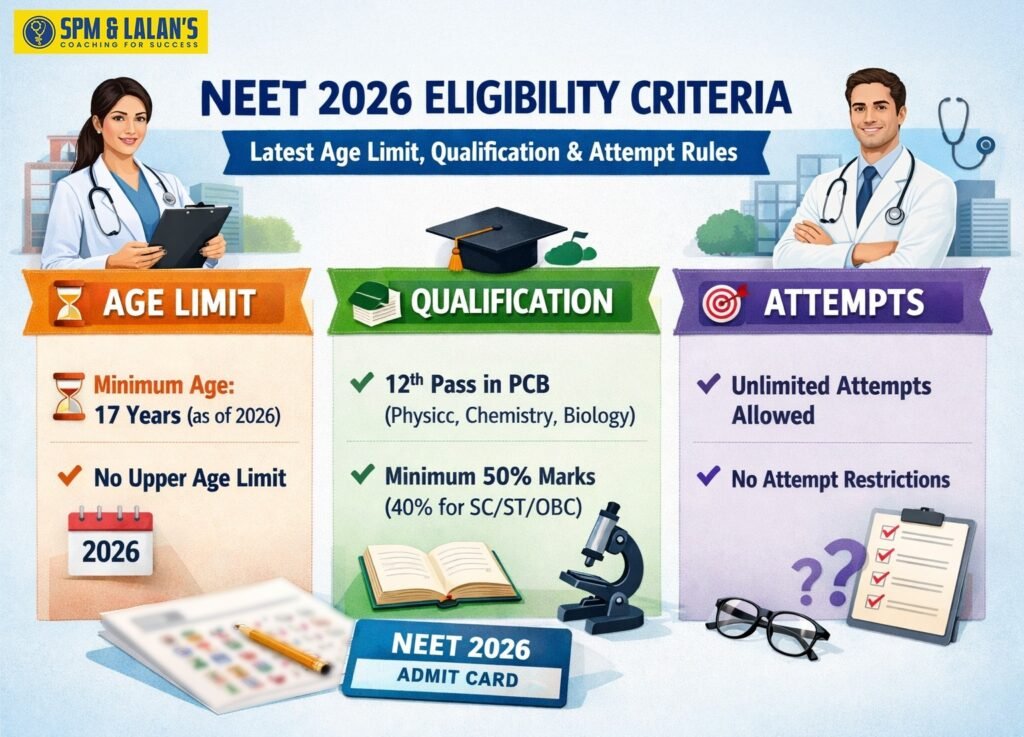
The minimum age requirement for NEET 2026 eligibility criteria is 17 years at the time of admission, or turning 17 on or before December 31, 2026.
In practical terms, candidates must be born on or before December 31, 2009, to be eligible to appear for NEET 2026. This is a strict requirement set by the NMC. Is there an upper age limit for NEET 2026? No. As per the current NMC guidelines, there is no upper age limit for NEET 2026. Earlier, there was an age cap of 25 years (30 for reserved categories), but the Supreme Court of India struck this down. Any candidate above 17 years can now apply.
Key Age Limit Points at a Glance
- Minimum age: 17 years as of December 31, 2026
- Date of birth cut-off: On or before December 31, 2009
- No maximum/upper age limit as per current NMC rules
- Age is verified using Class 10 board certificate or a government-issued birth certificate
Educational Qualifications for NEET 2026
The NTA NEET 2026 qualification requirement is that candidates must have passed Class 12 (10+2) or an equivalent examination from a recognised board.
The following subjects are mandatory in Class 12:
1. Physics
2. Chemistry
3. Biology or Biotechnology
4. English
Candidates appearing in Class 12 exams in 2026 are also eligible to apply for NEET 2026 provisionally. However, they must submit their passing certificate and marksheet before the counselling process.
Minimum PCB Percentage Required
The minimum marks for NEET 2026 eligibility in PCB (Physics, Chemistry, Biology) are as follows:
| Category | Minimum PCB Aggregate % | Who It Applies To |
| General / EWS | 50% | Unreserved candidates |
| OBC / SC / ST | 40% | Reserved category students |
| PwD (General) | 45% | Persons with Disability (General) |
| PwD (OBC/SC/ST) | 40% | Persons with Disability (Reserved) |
These percentages are calculated based on the aggregate marks in Physics, Chemistry, and Biology/Biotechnology only. English and other subjects are not counted in this calculation. PwD candidates must also ensure they have valid certification. You can read this detailed guide on PwD certificate for NEET to understand the process and requirements.
NEET 2026 Attempt Limit
Good news for all aspirants: As per the latest NTA guidelines, there is currently no limit on the number of attempts for NEET 2026. Candidates can appear for NEET as many times as they wish, provided they meet the age and qualification criteria.
The NEET 2026 attempt limit was previously restricted to three attempts, but this rule was removed after a legal review and the NMC’s revised policy. This allows gap-year students and repeat aspirants to prepare without fear of running out of chances.
Who Benefits from Unlimited Attempts?
1. Gap-year students appearing for the second or third time
2. Students who were unable to score well in previous attempts
3. Working professionals or mature aspirants aiming for a career in medicine
Eligibility for NIOS and Private Candidates
Students who have appeared through the National Institute of Open Schooling (NIOS) or state open schools are eligible to appear for NEET 2026, provided they have studied Physics, Chemistry, and Biology/Biotechnology as part of their curriculum.
The NMC and the Supreme Court have confirmed that open school students cannot be denied NEET 2026 eligibility solely on the basis of their board type. However, they must meet the minimum marks criteria, just like regular school students.
1. NIOS candidates with PCB subjects are eligible
2. State open school students are also eligible if the board is recognised by COBSE
3. Vocational stream students must check individual board eligibility rules
NEET 2026 Eligibility for NRI and Foreign Nationals
The NEET 2026 eligibility for NRI candidates follows the same academic and age criteria as Indian nationals. NRI students who have completed or are completing their Class 12 abroad must ensure the following:
1. The international board must be equivalent to India’s Class 12 standard
2. Biology, Physics, and Chemistry must be part of the curriculum
3. An equivalence certificate from the Association of Indian Universities (AIU) may be required
4. NRI candidates may apply under the NRI quota in medical colleges, which has a separate counselling process
Foreign nationals aspiring to study MBBS in India must also qualify for NEET, as per the NMC regulations. They are advised to contact the Ministry of External Affairs and the concerned university for the exact quota and admission procedures.
Conclusion: Start Your Preparation Today
Understanding the NEET 2026 eligibility criteria is the very first step toward a successful medical career. From the 17-year age rule to subject requirements and the freedom of unlimited attempts, the rules in 2026 are more inclusive than ever before. Whether you are a first-time aspirant or a determined repeater, the path to MBBS and BDS seats across India begins with NEET. Stay updated with the official NTA website (nta.ac.in) and the NMC guidelines for the latest notifications.
Start your NEET 2026 preparation early. Build strong concepts in Physics, Chemistry, and Biology, practice with previous years’ papers, or consider joining NEET coaching in Guwahati for structured guidance and aim for excellence. India’s top medical colleges are waiting for students like you. If you’re aiming for a specific score range, check out this guide on NEET 500–600 marks colleges and rank prediction to plan your strategy better.Good luck!
Frequently Asked Questions (FAQs)
1. Can I appear for NEET 2026 if I have a gap year?
Yes, absolutely. There is no restriction on gap-year students appearing for NEET 2026. You are fully eligible as long as you meet the age and educational qualification criteria. Many NEET toppers have cleared the exam after one or more gap years. Your focus should be on preparation, not eligibility concerns.
2. Is Mathematics required for NEET 2026 eligibility?
No. Mathematics is not required for NEET 2026 eligibility. The mandatory subjects are Physics, Chemistry, Biology (or Biotechnology), and English. Students from the PCM stream (Physics, Chemistry, Mathematics) without Biology are not eligible for NEET unless they also studied Biology as an additional subject.
3. I am appearing for Class 12 in 2026. Can I apply for NEET 2026?
Yes. Students who are currently in Class 12 and appearing in the 2026 board exams can apply for NEET 2026 provisionally. You will be required to submit your Class 12 result and passing certificate at the time of counselling. If you do not pass or do not meet the minimum PCB percentage, your NEET result will be considered void for admission purposes.
4. What documents are required to prove age eligibility for NEET 2026?
To prove age eligibility, you will typically need any one of the following documents:
1. Class 10 (Matriculation) Board Certificate (most widely accepted)
2. Government-issued Birth Certificate
3. Aadhar Card or Passport (as supporting document)
The Class 10 board certificate is the most reliable and universally accepted document for age proof in NEET applications. Ensure your date of birth is clearly mentioned and matches your NEET application form exactly.
5. Are vocational students eligible for NEET 2026?
Vocational stream students may be eligible for NEET 2026 if they have studied Physics, Chemistry, and Biology as core subjects under their vocational curriculum. However, eligibility depends on whether their specific vocational course is recognised by the Central Board of Secondary Education (CBSE) or their respective state board as equivalent to the science stream.
It is strongly recommended that vocational students verify their eligibility directly with NTA or refer to the official NEET 2026 Information Bulletin before applying.