

Choosing the right subjects after Class 10 is an important decision. It becomes even more important for students who dream of studying at an IIT. The required subjects for engineering aspirants build the base for JEE Main and JEE Advanced. Students should mainly focus on Physics, Chemistry, and Mathematics. These three subjects are commonly known as PCM. However, English and an optional subject also play a role in board results. This simple eligibility guide explains which subjects students should choose and how each one supports their IIT journey.
What Are the Required Subjects for Engineering Aspirants?
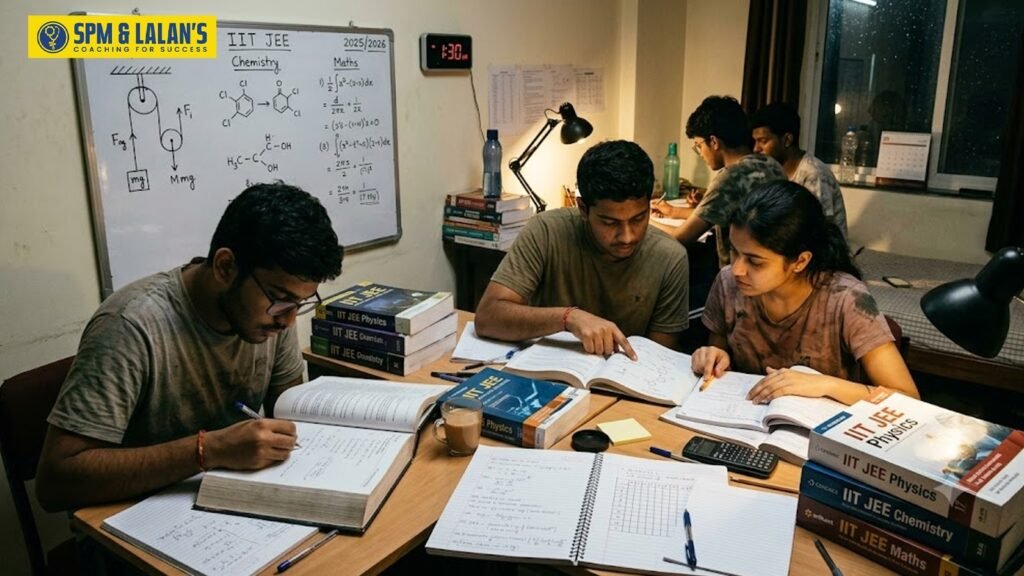
Students who want to enter an IIT must study Physics, Chemistry, and Mathematics in Class 11 and Class 12. These subjects form the core of the science stream for engineering students.
The official JEE Advanced 2026 rules state that Physics, Chemistry, and Mathematics must be compulsory subjects in Class 12 or an equivalent examination. Moreover, both JEE Advanced papers contain separate sections for these three subjects. Students should review the official IIT JEE Advanced syllabus carefully to understand the Physics, Chemistry, and Mathematics topics covered in the examination. Therefore, students must prepare all three subjects well
| Subject | Why Is It Important? |
| Physics | Builds understanding of motion, energy, electricity, heat, and machines |
| Chemistry | Explains materials, reactions, atoms, and industrial processes |
| Mathematics | Develops calculation, logic, and problem-solving skills |
| English or another language | Helps students meet board requirements and improve communication |
| Optional subject | Supports board marks and may provide useful extra knowledge |
Why Is Physics Essential?
Physics helps students understand how the world works. It explains motion, force, light, heat, sound, electricity, and energy. These ideas are also used in machines, vehicles, buildings, computers, and space technology.
For example, mechanical engineering uses the laws of motion. Electrical engineering uses ideas related to current and circuits. Civil engineering uses force, pressure, and balance.
Therefore, Physics is one of the main required subjects for engineering aspirants. However, students should not simply memorise formulas. They should first understand the idea behind each formula. After that, they should practise numerical questions.
A good Physics routine should include:
- Reading the theory carefully
- Understanding diagrams and graphs
- Learning important formulas
- Solving basic questions first
- Moving towards JEE-level problems
- Reviewing mistakes every week
Why Is Chemistry Important?
Chemistry studies matter and how it changes. It covers atoms, elements, chemical bonds, reactions, metals, fuels, and many other materials.
Engineering students use Chemistry in several fields. Chemical engineers study reactions and industrial processes. Materials engineers work with metals, plastics, and advanced materials. Environmental engineers study water, pollution, and waste treatment.
Thus, Chemistry is another of the required subjects for engineering aspirants. It is usually divided into Physical, Organic, and Inorganic Chemistry. Each part needs a different study method.
Physical Chemistry requires concepts and calculations. Organic Chemistry requires students to understand reactions. Inorganic Chemistry needs careful reading and regular revision. NCERT books are especially useful for building a clear base.
Why Is Mathematics Important?
Mathematics is the language of engineering. It helps students measure, compare, calculate, and find solutions. Almost every branch of engineering uses mathematical ideas.
For example, computer science uses logic and algorithms. Civil engineering uses geometry and measurement. Electrical engineering uses calculus and equations. Data science also depends on probability and statistics.
For this reason, Mathematics is one of the most important required subjects for engineering aspirants. Students should practise it regularly. Reading solved examples alone is not enough.
The following habits can improve Mathematics preparation:
- Practise questions every day
- Keep a separate formula notebook
- Learn different methods of solving a problem
- Revise weak chapters regularly
- Take timed tests
- Check every incorrect answer
The PCM importance becomes clear during JEE preparation. A student cannot depend on only one or two subjects. A balanced score in all three subjects is needed for a good rank.
Are English and Optional Subjects Also Important?
Yes. English or another recognised language is important for Class 12 results. It also improves reading and communication skills. These skills help students understand long questions and technical instructions.
An optional subject may include Computer Science, Informatics Practices, Physical Education, Biology, or another subject allowed by the school. It does not replace PCM for IIT admission. Still, it can support a student’s board percentage.
According to the JEE Advanced 2026 rules, five subjects are considered while calculating the Class 12 aggregate. These are Physics, Chemistry, Mathematics, one language, and the best-performing subject apart from these four.
Therefore, the required subjects for engineering aspirants must be selected carefully. Students should also choose an optional subject that matches their interest and workload.
Can PCB Students Apply for IIT Engineering Courses?
Students with only Physics, Chemistry, and Biology are generally not eligible for admission to IIT engineering programmes through JEE Advanced. Mathematics must be a compulsory Class 12 subject.
A student who wants to keep both medical and engineering choices open may select PCMB. It includes Physics, Chemistry, Mathematics, and Biology. However, this combination has a larger syllabus. Therefore, students should consider their interests and ability before choosing it.
For most IIT aspirants, PCM is the more direct choice. It provides the required subjects for engineering aspirants without adding the heavy Biology syllabus.
Understanding IIT Admission Eligibility
Selecting the correct subjects is only the first step. Students must also meet the examination and admission rules.
For IIT admission through JEE Advanced 2026, candidates must have Physics, Chemistry, and Mathematics as compulsory Class 12 subjects. They must also meet at least one of these board performance conditions:
- Secure at least 75% aggregate marks in Class 12
- Secure at least 65% if they belong to the SC, ST, or PwD category
- Fall within the category-wise top 20 percentile of their board
Students must also qualify through JEE Main and meet the other JEE Advanced conditions. These may cover age, number of attempts, year of first Class 12 appearance, and earlier IIT admission. Rules can change. Therefore, students should always check the latest official brochure before applying.
This eligibility guide is based on the 2026 rules. Future applicants must confirm the rules for their own examination year.
How Should Students Plan Classes 11 and 12?
Good academic planning reduces stress and prevents last-minute preparation. Students should divide their time between school lessons, board preparation, JEE concepts, and revision.
Here is a simple two-year plan:
| Stage | Main Focus |
| Beginning of Class 11 | Build basic concepts and create a regular study routine |
| Middle of Class 11 | Start mixed question practice and clear weak areas |
| End of Class 11 | Revise the full Class 11 syllabus before entering Class 12 |
| Beginning of Class 12 | Balance new chapters with Class 11 revision |
| Middle of Class 12 | Begin full-length tests and board answer-writing practice |
| Final months | Focus on revision, mock tests, speed, and accuracy |
Regular mock tests help students improve time management, identify weak chapters, and become familiar with exam pressure.
Students should avoid ignoring school examinations. Strong board preparation also improves basic concepts. At the same time, JEE questions require deeper thinking and more practice.
Proper academic planning should include rest, sleep, exercise, and short breaks. Studying for many hours without focus does not always bring better results.
How Can Students Balance PCM Subjects?
Every student has strong and weak subjects. One student may enjoy Mathematics but struggle with Chemistry. Another may understand Chemistry but find Physics difficult.
Students should not spend all their time on their favourite subject. Instead, they can divide the week according to their needs. Weak subjects may need more time, but strong subjects also need revision.
The following method can help:
- Study one concept at a time.
- Solve basic questions after learning it.
- Move to JEE-level problems.
- Take a short topic test.
- Record mistakes in a notebook.
- Revise those mistakes after a few days.
After completing each chapter, students should solve board-level previous-year papers to strengthen concepts and understand common question patterns.
This balanced method helps students cover all the required subjects for engineering aspirants without leaving major gaps. Students looking for additional academic support can consider a structured IIT JEE preparation programme that combines subject teaching, problem practice, mock tests, and performance analysis.
Future Opportunities After Studying PCM
PCM can open several career paths. Students may study engineering, architecture, statistics, data science, computer applications, defence technology, or pure sciences. They may also move into research, management, design, or entrepreneurship later.
Some popular engineering branches include:
- Computer Science and Engineering
- Mechanical Engineering
- Civil Engineering
- Electrical Engineering
- Electronics and Communication Engineering
- Chemical Engineering
- Aerospace Engineering
- Artificial Intelligence and Data Science
- Environmental Engineering
- Materials Engineering
These future opportunities are not limited to one job. For example, a mechanical engineering graduate may work in automobiles, robotics, manufacturing, or renewable energy. A computer science graduate may work in software, cybersecurity, artificial intelligence, or research.
Therefore, choosing the required subjects for engineering aspirant can support many long-term career choices. Students who want expert guidance in choosing the right academic path and preparing for competitive entrance examinations can explore the programmes offered by SPM & LALAN’S Coaching.
Common Mistakes Students Should Avoid
Students sometimes select subjects without understanding the admission rules. This can create problems later. Other common mistakes include:
- Avoiding Mathematics because it seems difficult
- Depending only on memorised formulas
- Ignoring Class 11 chapters in Class 12
- Studying only for board examinations
- Focusing only on JEE and neglecting board marks
- Collecting too many books
- Taking mock tests without reviewing mistakes
- Following another student’s timetable blindly
Joining the science stream requires regular effort. However, students do not need to study in the same way as everyone else. They should create a routine that suits their school schedule, learning speed, and health.
Conclusion
Physics, Chemistry, and Mathematics are the main required subjects for engineering aspirants who want to study at an IIT. English and a suitable optional subject also support Class 12 performance. Students should understand the role of each subject before beginning their preparation. They should build clear concepts, practise questions, revise regularly, and check official admission rules. Most importantly, they should remain patient. IIT preparation is a long journey, and steady progress matters more than rushed study. With the right subjects and a balanced plan, students can prepare for JEE with confidence. They can also build a strong base for engineering and other future opportunities.
Get Guidance for Your IIT Preparation
Students and parents in Guwahati can visit the SPM & LALAN’S Coaching centre to learn more about JEE preparation programmes, classroom support, test series, and admission options.
Frequently Asked Questions (FAQs)
Q1. Which subjects should students choose in Class 11 to prepare for IIT?
Physics, Chemistry, and Mathematics are the main required subjects for engineering aspirant planning to enter IITs through JEE Advanced. English or another language and one additional subject are also considered while calculating Class 12 aggregate marks. Students should study PCM in Classes 11 and 12 and regularly check official examination rules.
Q2. Can a PCB student apply for IIT engineering admission?
Students who study only Physics, Chemistry, and Biology generally cannot apply for IIT engineering admission through JEE Advanced because Mathematics must be compulsory in Class 12. Those wishing to keep medicine and engineering open may choose PCMB but should consider the larger syllabus and workload before making their final subject choice.

This article is written by the SPM & LALAN’S Content Team, a group of skilled writers, researchers, and content strategists passionate about creating accurate, reliable, and student-friendly educational content. Every article is thoroughly researched, fact-checked, and updated to ensure readers receive trustworthy and relevant information. The goal is to help students make informed academic decisions through clear, well-researched, and easy-to-understand content.