
Choosing the right Science institute is important for shaping your Academic Journey and future career. There are many Science Colleges in India. Each of them offers quality education, advanced laboratories, and valuable research opportunities. So choosing the right one can be challenging. Therefore, this article discusses the country’s leading science institutes and their popular courses.
NEET & JEE Mock Test
Why Choose a Top Science Institute in India?
Choosing one of the top Science Colleges in India gives students access to quality education, experienced faculty, and advanced laboratories.
Moreover, students get opportunities to participate in dynamic research projects, internships, workshops, and academic collaborations. It also gives exposure to accomplished scientists, modern facilities, and a competitive learning environment, which helps you to build strong subject knowledge
Most importantly, graduating from a reputed science institute can open pathways to higher education, scientific research, teaching, and careers in biotechnology, healthcare, data science, environmental science, and other emerging fields. Therefore, choosing the right institute among the leading Science Colleges in India can provide a strong academic foundation and better career opportunities.
Top Science Colleges in India: Quick Overview
| Institute and location | Popular programmes |
| Indian Institute of Science (IISc) Bengaluru, Karnataka | BS (Research), BTech, MSc and PhD |
| Indian Institutes of Science Education and Research (IISERs) Seven campuses across India | Five-year BS-MS, BS, BTech and specialised science programmes |
| National Institute of Science Education and Research (NISER), Bhubaneswar, Odisha | Five-year Integrated MSc in Physics, Chemistry, Mathematics and Biology |
| Indian Statistical Institute (ISI), Kolkata Bengaluru and other centres | BStat, BMath, Bachelor of Statistical Data Science, MStat, MMath and PhD |
| Chennai Mathematical Institute (CMI) Chennai, Tamil Nadu | BS in Mathematics and Computer Science, Mathematics and Physics, and Mathematics and Economics; MSc and PhD |
| Indian Association for the Cultivation of Science (IACS) Kolkata, West Bengal | Integrated BS-MS, Integrated MSc-PhD and PhD |
| Tata Institute of Fundamental Research (TIFR), Mumbai Maharashtra | PhD, Integrated MSc-PhD and selected MSc programmes |
| Jawaharlal Nehru Centre for Advanced Scientific Research (JNCASR), Bengaluru Karnataka | Integrated BS (Research)-PhD, MSc, Integrated PhD, MS and PhD |
| Homi Bhabha National Institute (HBNI), Mumbai, Maharashtra, with constituent institutions across India | MSc, MTech, PhD and specialised programmes in science, engineering and health sciences |
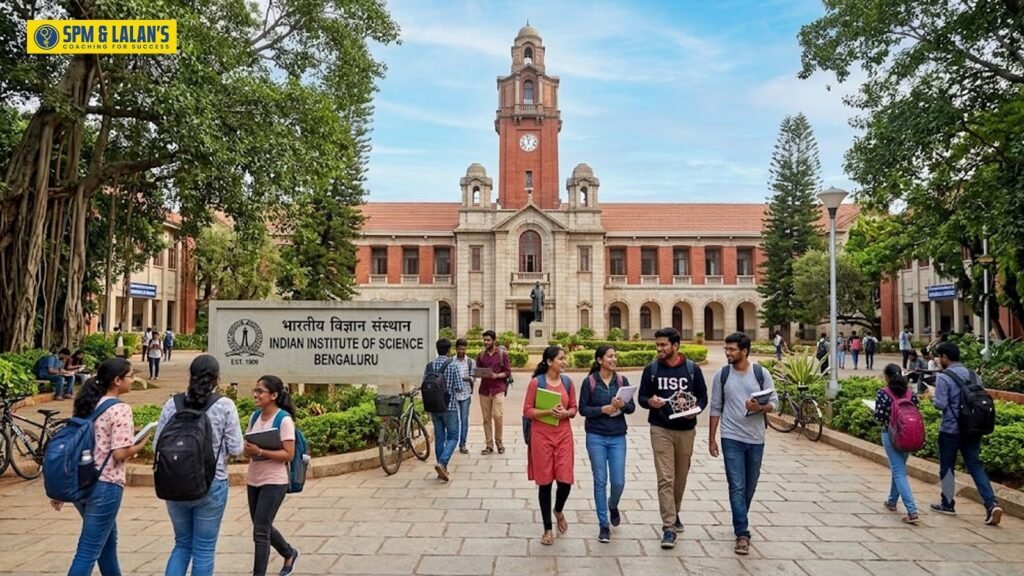
Indian Institute of Science (IISc), Bengaluru
- Established in 1909, the Indian Institute of Science is a leading public institution for advanced scientific and technological education and research.
- Located in Bengaluru, Karnataka, IISc offers undergraduate, postgraduate and doctoral programmes across science, engineering and interdisciplinary fields
- The BS (Research) programme offers majors in Biology, Chemistry, Physics, Mathematics, and Earth and Environmental Science. Students initially complete a shared science curriculum before selecting a major.
- BS (Research) admission route: Admission for Indian applicants is based on performance in either JEE Advanced or the IISER Aptitude Test (IAT). Applicants must also submit a separate application through the IISc admission portal.
- BTech admission route: Admission is conducted through JoSAA counselling, based on JEE Advanced rank.
- MTech admission route: Admission is generally based on a valid GATE score through the Common Offer Acceptance Portal (COAP). Some programmes may also conduct an aptitude test or interview.
- MSc and Integrated PhD admission route: Selection varies by discipline and may involve national-level examinations such as IIT JAM, followed by an interview or additional selection process.
- PhD and MTech (Research) admission route: Applicants are shortlisted using programme-specific qualifications and national examinations such as GATE, CSIR-UGC NET JRF, JEST, DBT-JRF or other recognised tests. Shortlisted candidates may be required to attend an interview.
- Among the leading Science Colleges in India, IISc is particularly suitable for students interested in scientific research and higher education
Indian Institutes of Science Education and Research (IISERs)
Recognised among the leading Science Colleges in India, the IISERs are public institutions that combine science education with research
Currently, India has seven IISERs:
- IISER Pune, Maharashtra
- IISER Kolkata, West Bengal
- IISER Mohali, Punjab
- IISER Bhopal, Madhya Pradesh
- IISER Thiruvananthapuram, Kerala
- IISER Tirupati, Andhra Pradesh
- IISER Berhampur, Odisha
Popular programmes
The flagship programme offered across all seven institutes is the five-year BS-MS Dual Degree. It combines undergraduate and postgraduate education with classroom instruction, laboratory work and research experience.
Generally, students begin with foundational courses covering subjects such as biology, chemistry, mathematics and physics. They later select a discipline for advanced study. Moreover, the final year usually includes a research project leading to an MS thesis.
However, programme choices are not identical across all IISER campuses. According to the official IISER Admissions 2026 information:
- IISER Kolkata offers the regular five-year BS-MS programme and a separate five-year BS-MS in Computational and Data Sciences.
- IISER Bhopal offers the five-year BS-MS in Natural Sciences, a four-year BS in Economic Sciences and four-year BTech programmes. Its BTech disciplines include Chemical Engineering, Data Science and Engineering, and streams under Electrical Engineering and Computer Science.
- IISER Tirupati offers the five-year BS-MS programme and a four-year BS in Economic and Statistical Sciences.
- IISER Pune, IISER Mohali, IISER Thiruvananthapuram and IISER Berhampur offer the five-year BS-MS programme. The subjects and majors available may differ by campus.
Entrance examination and admission route
For the 2026 admission cycle, admission to the five-year BS-MS, four-year BS and BTech programmes listed through the central IISER process is conducted through the IISER Aptitude Test (IAT).
Therefore, students must:
- Meet the academic eligibility requirements stated in the official admission brochure.
- Apply for and appear in IAT.
- Obtain an IAT rank.
- Submit their preferred institutes and programmes during the counselling process.
- Receive a seat based on their rank, category, preferences, and seat availability
Tata Institute of Fundamental Research (TIFR), Mumbai
- Established in 1945 under the vision of Dr Homi J. Bhabha, TIFR is one of India’s leading institutions for advanced scientific research.
- Its main campus is located in Colaba, Mumbai. Additionally, TIFR conducts research and academic activities through centres located in Mumbai, Pune, Bengaluru and Hyderabad.
- TIFR is a National Centre of the Government of India operating under the Department of Atomic Energy. It is also recognised as a deemed-to-be university.
- The institute conducts fundamental research in areas such as physics, chemistry, biology, mathematics, computer science, data science and science education.
Popular programmes
- PhD programmes
- Integrated MSc-PhD programmes
- MSc in Wildlife Biology and Conservation
- Other subject- and centre-specific graduate programmes
- Importantly, TIFR does not offer a regular undergraduate programme. Therefore, students can apply only after completing the relevant undergraduate or postgraduate qualification.
Entrance examination and admission route
- Admission to most graduate programmes begins with the TIFR Graduate School Entrance Examination, commonly known as the TIFR GS examination.
- First, applicants must select the subject and programme that match their educational qualifications.
- Next, eligible candidates appear for the nationwide entrance examination conducted by TIFR
- Subsequently, shortlisted candidates may be required to complete a subject-specific written test, interview or both. The exact process differs across departments and research centres.
- Additionally, selected programmes may consider scores from examinations such as GATE, JEST, CSIR-UGC NET or other recognised national tests.
- For biology-related programmes, admission may involve the Joint Graduate Entrance Examination for Biology and Interdisciplinary Life Sciences (JGEEBILS) process.
- However, qualifying an entrance examination does not automatically guarantee admission. Final selection depends on the programme’s shortlisting criteria and the candidate’s performance in the subsequent selection stages.
National Institute of Science Education and Research (NISER), Bhubaneswar
- NISER is one of the specialised Science Colleges in India operating as an autonomous institution under the Department of Atomic Energy, Government of India.
- Located at Jatni, near Bhubaneswar in Odisha, the institute focuses on education and research in basic and interdisciplinary sciences.
- Furthermore, NISER is an off-campus centre of the Homi Bhabha National Institute (HBNI), a deemed-to-be university. Therefore, its academic degrees are awarded through HBNI.
Popular programmes
- NISER’s flagship course is the five-year Integrated MSc programme, offered to eligible students after Class 12
- The programme allows students to specialise in: Biological Sciences, Chemical Sciences, Mathematical Sciences, Physical Sciences
- Initially, all Integrated MSc students study a common curriculum during their first year. Subsequently, they select their major discipline from the second year onwards.
- Additionally, students may earn a minor in another available discipline by completing the required courses.
- Besides the Integrated MSc, NISER offers: 1) Two-year MSc in Medical and Radiological Physics, followed by a mandatory one-year hospital internship; 2) Integrated MSc-PhD programmes in basic sciences; 3) PhD programmes.
- Its PhD programmes cover Physical Sciences, Chemical Sciences, Biological Sciences, Mathematical Sciences, Computer Sciences, Earth and Planetary Sciences, and Humanities and Social Sciences.
Entrance examination and admission route
- Admission to the five-year Integrated MSc programme is conducted through the National Entrance Screening Test (NEST).
- NEST is a national-level entrance examination jointly used for admission to NISER and the University of Mumbai’s Department of Atomic Energy Centre for Excellence in Basic Sciences.
- First, candidates must have completed or be appearing in the Class 12 examination with the required science subjects.
- Next, they must register for and appear in NEST. Admission is then offered according to the candidate’s NEST merit position, category, eligibility and seat availability.
- Meanwhile, admission to the MSc in Medical and Radiological Physics is based on a valid IIT JAM or JEST score, followed by a written examination, interview or both.
- For the Integrated MSc-PhD and PhD programmes, candidates are initially shortlisted according to their academic qualifications and scores in examinations such as CSIR-UGC NET, GATE, JEST, GPAT, DBT-JRF, ICMR-JRF or JGEEBILS.
- Subsequently, the relevant school may conduct a written test, an interview or both. Since eligibility differs between schools, applicants should check the requirements of their chosen discipline carefully.
Chennai Mathematical Institute (CMI), Chennai
- The Chennai Mathematical Institute, commonly known as CMI, is a centre for teaching and research in mathematical sciences.
- Founded in 1989 as part of the SPIC Science Foundation, it has operated as an autonomous institution since 1996.
- Located at Siruseri in Chennai, Tamil Nadu, CMI specialises primarily in mathematics, computer science, data science and theoretical physics.
- Furthermore, CMI was recognised as a university under Section 3 of the UGC Act, 1956, in December 2006. Therefore, it awards its own undergraduate, postgraduate and doctoral degrees.
Popular programmes
- CMI offers a four-year BS (Honours) programme. During the first two years, students complete a common foundation of basic and advanced mathematics courses.
- Subsequently, students select one of the following areas of focus: 1) Mathematics 2) Mathematics and Computer Science 3) Mathematics and Physics
- Depending on the selected focus, students receive a BS (Honours) degree in the corresponding discipline.
- Additionally, BS students can earn a minor in Data Science by completing the prescribed courses.
- CMI also offers the following two-year postgraduate programmes: 1) MSc in Mathematics, 2) MSc in Computer Science, and 3) MSc in Data Science
- Meanwhile, its PhD programmes are available in: 1) Mathematics, 2) Computer Science, and 3) Physics
Entrance examination and admission route
- Admission to the BS (Honours) programmes is normally conducted through the CMI Entrance Examination.
- The undergraduate entrance test primarily evaluates mathematical aptitude. It includes objective questions and longer mathematical problems based mainly on concepts studied up to Class 12.
- However, students with exceptionally strong performances in recognised national Olympiads in Mathematics, Physics or Informatics may receive an exemption from the BS entrance examination. Students interested in competitive science examinations may also benefit from understanding the National Science Olympiad syllabus and related olympiad preparation strategies. Such exemptions are granted at the discretion of the CMI Admissions Committee.
- Similarly, admission to the MSc programmes is conducted through CMI’s programme-specific entrance examinations.
- For the MSc Mathematics programme, shortlisted candidates may also be required to attend an interview.
- In contrast, PhD applicants may qualify for an interview through the CMI entrance examination or recognised national examinations such as GATE, JEST, NBHM and UGC-CSIR NET, depending on the selected discipline.
- Finally, admission is based on the programme’s selection process and the candidate’s performance in the applicable entrance examination and interview.
Indian Statistical Institute (ISI), Kolkata
- Founded by Professor P.C. Mahalanobis in 1931, ISI is an Institute of National Importance specialising in statistics, mathematics and quantitative research.
- Its headquarters is in Kolkata, with additional centres in Bengaluru, Delhi, Chennai and Tezpur.
Popular programmes
- BStat (Honours) – Kolkata
- BMath (Honours) – Bengaluru
- BS in Statistical Data Science
- MStat and MMath
- MS and MTech programmes
- Research fellowships leading to PhD
Admission route
- Admission to BStat and BMath is primarily conducted through the ISI Admission Test. Eligible INMO-qualified candidates may apply through a separate channel.
- Meanwhile, admission to the BS in Statistical Data Science is based on JEE Main or CUET-UG scores, according to the applicable admission year.
- Postgraduate and research admissions may involve the ISI Admission Test, GATE, national research fellowships, or interviews, depending on the programme.
Entrance Exams for Top Science Colleges in India
The entrance examination depends on the institute and selected programme. Since most entrance examinations such as JEE Advanced, IAT, NEST, and ISI Admission Test rely heavily on Class 11 and Class 12 concepts, students should build a strong foundation using the latest NCERT Class 12 Science textbooks. The following table presents the main admission routes:
| Institute | Entrance examination/admission route |
| Indian Institute of Science (IISc), Bengaluru | JEE Advanced or IISER Aptitude Test (IAT) for BS (Research) |
| Indian Institutes of Science Education and Research (IISERs) | IISER Aptitude Test (IAT) |
| National Institute of Science Education and Research (NISER), Bhubaneswar | National Entrance Screening Test (NEST) |
| Chennai Mathematical Institute (CMI), Chennai | CMI Entrance Examination |
| Indian Statistical Institute (ISI), Kolkata | ISI Admission Test for BStat and BMath; JEE Main or CUET-UG for BSDS |
| Tata Institute of Fundamental Research (TIFR), Mumbai | TIFR Graduate School Entrance Examination |
| Indian Association for the Cultivation of Science (IACS), Kolkata | IISER Aptitude Test (IAT) for BS-MS |
| Jawaharlal Nehru Centre for Advanced Scientific Research (JNCASR), Bengaluru | JNCASR Entrance Examination, JAM or CUET, depending on the programme |
| Homi Bhabha National Institute (HBNI), Mumbai | Admission through its constituent institutions using programme-specific examinations |
Download CBSE & CEBA PYQs here
Conclusion
India’s leading science institutes offer strong academic foundations, research exposure and pathways to rewarding careers. However, students should compare programmes, eligibility requirements and entrance examinations before applying. Moreover, they should consider their subject interests and long-term goals. Ultimately, choosing from the right Science Colleges in India can help students develop knowledge, practical skills and confidence for future opportunities . Students planning careers in medicine or healthcare may also explore specialised NEET coaching in Guwahati to strengthen their preparation for medical entrance examinations. Students can also explore additional academic resources, counselling support, and preparation programmes available at SPM and Lalan’s.
Need guidance for science entrance exams or career planning?
Students and parents can find the institute on Google Maps to visit the centre and speak with counsellors.

This article is written by the SPM & LALAN’S Content Team, a group of skilled writers, researchers, and content strategists passionate about creating accurate, reliable, and student-friendly educational content. Every article is thoroughly researched, fact-checked, and updated to ensure readers receive trustworthy and relevant information. The goal is to help students make informed academic decisions through clear, well-researched, and easy-to-understand content.