

Hey Buddy, have you ever wondered how humans, animals, birds, and plants came into this world? Have they changed their earlier forms? And how have they managed to survive for millions of years? The answer to these questions lies in one term: Evolution. Understanding Evolution helps us know how living beings changed slowly over time and adapted to their surroundings
Evolution is one of the most interesting topics in biology. Evolution is one of the most interesting topics in biology. Students preparing for medical entrance exams can also strengthen their concepts through professional NEET Coaching in Guwahati. You will be thrilled to know how organisms came into existence. This article on Understanding Evolution will help you learn the topic simply and clearly.
What is Evolution?
Let us start with the most basic question. What is Evolution? Before Understanding Evolution in detail, we must first know what evolution means. In simple words, evolution is the slow and gradual changes in the heritable traits of living organisms over many generations. These changes helps organism survive better in the environment in which it lives.
For example, some animals developed strong legs for running. Some birds developed wings for flying. Similarly, fish developed fins that help them survive in water. The changes happen over millions of years.
Moreover, evolution helps in the adaptation of organisms to their environment. Survival of an organism directly depends on its adaptation. An organism that adapts better to a changing environment has a higher chance of survival.
What is the importance of evolution?
Understanding evolution is important because it helps you understand the origin and development of life on Earth. It shows how simple living organisms slowly changed into more complex forms. By studying evolution, you can learn how different plants, animals, and humans came into existence. Students preparing for competitive exams should also learn how to prepare for Biology for NEET effectively to score well in chapters like evolution and genetics.
The emergence of life on Earth can be understood through evolution. Many scientists believe that the initial living beings were simple in nature. With time, thse organism changed and evolved into different forms of life.
In addition, evolution helps you understand the difference between plants and animals. It also explains the challenges faced by different organisms. Moreover, it also explains how organisms developed different features to live in an environment. For example, birds use their wings to fly, Cactus have thick stems which help them store water in deserts.
Theories of evolution
Lamarck’s Theory of Evolution
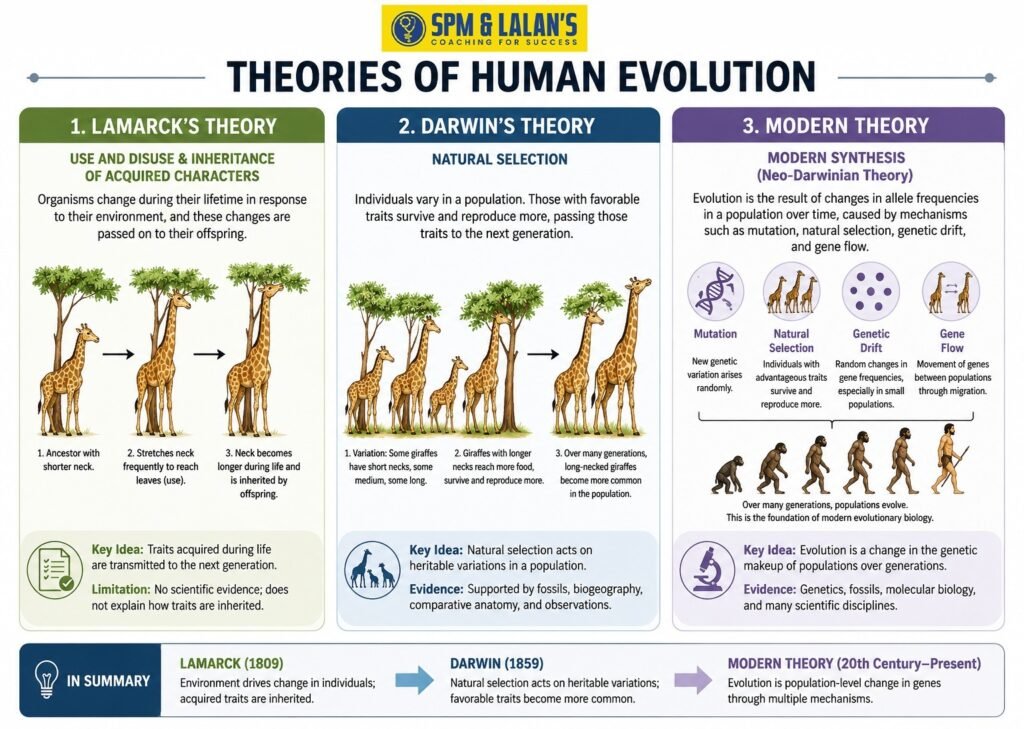
Lamarck was one of the first scientists to explain evolution. He proposed the Theory of Inheritance of Acquired Characters. It describes how living organisms change over time. Lamarck said that living organism slowly develop their new features based on their needs and surroundings. He believed that body parts that are used more become stronger. While the parts that are not used slowly become weak and may even disappear over time.
Furthermore, Lamarck explained that these changes are passed from parents to their offspring. In other words, he believed that organisms could inherit the characteristics acquired by their parents during their lifetime. For instance, Lamarck explained that giraffes developed long necks because their ancestors frequently stretched their necks to reach leaves on tall trees.
Limitations in Lamarck’s Theory of Evolution
Although Lamarck gave one of the earliest explanations of evolution. But scientists later found many problems in his theory. Lamarck believed that acquired characters could be passed from parents to their offspring. However, later scientific studies proved that this does not happen.
For example, if a person exercises daily and develops muscle, their children are not automatically born with strong muscles. In the same way, if an animal loses a body part during its lifetime, its offspring will still be born with that body part. This showed that changes acquired during an organism’s lifetime are usually not inherited by the next generation.
Darwin’s Theory of Evolution
Charles Darwin explained evolution through his Theory of Natural Selection. According to Darwin, all organisms produce more offspring than can actually survive. For example, fish lay thousands of eggs and plants produce many seeds. However, due to limited food, water, shelter, and space, all organisms cannot survive. As a result, living organisms constantly fight for survival.
Moreover, Darwin observed that no two organisms are exactly alike. Small differences among organisms are known as variations. Some variations are helpful and allow organisms to survive better in their environment. Therefore, organisms with useful features have a greater chance of survival and reproduction. This idea is known as “Survival of the Fittest.”
Furthermore, Darwin explained that nature selects organisms that are better adapted to their surroundings. This process is called natural selection. Over time importantl traits are passed to future generations and become more common. Darwin’s idea of natural selection is a very important part of Understanding Evolution.
Modern Theory of Evolution
Modern scientists combined Darwin’s ideas with Genetics. According to the modern theory, Genes control inherited characteristics, and mutations create new variations. Natural selection helps useful traits survive. This modern explanation is called the Synthetic Theory of Evolution.
Human Evolution
Understanding Evolution also helps us know how early humans slowly became modern humans. The evolution of humans explains the slow development of humans from ancient ape-like ancestors to present day human being. The scientist says that early humans slowly changed both physically and mentally to survive in their environment.
In the early stages, human ancestors looked very different from modern humans. They had smaller brains, strong body hair, and walked with difficulty. However, slow changes started taking place. Slowly, humans learned to walk upright on two legs. This helped them move easily and use their hands for different activities. As a result, they could make tools, gather food, and protect themselves better.
Moreover, the human brain gradually became larger and more developed. This is what made humans think and communicate. It also helped them live in groups and develop social behavior. After this, humans slowly learned to use fire, build shelter, and hunt animals for survival.
7 stages of human evolution
Do you know that present day human being is the result of evolution over millions of years?
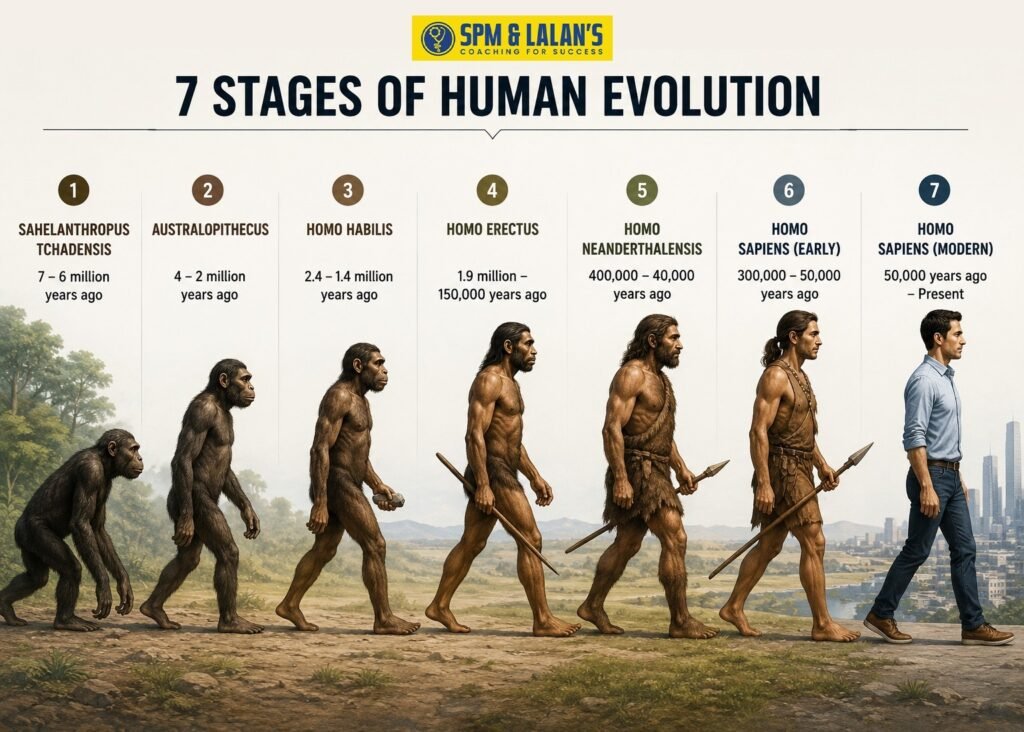
There are primarily 7 stages in which the evolution of humans can be discussed. These are-
Dryopithecus
Dryopithecus was one of the earliest ape-like ancestors of humans. It lived around 15 million years ago in forests. It mainly moved on trees and ate fruits and leaves. Moreover, the body was mostly covered with hair. It used all four limbs for movement. It marked an important stage of early human evolution
Australopithecus
Australopithecus lived about 4 million years ago in Africa. It is often called the “southern ape.” This stage became very important because these early humans could walk upright on two legs. Moreover, Australopithecus had a smaller brain than modern humans. It showed better movement and balance than modern Humans. They also learnt to use simple sticks and stones. It provided them protection and allowed them to gather food. As a result, it survived more efficiently than earlier ancestors.
Homo habilis
Homo habilis appeared around 2 million years ago. Its is aslo called “Handy Man” because it could make and use simple stone tools. This stage showed major improvement in intelligence and brain size. Furthermore, Homo habilis could communicate in simple ways and lived in groups. It hunted small animals and gathered food for survival. Because of its larger brain and tool-making ability, scientists considered it more advanced than Australopithecus.
Homo erectus
Homo erectus was more advanced and lived around 1.5 million years ago. It managed to walk completely upright and had a stronger body structure. Moreover, its brain was larger and more developed. The biggest achievements of Homo erectus were the use of fire. Fire helped humans cook food, stay warm, and protect themselves from wild animals. In addition, Homo erectus made better tools and started hunting more effectively.
Neanderthals
Neanderthals lived around 400,000 years ago in Europe and Asia. They were strong, intelligent, and well-adapted to cold climates. They used animal skins to cover themselves and lived in caves.
Neanderthals made advanced tools and hunted animals in groups. They also showed signs of social behavior. They cared for the injured member while hunting and gathering. They buried dead bodies, which showed emotional understanding and cultural development.
Homo Sapiens
Homo sapiens are modern humans. They appeared around 200,000 years ago and gradually spread across the world. If you compare it to earlier humans, Homo sapiens had a highly developed brain and better communication skills. Furthermore, they learned farming, built permanent homes, and formed civilizations. They developed language, art, science, and technology. As a result, humans became the most intelligent and advanced species on Earth. Today, all modern humans belong to the species Homo sapiens.
Evidence of Evolution
Scientists have uncovered much evidence supporting evolution. These evidences have been useful for understanding the process of evolution. It also provides credibility to the evolution theories proposed by many scientists. Fossils, DNA, body structures, and embryos are useful in Understanding Evolution.
Fossils
Fossils are the remains of ancient plants and animals found inside rocks. Fossils helps scientist understand the animals that are now extinct. Further, it helps to study how organism changes. The most important use of fossils is to trace the evolutionary history of Earth.
Comparative Anatomy
Here, the scientist compares the bodies of different animals. It helps to provide a comparative angle in the study of human evolution
Homologous Organs
These organs are similar in structure but perform different functions.Exaples- Human hand,bat wing, etc. This organ shows that they had common ancestors.
Analogous Organs
These organs perform similar functions but have different structures. Examples are- Wings of birds, Wings of insects. They both help in flying, but they are structurally different.
Vestigial Organs
Vestigial organs are body parts that are no longer useful. Examples in Humans, Appendix, Wisdom teeth, Tailbone. These organs suggest that human ancestors used them in the past.
Embryological Evidence
The embryos of many animals look similar during the early stages of development. This suggests that many animals may have evolved from common ancestors.
Molecular Evidence
Scientists also study DNA and proteins. Closely related organisms have similar DNA. Humans and chimpanzees share a large amount of similar DNA, showing that they are closely related.
Adaptive Radiation
Adaptive radiation means one organism changing into many forms to live in different environments. Example- Darwin studied finches on the Galápagos Islands. Different finches developed different beaks according to their food habits.
Hardy-Weinberg Principle
The Hardy-Weinberg Principle helps in Understanding Evolution at the population level. It says that if no outside factors disturb a population, then the genetic makeup of that population will remain almost the same over time. In simple words, traits and gene frequencies stay stable when there are no mutations, migration, natural selection, or random mating changes.
Scientists use this principle as a basic model to study evolution. When the genetic balance of a population changes, it shows that evolution is taking place. Thus, the Hardy-Weinberg Principle helps us understand how populations remain stable and how evolutionary changes begin.
Understanding concepts like evolution, genetics, and the Hardy-Weinberg Principle becomes easier with regular practice. Students preparing for competitive exams can test their preparation level through chapter-wise and full-length mock tests.
Factors Affecting Hardy-Weinberg Equilibrium
The Hardy-Weinberg equilibrium remains stable only when a population is free from evolutionary changes. But in nature, populations are rarely completely stable. Several factors continuously change gene frequency and disturb this equilibrium. These changes slowly drive the process of evolution.
Mutation introduces new alleles through sudden hereditary changes. Gene flow occurs when individuals migrate and mix their genes with another population. Genetic drift causes random changes in gene frequency, especially in small populations. The founder effect appears when a small group forms a new population with limited genetic variation. The bottleneck effect occurs when a sudden disaster sharply reduces population size and diversity. Natural selection further changes gene frequency by helping organisms with favorable traits survive and reproduce more successfully.
Conclusion
In short, Understanding Evolution helps us know how life changed over millions of years. It explains how simple living organisms slowly developed into different plants, animals, and humans. Evolution also shows how living beings adapt to their environment for better survival.
The evolution of human shows how early humans developed better bodies, larger brains, tools, fire, communication, and social life. The Hardy-Weinberg Principle also helps us understand how gene changes show evolution in a population. Overall, evolution is the story of how life began, changed, adapted, and survived on Earth. Students revising biology topics quickly can also follow this 60-day NEET Biology preparation strategy for better exam performance.
For more NEET study resources, biology notes, and preparation strategies, visit guwahati coaching centre
Solving Previous Year Questions (PYQs) is one of the best ways to strengthen Biology concepts and understand important exam patterns for NEET, CBSE, and CEBA examinations.
Frequently Asked Questions
How are hereditary changes responsible for evolution?
Hereditary changes are responsible for evolution because traits are passed from parents to offspring through genes. Some changes help organisms survive better in their environment. Over many generations, these useful traits become common in a species. This gradual accumulation of inherited changes leads to the process of evolution.
Can we call human evolution as adaptive radiation?
Human evolution cannot be fully called adaptive radiation because adaptive radiation mainly refers to the rapid formation of many different species from a common ancestor. Human evolution was a gradual process involving physical, mental, and social development. However, humans did adapt to different environments while evolving over millions of years.
What do you mean by evolution?
Evolution is the gradual process through which living organisms change over many generations. These changes occur as organisms adapt to their environment for better survival. Over time, small inherited changes accumulate and may lead to the development of new characteristics or even entirely new species.

This article is written by the SPM & LALAN’S Content Team, a group of skilled writers, researchers, and content strategists passionate about creating accurate, reliable, and student-friendly educational content. Every article is thoroughly researched, fact-checked, and updated to ensure readers receive trustworthy and relevant information. The goal is to help students make informed academic decisions through clear, well-researched, and easy-to-understand content.