
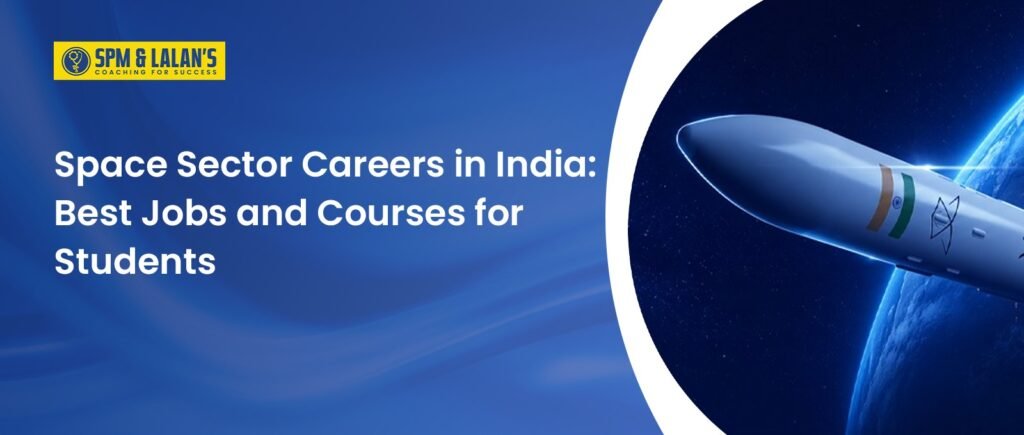
Can students build a strong career in India’s growing space sector? Today, space sector careers are not limited to becoming a scientist at ISRO. Students can explore opportunities in engineering, satellite technology, remote sensing, data science, software development and private space startups. With the right course, skills and practical exposure, India’s space industry can offer many promising career paths.

Overview of India’s Growing Space Sector
- To begin with, India’s space sector has moved beyond a purely government-led model. ISRO remains the main national space agency, but recent reforms have opened the sector for private companies, startups and industries to participate in different space-related activities.
- Moreover, IN-SPACe has become an important institutional support system for private players. It works as a single-window agency to promote, authorise and supervise private space activities, including launch vehicles, satellites, space-based services and access to ISRO/DOS infrastructure.
- At present, India’s space economy is valued at around $8.4 billion. According to PIB, the sector has also seen the growth of nearly 399 space startups working in areas such as launch vehicles, satellites, propulsion systems and space-grade electronics.
- In addition, private participation is increasing across the full space value chain. The Indian Space Policy 2023 permits private entities to carry out end-to-end space activities, including launches, satellite building and operations, data acquisition, data dissemination and ground station services.
- Furthermore, the sector is also becoming more commercially active. NSIL commercialises ISRO’s technologies, launch services and satellite services, while IN-SPACe supports authorisation and industry participation. According to PIB, NSIL’s revenue increased from ₹321.77 crore in FY 2021–22 to ₹3,246.09 crore in FY 2024–25.
- Another important point is that India is aiming for long-term growth in the global space economy. IN-SPACe’s Decadal Vision Report provides a roadmap to grow India’s space economy from $8.4 billion in 2022 to $44 billion by 2033, including $11 billion in exports.
- Besides this, India has also built strong launch capabilities. PIB notes that India can launch satellites up to 10 tonnes to Low Earth Orbit and 4.2 tonnes to Geostationary Transfer Orbit through operational launch vehicles such as PSLV, GSLV and LVM3.
- As a result, the space sector is now creating opportunities beyond traditional scientist roles. Students interested in space sector careers can look at fields such as aerospace engineering, satellite technology, remote sensing, geospatial data, software development, propulsion, electronics, and space entrepreneurship.
- Overall, India’s growing space sector is becoming a mix of public institutions, private companies, startups and research organisations. This makes the sector more career-oriented for students who want to work in science, technology, engineering, data, or space-based applications.
Career Opportunities in ISRO
- To begin with, ISRO offers career opportunities mainly through official recruitment notifications. Students and professionals can apply for different posts through ISRO’s Careers and Current Opportunities pages, where vacancies are published for various ISRO centres and units.
- Firstly, engineering graduates can apply for Scientist/Engineer posts. ISRO regularly recruits Scientist/Engineer ‘SC’ candidates in disciplines such as Electronics, Mechanical, Computer Science, Civil, Electrical, Refrigeration & Air-conditioning and Architecture, depending on the vacancy notification.
- Moreover, students from technical backgrounds can also explore assistant-level and technical roles. ISRO centres recruit for posts such as Technical Assistant, Scientific Assistant, Technician ‘B’, Draughtsman ‘B’ and Library Assistant, based on centre-specific requirements.
- In addition, research-oriented students can look for JRF and RA positions. ISRO centres such as URSC, SDSC SHAR and other units release notifications for Junior Research Fellow, Research Associate and temporary research personnel posts. These roles are suitable for students who want to work in space research, satellite systems, remote sensing or applied science.
- Furthermore, ISRO also provides opportunities for apprenticeships and training. For example, ISTRAC has released notifications for Graduate Apprentice Trainee, Diploma Apprentice Trainee and Trade ITI positions. Such opportunities can help young candidates gain practical exposure in space-related technical environments.
- Another important pathway is through IIST. The Indian Institute of Space Science and Technology offers undergraduate and dual-degree programmes in areas such as Aerospace Engineering, Electronics and Communication Engineering, Computer Science and Engineering, Engineering Physics, Astronomy and Astrophysics, Earth System Science, Solid State Physics and Optical Engineering. Eligible students from these programmes may be considered for Scientist/Engineer-SC recruitment in ISRO/DOS, subject to notified vacancies and required conditions.
- Besides engineering and science roles, ISRO also recruits for support and specialised posts. These may include Medical Officer, Nurse, Radiographer, Cook, Fireman, Driver, Legal Consultant and administrative positions, depending on the needs of different centres.
- Additionally, PhD holders may also find research-related opportunities. ISRO/DOS has mentioned a ‘Live Register’ scheme where PhD holders in specialised areas related to the Indian space programme can submit their dossiers for review, depending on suitability and centre recommendations.
- However, candidates should remember that eligibility varies by post. Qualifications, age limit, selection process, written test, interview and experience requirements change according to the specific advertisement. Therefore, students should always check the latest official ISRO notification before applying.
- Overall, ISRO offers opportunities for engineering graduates, science students, and diploma holders. For students interested in space sector careers, ISRO remains one of the most important destinations in India.
Engineering Careers in India’s Space Sector
- To begin with, engineering is one of the strongest routes for space sector careers in India. Engineers work on launch vehicles, satellites, payloads, ground systems, propulsion, electronics, software and mission support.
- Firstly, aerospace engineers can work on rockets, spacecraft design and flight systems. ISRO’s launch vehicle programme includes PSLV, GSLV and LVM3, which require strong engineering support in design, testing, integration and mission planning.
- Moreover, mechanical engineers are needed for structures, thermal systems and launch vehicle components. Their work is important in building reliable hardware that can perform under extreme space and launch conditions.
- In addition, electronics and communication engineers play a major role in satellite systems. They can work on communication payloads, navigation systems, sensors, onboard electronics, and signal processing.
- Similarly, computer science engineers are important for software, simulation, and mission operations. ISRO has recruited Scientist/Engineer ‘SC’ candidates in Computer Science, along with Electronics and Mechanical disciplines.
- Furthermore, electrical engineers can work on power systems, control systems and testing equipment. Satellites and launch vehicles need dependable electrical systems for smooth operation.
- Besides this, civil engineers also have opportunities in space infrastructure. They may contribute to launch pads, testing facilities, tracking stations, laboratories and other technical infrastructure.
- Another growing area is private space engineering. The Indian Space Policy 2023 allows private entities to take part in launches, satellite realisation and operations, data services and ground stations.
- As a result, engineers can now look beyond ISRO as well. Space startups and private companies need talent for satellite manufacturing, launch systems, propulsion, avionics, ground stations and space-based services.
- Overall, engineering careers in India’s space sector are suitable for students who enjoy science, problem-solving and technology. With the right degree, practical skills and project experience, students can build careers in both government and private space organisations. Students comparing different engineering specialisations can also read about the highest-paying engineering jobs in India to understand the earning potential and career scope of various engineering fields.
Research and Scientific Careers in Space Science
- Research-based space sector careers are ideal for students who want to study space beyond engineering design. These careers focus on understanding planets, stars, the Sun, Earth’s atmosphere, space weather and the wider universe.
- A major career path is astronomy and astrophysics. Researchers in this field study topics such as black holes, pulsars, exoplanets, cosmology, magnetic fields and the early universe. The Indian Institute of Astrophysics works on several of these areas.
- Another important area is planetary science. Scientists study planetary atmospheres, the origin and evolution of the solar system, astrochemistry, planetary geology and space instrumentation. PRL works in these areas through its Planetary Sciences Division.
- Moreover, students can also explore space and atmospheric sciences. This field connects space research with Earth’s atmosphere, climate, aerosols, solar activity and space weather. PRL carries out research in Space & Atmospheric Sciences along with Solar Physics and related fields.
- In addition, observational astronomy is another strong research route. Institutes such as ARIES work on the Sun, extrasolar planets, stars, star formation and stellar evolution through astronomical observations.
- For entry-level research exposure, students can look for JRF, project assistant, and research trainee roles. These positions usually help students work under senior scientists before moving towards a PhD or advanced research career.
- However, most long-term scientific careers need higher studies. Students generally build this path through B.Sc., M.Sc., integrated M.Sc.-PhD or PhD programmes in Physics, Astronomy, Astrophysics, Space Science, Planetary Science, Atmospheric Science or related subjects.
- Furthermore, ISRO also supports academic research through its RESPOND programme. This programme connects ISRO with academic institutions for research and development projects relevant to India’s space programme.
- Besides subject knowledge, researchers need strong analytical skills. Mathematics, physics, programming, data analysis, scientific writing and problem-solving are highly useful in space science research.
- Overall, scientific careers in space science are suitable for students who are curious, patient and research-oriented. Instead of building rockets directly, they help answer important questions about space, planets, stars, Earth systems and the universe.
Careers in Satellite Technology and Communication
Satellite technology plays an important role in communication, weather updates, navigation, broadcasting, disaster warning and Earth observation. In this field, students can work on satellite design, payload systems, antennas, sensors, onboard electronics, signal transmission and ground station operations.
Moreover, communication satellites help connect remote and far-flung areas where normal network services may be limited. Therefore, students from electronics, communication engineering, computer science, data analysis and networking backgrounds can find good opportunities in this sector.
Overall, space sector careers in satellite communication are suitable for students interested in telecom, satellites, electronics, software and space-based services.
Careers in Remote Sensing, GIS and Geospatial Technology
Remote sensing, GIS and geospatial technology are important parts of India’s space applications. These fields use satellite images and location-based data for mapping, disaster management, agriculture, urban planning, water resources and governance. NRSC also works on satellite data reception, data products, remote sensing applications, geospatial services and capacity building.
Moreover, students from geography, geology, civil engineering, environmental science, computer science and data-related backgrounds can explore space sector careers in this field. Useful skills include GIS software, satellite image interpretation, data analysis and basic programming.
Careers in Space Data, AI and Software Development
Space missions generate large amounts of data from satellites, sensors, ground stations and Earth observation systems. Therefore, software developers, data analysts and AI/ML professionals are becoming important in areas like satellite data processing, image analysis, automation, mission software and space-based services.
In addition, India’s space policy supports wider access to remote sensing data and encourages private participation in data acquisition, dissemination and ground station services. This creates opportunities for students who are good at coding, Python, machine learning, cloud computing and data visualisation.
Careers in Space Law, Policy and Management
Space law, policy and management is a growing career area because the space sector now includes government agencies, private companies, startups and international collaborations. This field deals with rules, permissions, satellite data use, liability, contracts, licensing, safety and policy planning.
Moreover, the Indian Space Policy 2023 gives IN-SPACe a role in authorisation, safety guidelines, liability-related rules and remote sensing data permissions. As a result, students from law, public policy, international relations, management and economics can explore non-technical careers in the space sector.
Career Opportunities for Students After Class 12
After Class 12, students usually cannot become ISRO scientists directly. Instead, they should choose the right higher education route, such as B.Tech, B.Sc., integrated science programmes, aerospace engineering, electronics, computer science, physics, mathematics, or data science.
Furthermore, IIST is one important pathway for space-focused education in India. Its undergraduate and dual-degree programmes include Aerospace Engineering, Electronics and Communication Engineering, Computer Science and Engineering, and Engineering Physics. Admission is based on JEE Advanced marks along with prescribed Class 12 criteria. Later, students can also explore internships, projects, higher studies, ISRO recruitment, research roles, and private space companies.
Preparing for Your Next Academic Step?
Students preparing for entrance examinations or board assessments can improve their performance through structured practice and previous-year papers.
NEET & JEE Mock Test
Download CBSE & CEBA PYQs here
Best Courses to Build a Career in India’s Space Sector
- To begin with, B.Tech in Aerospace Engineering is one of the most relevant courses. It helps students learn about aircraft, rockets, spacecraft systems, propulsion, aerodynamics, and flight mechanics. IIST offers Aerospace Engineering with a space-technology-focused curriculum.
- Moreover, B.Tech in Electronics and Communication Engineering is also useful. This course can lead to careers in satellite communication, sensors, antennas, navigation systems, payloads, and onboard electronics. IIST includes this as one of its undergraduate programmes.
- In addition, B.Tech in Computer Science or Data Science is becoming important. Space missions need software, coding, simulation, AI, data handling and satellite image processing. IIST also offers Computer Science and Engineering with Data Science.
- Similarly, Engineering Physics is a good option for research-minded students. At IIST, the dual-degree route combines B.Tech in Engineering Physics with higher studies in areas such as Astronomy and Astrophysics, Earth System Science, Solid State Physics and Optical Engineering.
- Furthermore, B.Sc. and M.Sc. in Physics, Mathematics, Astronomy or Space Science can support scientific careers. These courses are useful for students who want to move towards research, higher studies, JRF roles or PhD programmes.
- Besides this, courses in Remote Sensing, GIS and Geoinformatics are useful for space applications. IIRS focuses on training in geospatial applications and also offers online learning in remote sensing and geospatial technology.
- For technical exposure, internships and student projects are also valuable. ISRO provides internship opportunities for UG, PG, and PhD students in science and technology disciplines, with a maximum internship duration of 45 days.
- Overall, students should choose the right course according to their interests if they want to build strong space sector careers. They can also explore available courses to compare programmes based on their academic and career goals. Engineering is suitable for spacecraft and satellite systems, science is better for research, GIS is useful for Earth observation, and computer science is important for AI, software, and space data careers.
Future Scope of Careers in India’s Space Sector
- To begin with, India’s space sector is expected to grow strongly in the coming years. According to PIB, India’s space economy was about $8.4 billion in 2023 and is projected to reach around $44 billion by 2033 and $100 billion by 2040. This growth can create more space sector careers in both government and private organisations.
- Moreover, private companies are now playing a bigger role. The Indian Space Policy 2023 allows private entities to work in launches, satellite development, satellite operations, data services and ground stations. As a result, students can look beyond ISRO and explore space startups and private-sector jobs too.
- In addition, space startups are expanding in India. PIB reported that India had crossed 400 registered space startups by February 2026. This shows that future jobs may grow in areas like satellite manufacturing, launch systems, propulsion, space electronics and software.
- Furthermore, the sector will need skilled people in many fields. Future careers may open in engineering, software development, data analysis, manufacturing, research, satellite communication, Earth observation and geospatial technology. The ₹1,000 crore Venture Capital Fund for the space sector is also expected to support startups and employment across the space supply chain.
- Besides this, launch services may also create new opportunities. IN-SPACe has worked out a strategy to expand India’s share in the global satellite launch market, with the launch segment expected to contribute $3.5 billion to India’s space economy by 2033.
- Overall, the future scope of space sector careers in India looks promising. Students who build strong skills in science, engineering, coding, data, electronics or geospatial technology can find opportunities in ISRO, research institutes, startups, private companies and space-based service industries.
Students who need guidance in choosing an appropriate academic programme can learn more about the institution, programmes and student opportunities on the coaching institute guwahati.
Conclusion
In conclusion, India’s space sector is opening new paths for students beyond traditional science roles. With ISRO, private startups, research institutes and satellite-based services growing together, learners can choose careers in engineering, data, GIS, AI, communication or policy. Therefore, space sector careers can be a strong choice for students who build the right skills, choose suitable courses and stay ready for future opportunities.
Interested students and parents can visit the campus for further information about programmes and admissions. View our location on Google Maps and plan your visit.

This article is written by the SPM & LALAN’S Content Team, a group of skilled writers, researchers, and content strategists passionate about creating accurate, reliable, and student-friendly educational content. Every article is thoroughly researched, fact-checked, and updated to ensure readers receive trustworthy and relevant information. The goal is to help students make informed academic decisions through clear, well-researched, and easy-to-understand content.