
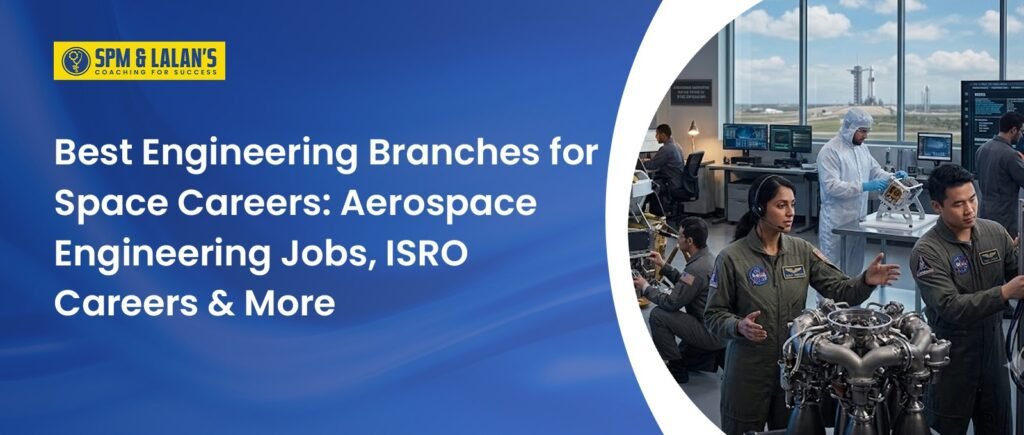
A career in space is a dream for many students, but it is not only for astronauts. Engineers also play a big role in building rockets, satellites, space technology, and mission systems. If you are planning for aerospace engineering jobs or want to work with ISRO and other space organisations, choosing the right engineering branch is important. In this article, we will explore the best engineering branches that can help you build a career in the space field.
What Are Space Careers in Engineering?
Space careers in engineering are jobs where engineers help design, build, test, and improve space-related technology. These roles can also prepare students for future aerospace engineering jobs. This can include rockets, satellites, spacecraft, launch systems, mission software, communication systems, and research equipment.
However, a space career does not mean you have to become an astronaut. In fact, most space missions depend on engineers working behind the scenes. For example, aerospace engineers work on aircraft and spacecraft design, while computer engineers help create software used in space missions. NASA also mentions that it hires many types of engineers, including aerospace, general, and computer engineers.
Similarly, in India, organisations like ISRO recruit engineers from fields such as electronics, mechanical, computer science, electrical, physics, chemistry, and mathematics. So, if a student is interested in space, they can choose different engineering branches based on their skills and interests.
In simple words, space careers in engineering are about using engineering knowledge to support space exploration, satellite technology, communication, research, and future missions.
Why Engineering Students Are Choosing Space Careers
Engineering Students are choosing space careers because:
- More career options are opening up: Space careers are no longer limited to ISRO or NASA only. As a result, many students are exploring aerospace engineering jobs in both government and private space organisations.
- Dynamic Field Opportunities: Students from aerospace, mechanical, electronics, computer science, electrical, and other branches can build careers in the space sector. NASA says it hires around 20 types of engineers, with aerospace, general, and computer engineers being common roles.
- ISRO recruits from multiple fields: In India, ISRO offers Scientist/Engineer roles for students from fields like Electronics, Mechanical, Computer Science, Electrical, Physics, Chemistry, and Mathematics.
- India’s private space sector is growing: The Indian government has allowed more private participation in the space sector. In 2024, India also updated its FDI policy to allow up to 100% FDI in the space sector under different routes.
- Space technology is used in daily life: Satellites support communication, GPS, weather forecasting, disaster management, defence, internet services, and remote sensing. Therefore, engineers working in space technology are contributing to real-world needs.
- It offers challenging and meaningful work: Many students choose space careers because they get to work on advanced projects like rockets, satellites, mission software, robotics, propulsion systems, and spacecraft design.
- There is scope for both government and private jobs: Students can aim for ISRO, DRDO, HAL, research institutes, startups, satellite companies, aerospace firms, and global space organisations, depending on their branch and skills. They can also explore the highest-paying engineering jobs in India to understand the earning potential and career scope of different engineering fields.
- The field has future growth: With more missions, satellite launches, space startups, and private investment, space careers are becoming more attractive for engineering students who want long-term opportunities.
Choosing the right branch is important, but students should also consider the quality of the institution, laboratories, faculty, placement support, and practical learning opportunities. Comparing the best engineering colleges in India can help students make a more informed decision before beginning their engineering journey.
Best Engineering Branches That Can Lead to Space Careers
- Aerospace Engineering
This is the most direct branch for students interested in space careers. It deals with aircraft, rockets, spacecraft, aerodynamics, and flight systems. Students aiming for aerospace engineering jobs in space organisations often choose this branch.
- Mechanical Engineering
Mechanical engineers are important in the space sector because rockets, engines, launch vehicles, machines, and spacecraft parts need strong mechanical design and testing. This makes Mechanical Engineering a strong support branch for many aerospace engineering jobs. ISRO also recruits engineers from the Mechanical branch for Scientist/Engineer roles.
- Electronics and Communication Engineering
Satellites, communication systems, sensors, signals, and control systems are a big part of space missions. Therefore, ECE students can find good opportunities in satellite technology, avionics, and mission communication. ISRO has also listed Electronics as one of the disciplines for Scientist/Engineer recruitment.
- Computer Science Engineering
Space missions need software for data analysis, mission control, simulation, AI, automation, and satellite operations. Therefore, coding and software skills can also help students enter selected aerospace engineering jobs.
- Electrical Engineering
Spacecraft and satellites need proper power systems, circuits, control units, and electrical testing. So, electrical engineers can work in areas related to spacecraft power, launch systems, and technical support.
- Instrumentation and Control Engineering
Space missions depend on accurate measurement and control. This branch is useful for students interested in sensors, navigation systems, monitoring devices, and automatic control systems.
- Robotics and Automation Engineering
Robotics is useful in space exploration, rover technology, satellite handling, and automated testing. As space missions become more advanced, this field can offer strong future scope.
- Materials Science Engineering
Spacecraft and rockets need materials that can handle heat, pressure, vibration, and harsh space conditions. This branch is useful for students interested in spacecraft materials, thermal protection, and lightweight structures.
- Chemical Engineering
Chemical engineers can contribute to areas like rocket fuels, propellants, combustion, materials processing, and chemical testing. It is not the most common route, but it has specific use in the space sector.
- Civil Engineering
Civil engineers may not work directly on rockets, but they are needed for launch pads, testing centres, research facilities, and space infrastructure. So, this branch also has a limited but real role in the space industry.
Which Engineering Branch Is Best for ISRO?
There is no single “best” engineering branch for ISRO because space missions need different types of engineers. From Rockets to satellites to launch centres, all require different skills.
However, Electronics, Mechanical, and Computer Science Engineering are among the most common and important branches for ISRO aspirants. ISRO’s official recruitment pages mention Scientist/Engineer posts in fields such as Electronics, Mechanical, Computer Science, Electrical, Physics, Chemistry, and Mathematics.
Electronics and Communication Engineering is useful because satellites and space missions depend on sensors, signals, circuits, and communication systems. Mechanical Engineering is also important because rockets, engines, spacecraft parts, and launch vehicles need strong design and testing.
Similarly, Computer Science Engineering has strong scope because space missions need software, data handling, automation, simulation, and mission control systems. Aerospace Engineering is also a good option for students who are specifically interested in rockets, aircraft, spacecraft, and flight technology. Students who like these areas can also explore aerospace engineering jobs along with ISRO-related roles.
So, the best branch depends on your interest. Choose Electronics if you like communication and circuits, Mechanical if you like machines and design, Computer Science if you like coding and software, and Aerospace if you are deeply interested in space vehicles and flight systems. Also, students should always check the latest ISRO notification before applying, because eligibility can change from one recruitment to another.
Preparing for an engineering entrance examination? Assess your preparation and improve your speed with our practice tests.
What Skills are Required to Build a Career in the Space Industry?
- Strong subject knowledge
Students should first understand their own engineering branch well. Mechanical students should know machines and design. Electronics students should know circuits and signals. Computer Science students should know coding and software.
- Basic maths and physics
Space technology is based on maths and physics. These subjects help students understand motion, force, energy, signals, and data.
- Problem-solving skills
Space missions involve many difficult tasks. So, students must learn to solve problems step by step. This skill is useful in every space-related role.
- Programming skills
Software is used in satellites, mission control, data analysis, and simulations. Therefore, coding can be useful for many engineering students.
- Practical project experience
Students should work on real projects. These can include robotics, electronics, coding, model rockets, or research projects. This helps them apply classroom knowledge. Students can also explore available engineering courses to identify a programme that matches their interests and career goals.
- Teamwork and communication
Space projects require teamwork. Engineers, scientists, and technicians work together. So, students should learn to explain ideas clearly. - Attention to detail
In the space industry, small mistakes can create big problems. Therefore, accuracy and careful checking are very important.
- Learning mindset
Space technology keeps changing. Students should keep learning new tools, new software, and new technologies.
Strong fundamentals in mathematics, physics, and science begin with consistent academic preparation. Practising previous-year papers can help students understand important questions and examination patterns.
Top Career Options After Engineering in the Space Sector
- Aerospace Engineer
This is one of the most direct career options. Aerospace engineers work on rockets, spacecraft, aircraft systems, and flight technology. That is why many students searching for aerospace engineering jobs start by learning about this role first. Moreover, it is one of the common engineering fields of NASA.
- Mechanical Engineer
Mechanical engineers work on rocket parts, engines, structures, machines, and testing systems. Therefore, this branch has particular significance in launch vehicles and spacecraft development.
- Electronics Engineer
Sensors, circuits, communication systems, and control units are the core components of Stellites and Space Misssions. So, electronics engineers are important in mission hardware and satellite technology.
- Computer Science Engineer
Space missions need software for data handling, simulation, automation, and mission control. As a result, computer science engineers can work in space software, AI, and satellite operations.
- Scientist/Engineer at ISRO
Many students aim for ISRO after engineering. ISRO has recruited Scientist/Engineer candidates from branches like Electronics, Mechanical, and Computer Science.
- Satellite Systems Engineer
This role is connected with satellite design, testing, communication, and operation. It is suitable for students from electronics, electrical, computer science, and aerospace backgrounds.
- Mission Control Engineer
Mission control engineers help monitor and support space missions from the ground. They work with data, software, communication systems, and technical teams during mission operations.
- Robotics Engineer
Robotics engineers can work on rovers, robotic arms, automated testing systems, and space exploration tools. This field is becoming more useful as space missions become more advanced.
- Space Research and Development Engineer
Some engineers work in research labs and development centres. They help improve materials, propulsion systems, satellite technology, software, and testing methods.
- Engineer in Private Space Companies
Apart from government organisations, private space companies also hire engineers. In India, companies like Skyroot Aerospace are working on launch vehicles and space technology.
Conclusion
Overall, space careers are not limited to one engineering branch. Aerospace Engineering is a direct path, but Mechanical, Electronics, Computer Science, Electrical, and other branches also offer real opportunities. Therefore, students should choose a branch based on their interest, skills, and career goals. With the right preparation, engineering can become a strong step toward the space industry.
Students looking for engineering education, course information, and academic guidance can learn more by visiting the coaching institute guwahati.
Interested in exploring engineering programmes and campus facilities? Get directions to our campus on Google Maps.
Frequently Asked Questions (FAQs)
Q1. Which engineering branch is best for a space career?
There is no single best branch for every student. However, Aerospace, Mechanical, Electronics and Communication, and Computer Science are strong options. Aerospace is more directly linked to rockets and spacecraft, while other branches support satellites, software, testing, communication, and mission systems in the space sector.
Q2. Can students from non-aerospace branches get space jobs?
Yes, students from non-aerospace branches can also build space careers. Space organisations need engineers for software, electronics, mechanical systems, power systems, robotics, materials, and infrastructure. So, students should focus on strong subject knowledge, practical projects, coding basics, and official eligibility requirements before applying for roles.

This article is written by the SPM & LALAN’S Content Team, a group of skilled writers, researchers, and content strategists passionate about creating accurate, reliable, and student-friendly educational content. Every article is thoroughly researched, fact-checked, and updated to ensure readers receive trustworthy and relevant information. The goal is to help students make informed academic decisions through clear, well-researched, and easy-to-understand content.