

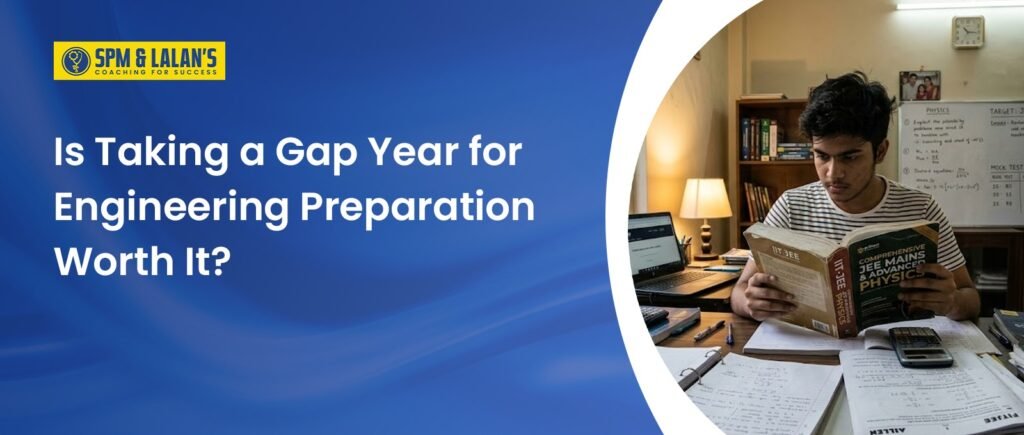
Finishing Class 12 without getting the expected engineering entrance result can feel disappointing. Some students immediately choose another course. Others think about preparing for one more year.
A gap year can offer a second chance. However, it also brings pressure, expectations, and uncertainty. A clear engineering repeater strategy can help students decide whether another attempt is truly right for them.
The answer is not the same for everyone. It depends on the student’s preparation level, goals, discipline, and emotional readiness.
Why Do Students Consider a Gap Year?
Students choose a gap year for different reasons. Some begin their entrance preparation late. Others struggle to manage school examinations and entrance coaching together.
A student may also have weak concepts in one or two subjects. In some cases, health or family problems affect preparation. Therefore, a low score does not always mean that the student lacks ability.
Another year can give students time to correct these problems. Still, they need more than motivation. They need a realistic plan and the discipline to follow it.
What Should an Engineering Repeater Strategy Include?
An engineering repeater strategy is a structured plan for students attempting an engineering entrance examination again. It should focus on concept revision, question practice, mock tests, and regular progress checks.
The plan must begin with an honest review of the previous attempt. Students should know why their earlier preparation did not produce the expected result.
They can ask themselves:
- Did I start preparing too late?
- Were my basic concepts weak?
- Did I solve enough questions?
- Did I avoid mock tests?
- Was my time management poor?
- Did exam pressure affect my performance?
Honest answers can show whether a gap year has the potential to bring a better result.
When Can a Gap Year Be Worth It?
A gap year may be useful when a student has a clear engineering goal. The student should also be willing to study regularly for several months.
It can be a sensible choice if the earlier score was affected by correctable mistakes. For example, a student may have understood most concepts but lacked speed and test practice.
A good engineering repeater strategy can then focus on those specific gaps. It gives the student a clearer direction instead of making them repeat the entire journey without change.
However, students should not take a gap year only because friends are doing it. Family pressure should not be the only reason either. The decision must match the student’s interest and readiness.
When May a Gap Year Not Be the Right Choice?
Another attempt may not be suitable for every student. Some students feel mentally tired after months of preparation. Forcing them into another year may increase stress.
A gap year may also be risky when the student has no interest in engineering. In such a case, choosing a different course may lead to better academic and career growth.
Students should also avoid taking a gap year with the idea that “more time will automatically bring better marks.” Time alone changes nothing. The method of preparation must also improve.
Start with Honest Drop Year Planning
Good drop year planning begins with a review of the previous scorecard and test performance. Students should identify strong chapters, weak chapters, and topics they never completed.
Next, they should divide the year into clear stages:
| Preparation Stage | Main Focus |
| Foundation stage | Strengthen weak concepts and complete the syllabus |
| Practice stage | Solve chapter-wise and mixed questions |
| Testing stage | Attempt timed mock tests and analyse mistakes |
| Revision stage | Revise formulas, notes, and frequent errors |
This structure prevents students from studying randomly. It also ensures that enough time remains for full revision.
During the practice and revision stages, students can solve previous-year board examination papers to strengthen subject fundamentals and become familiar with different question formats.
An effective engineering repeater strategy should include monthly goals. However, those goals must be practical. An overloaded plan often creates stress and becomes difficult to follow.
Students who need a structured schedule, regular testing, and academic guidance may enrol in a JEE dropper batch designed specifically for repeat aspirants.
Build a Study Routine That You Can Follow
A strict timetable may look impressive on paper. Yet, it is useless if a student cannot follow it for more than a few days.
A balanced study routine should include concept learning, practice, revision, and breaks. Students can divide their day into two or three focused sessions. Each session should have a clear task.
For example, a student can study Physics concepts in the morning, practise Mathematics in the afternoon, and revise Chemistry at night.
A practical engineering repeater strategy should also include proper sleep and exercise. Studying for very long hours without rest can reduce attention and memory.
Do Not Repeat the Same Preparation Method
Many repeaters make one major mistake. They use the same books, timetable, and learning method that failed during the previous attempt.
A gap year should not become a copy of the earlier year. Students must change what did not work.
If concepts were weak, they should spend more time understanding the basics. If speed was the problem, they should practise timed questions. If careless mistakes reduced marks, they should maintain an error notebook.
Students targeting IIT admission should also include focused JEE Advanced preparation, with greater emphasis on multi-concept questions, analytical thinking, and advanced problem-solving.
This change in method is often more important than increasing study hours.
Use Coaching Support Wisely
Some students can prepare independently. Others need regular guidance and accountability. Choosing a suitable coaching institute in Guwahati can give repeaters access to experienced teachers, planned syllabus coverage, regular assessments, doubt-clearing sessions, and mentoring. In such cases, coaching support can provide a clear syllabus schedule, experienced teachers, tests, and doubt sessions.
However, joining a course does not guarantee success. Students must attend classes, complete assignments, and ask questions when they feel confused.
A useful engineering repeater strategy should treat coaching support as guidance rather than a replacement for self-study. Teachers can show the right direction, but students must complete the daily work.
Give More Importance to Test Analysis
Mock tests are useful only when students learn from them. Simply checking the total score is not enough.
Students can begin by taking a full-length test under timed conditions. This can help them evaluate their preparation, accuracy, speed, and ability to handle examination pressure.
After every test, students should separate their mistakes into four groups:
- Conceptual mistakes
- Calculation errors
- Questions left because of poor time management
- Answers marked through guessing
This analysis shows where marks are being lost. It also helps students decide what to revise next.
For real rank improvement, students must reduce repeated errors. Even a small rise in accuracy can make a meaningful difference in a competitive examination.
Track Progress Without Becoming Obsessed
Students should check their progress every week or month. They can record mock-test scores, accuracy, completed chapters, and weak areas.
However, scores may not rise every week. Some tests can be harder than others. Therefore, one low score should not destroy confidence.
The aim should be steady improvement over time. A good engineering repeater strategy measures progress through better concepts, fewer mistakes, faster calculations, and improved test control.
Students should compare their current performance with their own earlier performance. Constant comparison with friends can create unnecessary pressure.
Protect Mental and Physical Health
A gap year can sometimes feel lonely. Friends may join colleges while the repeater continues preparing at home. This can affect confidence.
Students should stay connected with supportive people. They should speak to parents, teachers, or mentors when pressure becomes difficult to manage.
Regular exercise, enough sleep, and short breaks can protect energy levels. Students should also keep one light activity in their week, such as walking, music, or spending time with family.
Long-term motivation often comes from small achievements. Completing a weak chapter or improving a test score can make students feel hopeful again.
Common Mistakes Repeaters Should Avoid
Students should not treat the entire year as unlimited preparation time. Delaying serious study for the first few months can create pressure later.
Other common mistakes include collecting too many books, changing teachers repeatedly, avoiding difficult chapters, and giving mock tests without reviewing them.
An engineering repeater strategy should remain simple. Students need limited resources, regular practice, and repeated revision. They do not need a new book for every topic.
They should also avoid studying only their favourite subject. A balanced score across Physics, Chemistry, and Mathematics is important for meaningful rank improvement.
Questions to Ask Before Making the Decision
Before taking a gap year, students should answer a few important questions honestly:
- Do I genuinely want to study engineering?
- Am I ready to follow a fixed plan for another year?
- Can I handle the pressure of a second attempt?
- Do I know what went wrong previously?
- Do I have access to the resources I need?
- Will my family support the decision?
Clear answers make drop year planning more realistic. If several answers are uncertain, students should speak with parents, teachers, or a career counsellor before deciding.
Conclusion
Taking a gap year for engineering preparation can be worthwhile, but it is not an automatic path to success. Another year helps only when students use it with purpose.
A strong engineering repeater strategy should correct earlier mistakes, strengthen concepts, increase question practice, and include regular test analysis. Students must also protect their health and stay patient during slow periods.
Therefore, the final decision should not come from fear, pressure, or comparison. It should come from honest self-review and a clear willingness to improve. With the right approach, a gap year can become a fresh beginning rather than a repeated struggle.
Frequently Asked Questions
1. Is taking a gap year a good choice for every engineering aspirant?
A gap year can be useful when a student has clear goals, understands past mistakes, and is ready to study consistently. It may not help someone who feels forced or has no plan. The decision should consider academic gaps, mental readiness, family support, and available resources.
2. How should students organise their engineering preparation during a gap year?
Students should set weekly targets, revise core concepts, solve timed questions, and review every test carefully. They should also protect their sleep, take short breaks, and discuss problems with teachers or family. Regular progress checks make the year organised and prevent stress from building up.
3. Can a gap year guarantee a better engineering entrance rank?
A score rise depends on the student’s starting level, consistency, subject gaps, and exam practice. No course or timetable can promise a fixed result. However, careful test analysis, steady revision, and better time management can greatly improve accuracy, confidence, and overall exam performance over time.
Visit the Coaching Centre
Students and parents considering classroom coaching can view the coaching institute’s Guwahati location on Google Maps before planning a visit.

This article is written by the SPM & LALAN’S Content Team, a group of skilled writers, researchers, and content strategists passionate about creating accurate, reliable, and student-friendly educational content. Every article is thoroughly researched, fact-checked, and updated to ensure readers receive trustworthy and relevant information. The goal is to help students make informed academic decisions through clear, well-researched, and easy-to-understand content.