
The JEE Advanced 2027 Syllabus covers Physics, Chemistry, and Mathematics of Class 11 and 12. However, the questions asked in JEE Advanced are of much greater depth than those in the Boards and JEE Main. The nature of the syllabus tends to evaluate candidates’ conceptual depth, analytical ability, and problem-solving ability within a stipulated time frame.
Students preparing for JEE Advanced 2027 must be well known to the syllabus before the examination. In this article, we will discuss the JEE Advanced 2027 Syllabus in detail.
For additional information about exam dates, eligibility criteria, and the examination pattern, explore our JEE Advanced 2027 complete guide.
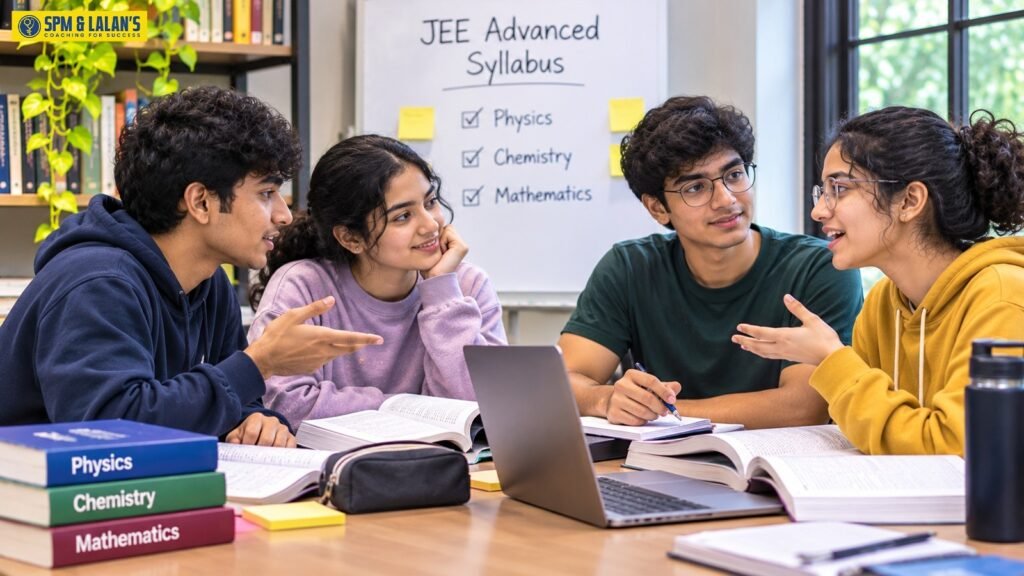
JEE Advanced 2027: Subject-Wise Syllabus Overview
The JEE Advanced 2027 syllabus consists of 3 core subjects: Physics, Chemistry, and Mathematics, commonly known as PCM. In the table below, we have provided a short overview of the subject-wise JEE Advanced 2027 Syllabus
| Subject | Key Sections |
| Physics | Mechanics, Thermal Physics, Electricity & Magnetism, Optics, Modern Physics |
| Chemistry | Physical Chemistry, Organic Chemistry, Inorganic Chemistry |
| Mathematics | Algebra, Calculus, Coordinate Geometry, Trigonometry, Vectors, Probability |
Note: The official JEE Advanced 2027 is not released yet; the above table is based on the 2025 Syllabus. However, the syllabus will likely remain the same for JEE Advanced 2027. But it is recommended that students regularly visit the official JEE Advanced website, jeeadv.ac.in, for any updates to the syllabus.
Students preparing for both examinations should also review the complete JEE Main 2027 syllabus to understand the overlapping topics and plan their preparation effectively.
JEE Advanced Physics Syllabus
The JEE Advanced Physics syllabus requires clear concepts and strong problem-solving skills. It covers Mechanics, Thermal Physics, Electricity and Magnetism, Optics, and Modern Physics. A thorough understanding of these topics in the JEE Advanced 2027 Syllabus helps students tackle questions that combine multiple concepts.
General Physics
| Topic | Subtopics |
| Units and Dimensions | Units and dimensions of physical quantities; dimensional analysis. |
| Measurements and Errors | Least count; significant figures; methods of measurement and error analysis associated with the prescribed experiments. |
| Mechanics-Based Experiments | Vernier callipers and screw gauge; determination of acceleration due to gravity using a simple pendulum; Young’s modulus; surface tension of water by capillary rise and the effect of detergents. |
| Heat, Optics and Sound Experiments | Specific heat of a liquid using a calorimeter; focal length of a concave mirror and a convex lens using the u-v method; speed of sound using a resonance column. |
| Electricity-Based Experiments | Verification of Ohm’s law using a voltmeter and ammeter; specific resistance of a wire using a metre bridge and post office box. |
Mechanics
| Topic | Subtopics |
| Kinematics | Motion in one and two dimensions using Cartesian coordinates only; projectile motion; uniform circular motion; relative velocity. |
| Laws of Motion | Newton’s laws; inertial and uniformly accelerated frames of reference; static and dynamic friction. |
| Work, Energy and Power | Kinetic and potential energy; work and power; conservation of linear momentum and mechanical energy. |
| Systems of Particles and Collisions | Centre of mass and its motion; impulse; elastic and inelastic collisions. |
| Rotational Motion | Rigid bodies; moment of inertia; parallel and perpendicular axes theorems; moment of inertia of uniform bodies with simple geometrical shapes; angular momentum; torque; conservation of angular momentum. |
| Rigid Body Dynamics | Fixed-axis rotation; rolling without slipping of rings, cylinders and spheres; equilibrium of rigid bodies; collisions of point masses with rigid bodies. |
| Oscillations | Linear and angular simple harmonic motion; forced and damped oscillations in one dimension; resonance. |
| Elasticity | Hooke’s law; Young’s modulus; modulus of rigidity; bulk modulus. |
| Gravitation | Law of gravitation; gravitational potential and field; acceleration due to gravity; Kepler’s law; geostationary orbits; circular motion of planets and satellites; escape velocity. |
| Fluid Mechanics | Fluid pressure; Pascal’s law; buoyancy; surface energy and surface tension; angle of contact; drops, bubbles and capillary rise; viscosity, excluding Poiseuille’s equation; Stokes’ law; terminal velocity; streamline flow; equation of continuity; Bernoulli’s theorem and its applications. |
| Waves and Sound | Plane waves only; longitudinal and transverse waves; superposition; progressive and stationary waves; vibrations of strings and air columns; resonance; beats; speed of sound in gases; Doppler effect in sound. |
Thermal Physics
| Topic | Subtopics |
| Thermal Expansion and Calorimetry | Thermal expansion of solids, liquids and gases; calorimetry; latent heat. |
| Heat Transfer | Heat conduction in one dimension; elementary concepts of convection and radiation; Newton’s law of cooling. |
| Ideal Gases | Ideal gas laws; specific heats, Cv and Cp, for monoatomic and diatomic gases; isothermal and adiabatic processes; bulk modulus of gases. |
| Thermodynamics | Equivalence of heat and work; first law and its applications to ideal gases only; second law; reversible and irreversible processes; Carnot engine and its efficiency. |
| Blackbody Radiation | Absorptive and emissive powers; Kirchhoff’s law; Wien’s displacement law; Stefan’s law. |
Electricity and Magnetism
| Topic | Subtopics |
| Electrostatics | Coulomb’s law; electric field and potential; potential energy of a system of point charges; potential energy of electric dipoles in a uniform electrostatic field; electric field lines; electric flux. |
| Gauss’s Law | Gauss’s law and simple applications involving an infinitely long straight wire, a uniformly charged infinite plane sheet and a uniformly charged thin spherical shell. |
| Capacitance | Parallel plate capacitors with and without dielectrics; capacitors in series and parallel; energy stored in a capacitor. |
| Current Electricity | Electric current; Ohm’s law; series and parallel arrangements of resistances and cells; Kirchhoff’s laws and simple applications; heating effect of current. |
| Magnetic Effects of Current | Biot–Savart’s law; Ampere’s law; magnetic field near a current-carrying straight wire, along the axis of a circular coil and inside a long straight solenoid. |
| Magnetic Force and Current Loops | Force on a moving charge and a current-carrying wire in a uniform magnetic field; magnetic moment of a current loop; effect of a uniform magnetic field on a current loop. |
| Electrical Instruments | Moving coil galvanometer; voltmeter and ammeter; conversions between these instruments. |
| Electromagnetic Induction and Circuits | Faraday’s law; Lenz’s law; self and mutual inductance; RC, LR, LC and series LCR circuits with DC and AC sources. |
| Electromagnetic Waves and Spectrum | Characteristics of electromagnetic waves; radio waves, microwaves, infrared, visible light, ultraviolet, X-rays and gamma rays; elementary facts about their uses. |
Optics
| Topic | Subtopics |
| Geometrical Optics | Rectilinear propagation of light; reflection and refraction at plane and spherical surfaces; total internal reflection; deviation and dispersion by a prism; thin lenses; combinations of mirrors and thin lenses; magnification. |
| Interference | Wave nature of light; Huygens’ principle; interference limited to Young’s double-slit experiment. |
| Diffraction and Polarisation | Single-slit diffraction; polarisation; plane-polarised light; Brewster’s law; Polaroids. |
Modern Physics
| Topic | Subtopics |
| Nuclear Physics | Atomic nucleus; alpha, beta and gamma radiations; radioactive decay law; decay constant; half-life and mean life; binding energy and its calculation; nuclear fission and fusion; energy calculations in these processes. |
| Atomic and Quantum Physics | Photoelectric effect; Bohr’s theory of hydrogen-like atoms; characteristic and continuous X-rays; Moseley’s law; de Broglie wavelength of matter waves. |
JEE Advanced Chemistry Syllabus
The JEE Advanced Chemistry syllabus demands conceptual clarity, accurate calculations, and careful revision. It covers Physical Chemistry, Inorganic Chemistry, and Organic Chemistry. Preparing the JEE Advanced Chemistry chapter-wise syllabus systematically helps students connect topics and approach different types of questions with confidence.
Physical Chemistry
| Topic | Subtopics |
| General Topics | Atoms and molecules; Dalton’s atomic theory; mole concept; chemical formulae; balanced chemical equations; mole concept and stoichiometric calculations involving common oxidation-reduction, neutralisation and displacement reactions; mole fraction, molarity, molality and normality. |
| States of Matter: Gases and Liquids | Gas laws; ideal gas equation; absolute temperature scale; deviation from ideal behaviour; van der Waals equation; kinetic theory of gases; average, root mean square and most probable velocities and their relationship with temperature; partial pressures; diffusion; types and distance dependence of intermolecular interactions and their effects on properties; vapour pressure, surface tension and viscosity of liquids. |
| Atomic Structure | Bohr model; hydrogen spectrum; wave-particle duality; de Broglie hypothesis; uncertainty principle; qualitative quantum mechanical picture of hydrogen; energies and quantum numbers; wave function and probability density plots only; shapes of s, p and d orbitals; Aufbau principle; Pauli’s exclusion principle; Hund’s rule. |
| Chemical Thermodynamics | Intensive and extensive properties; state functions; first law; internal energy; pressure-volume work only; heat; enthalpy; heat capacity; standard state; Hess’s law; enthalpies of reaction, fusion and vaporisation; lattice enthalpy; second law; entropy; Gibbs energy; equilibrium and spontaneity criteria. |
| Chemical and Ionic Equilibrium | Law of mass action; significance of ΔG and standard ΔG in equilibrium; Kp, Kc and reaction quotient; Le Chatelier’s principle and effects of concentration, temperature and pressure; solubility product and applications; common ion effect; pH; buffers; Brønsted and Lewis acids and bases; salt hydrolysis. |
| Electrochemistry | Electrochemical cells and reactions; standard electrode potentials; electrochemical work; Nernst equation; electrochemical series; EMF of galvanic cells; Faraday’s laws; electrolytic conductance; specific, equivalent and molar conductivity; Kohlrausch’s law; primary and secondary batteries; fuel cells; corrosion. |
| Chemical Kinetics | Reaction rates; order and molecularity; rate law; rate constant; half-life; differential and integrated rate expressions for zero- and first-order reactions; Arrhenius equation; activation energy; homogeneous and heterogeneous catalysis; activity and selectivity of solid catalysts; enzyme catalysis and its mechanism. |
| Solid State | Classification of solids; crystalline state; seven crystal systems and their cell parameters; cubic and hexagonal close packing; packing in FCC, BCC and HCP lattices; nearest neighbours; ionic radii; radius ratio; point defects. |
| Solutions | Henry’s law; Raoult’s law; ideal solutions; lowering of vapour pressure; elevation of boiling point; depression of freezing point; osmotic pressure; van’t Hoff factor. |
| Surface Chemistry | Physisorption and chemisorption; Freundlich adsorption isotherm; types, preparation and general properties of colloids; emulsions, surfactants and micelles—definitions and examples only. |
Inorganic Chemistry
| Topic | Subtopics |
| Chemical Bonding and Molecular Structure | Orbital overlap; covalent bonding; hybridisation involving s, p and d orbitals only; molecular orbital energy diagrams of homonuclear diatomic species up to Ne₂; hydrogen bonding; molecular polarity and dipole moment; VSEPR model; linear, angular, triangular, square planar, pyramidal, square pyramidal, trigonal bipyramidal, tetrahedral and octahedral shapes. |
| Classification of Elements and Periodicity in Properties | Modern periodic law; present form of the periodic table; electronic configurations; trends in atomic and ionic radii, ionisation enthalpy, electron gain enthalpy, valence, oxidation states, electronegativity and chemical reactivity. |
| Hydrogen | Position in the periodic table; occurrence; isotopes; preparation, properties and uses; ionic, covalent and interstitial hydrides; physical and chemical properties of water and heavy water; preparation, reactions, uses and structure of hydrogen peroxide; hydrogen as a fuel. |
| s-Block Elements | Reactivity of alkali and alkaline earth metals towards air, water, hydrogen, halogens and acids; reducing nature, including solutions in liquid ammonia; uses; characteristics of oxides, hydroxides, halides and salts of oxoacids; anomalous behaviour of lithium and beryllium; preparation, properties and uses of sodium carbonate, sodium chloride, sodium hydroxide, sodium hydrogen carbonate, calcium oxide, calcium hydroxide, calcium carbonate and calcium sulphate. |
| p-Block Elements: General Trends | Oxidation states and chemical reactivity trends in Groups 13–17; anomalous behaviour of boron, carbon, nitrogen, oxygen and fluorine compared with other elements in their groups. |
| Group 13 | Reactivity towards acids, alkalis and halogens; preparation, properties and uses of borax, orthoboric acid, diborane, boron trifluoride, aluminium chloride and alums; uses of boron and aluminium. |
| Group 14 | Reactivity towards water and halogens; carbon allotropes and uses of carbon; preparation, properties and uses of carbon monoxide, carbon dioxide, silicon dioxide, silicones, silicates and zeolites. |
| Group 15 | Reactivity towards hydrogen, oxygen and halogens; phosphorus allotropes; preparation, properties and uses of nitrogen, ammonia, nitric acid, phosphine, phosphorus trichloride and phosphorus pentachloride; nitrogen oxides; phosphorus oxoacids. |
| Group 16 | Reactivity towards hydrogen, oxygen and halogens; simple oxides; sulphur allotropes; preparation or manufacture, properties and uses of oxygen, ozone, sulphur dioxide and sulphuric acid; sulphur oxoacids. |
| Group 17 | Reactivity towards hydrogen, oxygen and metals; preparation or manufacture, properties and uses of chlorine, hydrogen chloride and interhalogen compounds; halogen oxoacids; bleaching powder. |
| Group 18 | Chemical properties and uses; xenon compounds with fluorine and oxygen. |
| d-Block Elements | Oxidation states and their stability; standard electrode potentials; interstitial compounds; alloys; catalytic properties; applications; preparation, structure and reactions of chromium and manganese oxoanions. |
| f-Block Elements | Lanthanoid and actinoid contractions; oxidation states; general characteristics. |
| Coordination Compounds | Werner’s theory; nomenclature; cis-trans and ionisation isomerism; hybridisation and linear, tetrahedral, square planar and octahedral geometries of mononuclear compounds; valence bond theory; crystal field theory for octahedral and tetrahedral fields; spin-only magnetic properties and colour of 3d-series compounds; ligands; spectrochemical series; stability; importance and applications; metal carbonyls. |
| Isolation of Metals | Metal ores and concentration; extraction of crude metals; thermodynamic principles for iron, copper and zinc; electrochemical principles for aluminium; cyanide process for silver and gold; refining. |
| Principles of Qualitative Analysis | Groups I–V, restricted to Ag⁺, Hg²⁺, Cu²⁺, Pb²⁺, Fe³⁺, Cr³⁺, Al³⁺, Ca²⁺, Ba²⁺, Zn²⁺, Mn²⁺ and Mg²⁺; nitrate; halides excluding fluoride; carbonate; bicarbonate; sulphate; sulphide. |
| Environmental Chemistry | Atmospheric, water and soil pollution; industrial waste; pollution-control strategies; green chemistry. |
Organic Chemistry
| Topic | Subtopics |
| Basic Principles of Organic Chemistry | Carbon hybridisation; sigma and pi bonds; shapes of simple organic molecules; aromaticity; structural and geometrical isomerism; enantiomers, diastereomers and meso compounds with up to two asymmetric centres, excluding R/S and E/Z configurations; empirical and molecular formula determination by combustion only; IUPAC nomenclature of hydrocarbons, simple cyclic hydrocarbons and their monofunctional and bifunctional derivatives; hydrogen bonding effects; inductive, resonance and hyperconjugative effects; acidity and basicity; homolytic and heterolytic bond cleavage; formation, structure and stability of carbocations, carbanions and free radicals. |
| Alkanes | Homologous series; melting points, boiling points and density; effects of branching; ethane and butane conformations using Newman projections only; preparation from alkyl halides and aliphatic carboxylic acids; combustion; halogenation, including allylic and benzylic halogenation; oxidation. |
| Alkenes and Alkynes | Boiling points, density and dipole moments; preparation by elimination; acid-catalysed hydration, excluding stereochemistry of addition and elimination; metal acetylides; alkene reactions with potassium permanganate and ozone; reduction; electrophilic addition of X₂, HX and HOX to alkenes; peroxide effect; cyclic polymerisation of alkynes. |
| Benzene | Structure; electrophilic substitution through halogenation, nitration, sulphonation, Friedel–Crafts alkylation and acylation; directing effects in monosubstituted benzene. |
| Phenols | Physical properties; preparation; halogenation, nitration and sulphonation; Reimer–Tiemann and Kolbe reactions; esterification; etherification; aspirin synthesis; oxidation and reduction. |
| Alkyl Halides | Alkyl carbocation rearrangements; Grignard reactions; nucleophilic substitution reactions and their stereochemical aspects. |
| Alcohols | Physical properties; esterification; dehydration to alkenes and ethers; reactions with sodium, phosphorus halides, zinc chloride/concentrated hydrochloric acid and thionyl chloride; conversion into aldehydes, ketones and carboxylic acids. |
| Ethers | Williamson’s synthesis; carbon–oxygen bond cleavage reactions. |
| Aldehydes and Ketones | Preparation from acid chlorides and nitriles; aldehydes from esters; benzaldehyde from toluene and benzene; oxidation; reduction; oxime and hydrazone formation; aldol condensation; Cannizzaro and haloform reactions; nucleophilic addition with RMgX, sodium hydrogen sulphite, hydrogen cyanide, alcohols and amines. |
| Carboxylic Acids | Physical properties; preparation from nitriles and Grignard reagents; hydrolysis of esters and amides; benzoic acid from alkylbenzenes; reduction; halogenation; formation of esters, acid chlorides and amides. |
| Amines | Preparation from nitro compounds, nitriles and amides; Hoffmann bromamide degradation; Gabriel phthalimide synthesis; reactions with nitrous acid; azo coupling of aromatic diazonium salts; Sandmeyer and related diazonium salt reactions; carbylamine reaction; Hinsberg test; alkylation and acylation. |
| Haloarenes | Fittig and Wurtz–Fittig reactions; nucleophilic aromatic substitution in haloarenes and substituted haloarenes, excluding benzyne mechanism and cine substitution. |
| Biomolecules: Carbohydrates | Classification; monosaccharides and disaccharides, including glucose and sucrose; oxidation; reduction; glycoside formation; hydrolysis of sucrose, maltose and lactose; anomers. |
| Biomolecules: Proteins and Nucleic Acids | Amino acids; peptide linkage; primary and secondary structures of peptides; fibrous and globular proteins; chemical composition and structure of DNA and RNA. |
| Polymers | Addition and condensation polymerisation; homopolymers and copolymers; natural rubber; cellulose; nylon; Teflon; Bakelite; PVC; biodegradable polymers; applications. |
| Chemistry in Everyday Life | Drug-target interactions; therapeutic actions and examples of antacids, antihistamines, tranquillisers, analgesics, antimicrobials and antifertility drugs, excluding structures; artificial sweeteners—names only; soaps, detergents and cleansing action. |
| Practical Organic Chemistry | Detection of nitrogen, sulphur and halogens; detection and identification of alcoholic and phenolic hydroxyl, aldehyde and ketone carbonyl, carboxyl, amino and nitro groups. |
JEE Advanced Mathematics Syllabus
The JEE Advanced Mathematics syllabus demands both speed and conceptual precision. It covers Algebra, Trigonometry, Probability, Differential Calculus, Integral Calculus, and Coordinate Geometry. Mastering the JEE Advanced Maths chapter-wise syllabus helps students build the accuracy and flexibility needed to solve challenging problems within the available time.
Sets, Relations and Functions
| Topic | Subtopics |
| Sets | Representations of sets; empty, finite and infinite sets; algebra of sets; intersection, complement, difference and symmetric difference; algebraic properties; De Morgan’s laws for a finite number of sets; related practical problems. |
| Relations | Cartesian product of finite sets; ordered pairs; relations; domain and codomain; equivalence relations. |
| Functions | Functions as special relations and mappings; domain, codomain and range; invertible, even, odd, into, onto and one-to-one functions; polynomial, trigonometric, exponential, logarithmic, power, absolute value and greatest integer functions; sum, difference, product and composition of functions. |
Algebra
| Topic | Subtopics |
| Complex Numbers | Addition, multiplication and conjugation; polar representation; modulus and principal argument; triangle inequality; cube roots of unity; geometrical interpretations. |
| Quadratic Equations | Statement of the fundamental theorem of algebra; quadratic equations with real coefficients; relationships between roots and coefficients; formation of equations with given roots; symmetric functions of roots. |
| Sequences and Series | Arithmetic and geometric progressions; arithmetic and geometric means; finite AP and GP sums; infinite geometric series; sums of the first n natural numbers, their squares and their cubes. |
| Logarithms | Logarithms and their properties. |
| Permutations and Combinations | Permutations and combinations. |
| Binomial Theorem | Binomial theorem for a positive integral index; properties of binomial coefficients. |
Matrices
| Topic | Subtopics |
| Matrix Operations | Matrices as rectangular arrays of real numbers; equality; addition; scalar multiplication; matrix multiplication; transpose; elementary row and column transformations; properties of these operations. |
| Determinants and Inverses | Determinants of square matrices up to order three; adjoint; inverses of square matrices up to order three. |
| Special Matrices and Linear Equations | Diagonal, symmetric and skew-symmetric matrices and their properties; simultaneous linear equations in two or three variables. |
Probability and Statistics
| Topic | Subtopics |
| Probability | Random experiments; sample space; impossible, simple and compound events; addition and multiplication rules; conditional probability; independent events; total probability; Bayes’ theorem; probability calculations using permutations and combinations. |
| Statistics | Measures of central tendency and dispersion; mean, median and mode; mean deviation; standard deviation and variance of grouped and ungrouped data; analysis of frequency distributions with the same mean but different variances. |
| Random Variables | Random variables and their mean and variance. |
Trigonometry
| Topic | Subtopics |
| Trigonometric Functions | Periodicity and graphs; addition and subtraction formulae; multiple- and sub-multiple-angle formulae; general solutions of trigonometric equations. |
| Inverse Trigonometric Functions | Principal values only; elementary properties. |
Analytical Geometry
| Topic | Subtopics |
| Two-Dimensional Coordinates | Cartesian coordinates; distance between two points; section formulae; shift of origin. |
| Straight Lines | Equations in various forms; angle between lines; distance of a point from a line; lines through the intersection of two given lines; angle bisectors; concurrency of lines. |
| Triangle Centres | Centroid, orthocentre, incentre and circumcentre. |
| Circles | Equations in various forms; tangents, normals and chords; parametric equations; intersection with a straight line or another circle; circles through the intersection points of two circles or a circle and a straight line. |
| Conic Sections | Standard equations of parabola, ellipse and hyperbola; foci, directrices and eccentricity; parametric equations; tangents and normals. |
| Locus | Locus problems. |
| Three-Dimensional Geometry | Distance between points; direction cosines and ratios; equations of straight lines in space; skew lines; shortest distance between two lines; equations of planes; distance of a point from a plane; angles between two lines, two planes, and a line and a plane; coplanar lines. |
Differential Calculus
| Topic | Subtopics |
| Limits and Continuity | Limits at a real number; continuity; limits and continuity of sums, differences, products and quotients; L’Hospital’s rule; continuity of composite functions; intermediate value property. |
| Differentiation | Derivatives of sums, differences, products and quotients; chain rule; derivatives of polynomial, rational, trigonometric, inverse trigonometric, exponential and logarithmic functions; second-order derivatives; implicit differentiation up to order two; geometrical interpretation of derivatives. |
| Applications of Derivatives | Tangents and normals; increasing and decreasing functions; maximum and minimum values. |
| Mean Value Theorems | Rolle’s theorem; Lagrange’s mean value theorem; geometrical interpretations of both theorems. |
Integral Calculus
| Topic | Subtopics |
| Indefinite Integration | Integration as the inverse of differentiation; standard integrals; integration by parts, substitution and partial fractions. |
| Definite Integration | Definite integrals as limits of sums; properties of definite integrals; fundamental theorem of integral calculus. |
| Applications of Integration | Areas bounded by simple curves using definite integrals. |
| Differential Equations | Formation of ordinary differential equations; homogeneous differential equations of first order and first degree; separation of variables; linear first-order differential equations. |
How to Download the JEE Advanced 2027 Syllabus?
Follow these steps to download the JEE Advamced 2027 Syllabus, once it is officially released
- Visit the Official Website:
Go to jeeadv.ac.in to find the official information brochure and syllabus. - Find the Syllabus Section:
Look for the “Syllabus” link on the homepage. You may find it under “Important Links” or the “Examination” menu. - Choose the Correct Year:
Check that you are opening the JEE Advanced 2027 syllabus, rather than an older version. - Download the PDF:
Click on the syllabus link to open the PDF, then download it to your device. - Save or Print a Copy:
Keep the PDF saved for easy access. You can also print it if you prefer referring to a paper copy while studying. - Review the Topics Carefully:
Read through the JEE Advanced chapter-wise syllabus
Conclusion
Understanding the JEE Advanced 2027 Syllabus is the first step towards focused preparation. Use the subject-wise topics to plan your studies and give Physics, Chemistry, and Mathematics regular attention. Build clear concepts, practise previous years’ questions, and make time for revision. You do not have to master everything at once—steady, daily progress can help you build confidence. Also, check the official syllabus when it becomes available and adjust your study plan accordingly.
Students looking for the best coaching for JEE Advanced can explore the structured JEE preparation programmes offered by SPM & Lalan’s in Guwahati.
For expert guidance, structured study plans, and preparation resources for engineering entrance examinations, explore SPM & Lalan’s Coaching Centres in Guwahati and learn more about their JEE Main and Advanced preparation programmes.
Students and parents interested in visiting the institute can view SPM & Lalan’s location on Google Maps for directions and location information.
Frequently Asked Questions
Q1. What subjects does the JEE Advanced 2027 Syllabus cover?
The JEE Advanced 2027 Syllabus covers Physics, Chemistry, and Mathematics, drawing on Class 11 and 12 concepts. Use the subject-wise topics to organise your preparation and identify areas that need more practice. When the official syllabus becomes available, check it carefully before finalising your study plan.
Q2. How can I prepare effectively for JEE Advanced 2027?
Start by understanding the syllabus and setting small, realistic study goals. Give Physics, Chemistry, and Mathematics regular attention, and focus on understanding concepts before attempting difficult questions. Solve previous years’ papers, review your mistakes, and take mock tests. Consistent practice and revision can build your confidence.
Q3. How can I download the official JEE Advanced 2027 syllabus PDF?
To download the official syllabus PDF, visit the JEE Advanced website and look for the syllabus section. Once the 2027 version is available, open the document and check the year before saving it. Keep a copy handy so you can track topics throughout your exam preparation.
READ MORE:

This article is written by the SPM & LALAN’S Content Team, a group of skilled writers, researchers, and content strategists passionate about creating accurate, reliable, and student-friendly educational content. Every article is thoroughly researched, fact-checked, and updated to ensure readers receive trustworthy and relevant information. The goal is to help students make informed academic decisions through clear, well-researched, and easy-to-understand content.