
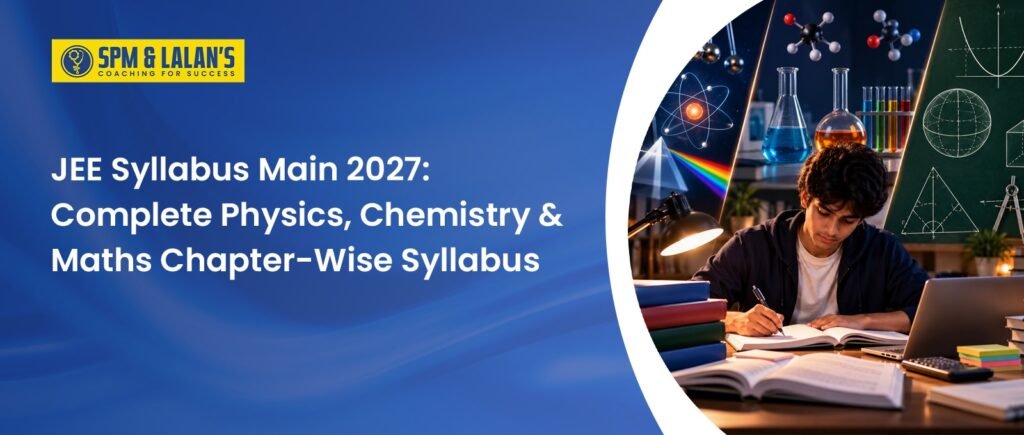
The JEE Syllabus Main 2027 is the starting point for every serious engineering aspirant. Before making a study timetable or buying books, you should know exactly what you need to study. It helps you avoid wasting time on topics that are not part of the exam. For Paper 1, which is for B.E./B.Tech. admission, the paper covers Physics, Chemistry, and Mathematics. Each subject has important Class 11 and Class 12 concepts. So, build your preparation around the official topic list and revise it regularly. Before setting your study deadlines, check the JEE Main 2027 exam date and follow official NTA updates to plan your preparation.
In this article, we will discuss the JEE Main Syllabus 2027 in a simple, chapter-wise format. It focuses only on the topics you need to cover for your preparation. The JEE Main Syllabus 2027 comprises three core subjects: Physics, Chemistry, and Mathematics, covering topics from the NCERT curriculum of Classes 11 and 12. Key areas include Mechanics, Electricity and Magnetism, Organic and Inorganic Chemistry, Algebra, Calculus, Coordinate Geometry, and Trigonometry. A clear understanding of the syllabus helps aspirants identify important topics, prioritise their preparation, develop an effective study plan, and prepare strategically for the examination.

JEE Syllabus Main 2027: Paper 1 at a Glance
The Paper 1 syllabus has three core subjects. You need a strong grip on concepts, formulas, numerical practice and problem-solving. In addition, practical and application-based questions can appear in Physics and Chemistry.
| Subject | Main areas to cover |
| Mathematics | Algebra, calculus, coordinate geometry, vectors, probability and trigonometry |
| Physics | Mechanics, heat, electricity, magnetism, optics, modern physics and experiments |
| Chemistry | Physical, inorganic, organic and practical chemistry |
The JEE Main Syllabus 2027 is broad, but it becomes easier when you divide it subject-wise. Start with the basics. Then move to chapter questions and timed practice.
What Is the JEE Main 2027 Mathematics Syllabus?
Mathematics needs daily practice. It is not enough to understand a formula once. You must solve different types of questions and learn where each formula applies. The JEE Syllabus Main 2027 Maths section includes the following chapters.
| Chapter group | Topics included |
| Sets, relations and functions | Sets, union, intersection, complement, relations, functions, one-one and onto functions |
| Complex numbers and quadratic equations | Argand plane, modulus, argument, roots, coefficients and quadratic equations |
| Matrices and determinants | Types of matrices, determinants, inverse matrices and linear equations |
| Permutations and combinations | Counting principle, permutations, combinations and simple applications |
| Binomial theorem | General term, middle term and basic applications |
| Sequence and series | Arithmetic progression, geometric progression, A.M. and G.M. |
| Limits, continuity and differentiability | Functions, limits, derivatives, maxima, minima and rate of change |
| Integral calculus | Indefinite integration, definite integration, area under curves and properties of integrals |
| Differential equations | Order, degree, separation of variables and linear equations |
| Coordinate geometry | Straight lines, circles, parabola, ellipse and hyperbola |
| Three-dimensional geometry | Points in space, direction ratios, direction cosines and lines |
| Vector algebra | Scalars, vectors, vector addition, dot product and cross product |
| Statistics and probability | Mean, median, mode, variance, standard deviation and probability |
| Trigonometry | Trigonometric identities, functions and inverse trigonometric functions |
Calculus, coordinate geometry and algebra need extra attention because they carry many connected ideas. For example, limits help in differentiation, and differentiation helps in applications of derivatives. Therefore, study them in the correct order.
While following the JEE Syllabus Main 2027, do not leave probability, statistics or vectors for the last month. These chapters may look small, but regular practice can make them scoring areas.
What Is the JEE Main 2027 Physics Syllabus?
Physics is about understanding how things work. First, learn the concept. Next, connect it with formulas. Finally, solve numerical questions. The Syllabus of the Physics section covers both theory and experimental skills.
| Chapter group | Topics included |
| Units and measurements | SI units, dimensions, significant figures, errors and dimensional analysis |
| Kinematics | Motion in a straight line, motion in a plane, projectile motion and circular motion |
| Laws of motion | Newton’s laws, friction, momentum, impulse and centripetal force |
| Work, energy and power | Work-energy theorem, power, springs, collisions and conservation of energy |
| Rotational motion | Centre of mass, torque, angular momentum, moment of inertia and rigid body motion |
| Gravitation | Universal gravitation, satellites, escape velocity and Kepler’s laws |
| Properties of solids and liquids | Elasticity, fluids, viscosity, surface tension, heat and thermal expansion |
| Thermodynamics | Heat, work, internal energy, first law, second law and thermal processes |
| Kinetic theory of gases | Gas laws, RMS speed, degrees of freedom and kinetic theory |
| Oscillations and waves | SHM, pendulum, waves, sound, beats, strings and organ pipes |
| Electrostatics | Charges, electric field, potential, capacitors and Gauss’s law |
| Current electricity | Ohm’s law, resistance, cells, Kirchhoff’s laws and Wheatstone bridge |
| Magnetism | Biot-Savart law, Ampere’s law, magnetic force, galvanometer and magnetic materials |
| EMI and alternating current | Faraday’s law, Lenz’s law, inductance, AC circuits, generator and transformer |
| Electromagnetic waves | Spectrum, properties and uses of electromagnetic waves |
| Optics | Mirrors, lenses, refraction, prism, interference, diffraction and polarization |
| Dual nature of matter and radiation | Photoelectric effect, Einstein’s equation and de Broglie relation |
| Atoms and nuclei | Bohr model, hydrogen spectrum, mass defect, fission and fusion |
| Electronic devices | Semiconductors, diodes, solar cells, Zener diode and logic gates |
| Experimental skills | Vernier calipers, screw gauge, pendulum, metre bridge, optics and diode experiments |
Mechanics forms the base of Physics. Therefore, start with units, motion, laws of motion, and work-energy-power. After that, move to rotation and gravitation. Similarly, learn electrostatics before current electricity and magnetism.
The JEE Syllabus Main 2027 also includes experimental skills. So, do not ignore them. Understand the purpose of each experiment, the instrument used, and the observation involved.
What Is the JEE Main 2027 Chemistry Syllabus?
Chemistry has three major parts: Physical Chemistry, Inorganic Chemistry, and Organic Chemistry. Each part needs a different method. Physical Chemistry needs calculations. Inorganic Chemistry needs clear facts and patterns. Organic Chemistry needs an understanding of reactions.
The JEE Syllabus Main 2027 Chemistry topics are given below.
| Chemistry section | Chapters included |
| Physical Chemistry | Basic concepts of chemistry, atomic structure, chemical bonding, thermodynamics, solutions, equilibrium, redox reactions, electrochemistry and chemical kinetics |
| Inorganic Chemistry | Periodic classification, p-block elements, d-block and f-block elements, coordination compounds |
| Organic Chemistry | Purification and characterisation, basic principles of organic chemistry, hydrocarbons, halo compounds, oxygen compounds, nitrogen compounds and biomolecules |
| Practical Chemistry | Functional-group tests, salt analysis, titration principles, preparations and basic experiments |
In Physical Chemistry, focus on the mole concept, chemical equilibrium, thermodynamics, electrochemistry, and kinetics. These chapters need formula practice. Write important formulas in one notebook. Then revise them every week.
In Inorganic Chemistry, understand the periodic table first. It makes p-block, d-block, and f-block easier. Read each trend carefully, such as oxidation state, size, colour, and reactivity. Moreover, revise coordination compounds often because the naming rules and concepts need repetition.
Organic Chemistry becomes easier when you first learn basic principles. Start with nomenclature, isomerism, electronic effects, electrophiles and nucleophiles. Then study hydrocarbons and functional groups. Do not try to memorise every reaction without understanding the reason behind it.
The JEE Syllabus contains also includes biomolecules and practical chemistry. These are important for a complete preparation plan. Keep short notes for named reactions, tests, important compounds, and common exceptions.
JEE Main 2027 Chapter-Wise Syllabus: How to Study It
A chapter list becomes useful only when you turn it into a daily plan. First, mark each chapter as easy, moderate or difficult. Then begin with the basic chapters that support other topics. For a structured plan covering syllabus completion, revision and mock tests, follow our JEE Main 2027 preparation strategy.
For Mathematics, complete functions before calculus. For Physics, finish mechanics before moving to advanced topics. For Chemistry, study atomic structure and chemical bonding before inorganic topics. This method builds confidence because every new chapter feels more connected.
Use three simple steps for each chapter:
- Read the concept from NCERT and class notes.
- Solve basic examples before attempting higher-level questions.
- Review mistakes after every practice session.
Also, revise old chapters while learning new ones. Otherwise, you may understand a topic today and forget it after two weeks. A short weekly revision keeps the entire JEE Syllabus Main 2027 active in your mind.
JEE Main 2027 Deleted Syllabus: What to Keep in Mind
Do not prepare from random old chapter lists. Always match your notes and study material with the current syllabus used for your preparation. If a topic is not listed, do not spend too much time on it. Instead, use that time to revise the listed chapters well.
However, do not make assumptions based only on coaching notes or social media posts. Keep your preparation focused on the complete subject-wise list. This gives you a clear direction and prevents confusion close to the exam.
A Simple Subject-Wise Preparation Approach
Maths requires practice every day. Physics requires concepts plus numerical solving. Chemistry requires a mix of learning, revision, and application. Therefore, do not study all three subjects in the same way.
For Maths, solve questions with a timer. For Physics, draw diagrams and write down the given values before solving. For Chemistry, revise NCERT-based facts and make short reaction notes. These small habits make the JEE Syllabus Main 2027 easier to manage. Students preparing for both Main and Advanced can explore JEE Advanced coaching in Guwahati for structured lessons and guided problem-solving practice.
Also, avoid studying only your favourite subject. A balanced routine matters. Even if you are strong in Mathematics, give regular time to Chemistry and Physics. Your final score depends on all three subjects. To explore classroom preparation options, visit SPM & Lalan’s coaching centres in Guwahati and learn about the available courses.
What Is the JEE Main Syllabus for Paper 2A (B.Arch)?
The JEE Main Paper 2A syllabus is designed for students seeking admission to the Bachelor of Architecture (B.Arch) programme. It consists of three parts: Mathematics, General Aptitude, and Drawing. Candidates should prepare for all three sections to develop their mathematical knowledge, spatial reasoning, architectural awareness, and drawing skills.
1. Mathematics Syllabus
The Mathematics syllabus for JEE Main Paper 2A is the same as that for Paper 1 (B.E./B.Tech.). It covers topics from the Class 11 and Class 12 Mathematics curriculum, including Algebra, Calculus, Coordinate Geometry, Trigonometry, and Probability.
2. General Aptitude Syllabus
The General Aptitude section evaluates candidates’ visualisation skills, analytical reasoning, spatial awareness, and understanding of architectural forms and design.
| Section | Topics Covered |
| Part I: Awareness and Reasoning | Awareness of places, people, buildings, materials, and objects; visualising different sides of three-dimensional objects; interpreting 3D objects from 2D drawings; verbal, numerical, and visual reasoning. |
| Part II: Visual and Architectural Aptitude | Understanding scale and proportion; appreciation of building forms, textures, colours, harmony, and contrast; designing abstract and geometric patterns; transforming 2D and 3D forms through rotation, addition, and subtraction; developing surfaces and volumes; preparing plans, elevations, and 3D views; creating compositions using shapes and forms. |
3. Drawing Test Syllabus
The Drawing Test evaluates candidates’ ability to represent objects, spaces, and scenes through sketches. It focuses on visual creativity, proportion, observation, and the ability to translate ideas into drawings.
Important topics include:
- Sketching scenes from memory, such as markets, public spaces, festivals, streets, monuments, and recreational areas.
- Drawing natural landscapes featuring rivers, gardens, trees, plants, and forests.
- Representing rural life and everyday activities.
- Understanding perspective, proportion, composition, and spatial relationships.
- Creating drawings that demonstrate observation skills and visual imagination.
What Is the JEE Main Syllabus for Paper 2B (B.Planning)?
JEE Main Paper 2B is intended for candidates seeking admission to the Bachelor of Planning (B.Plan) programme. The examination consists of Mathematics, General Aptitude, and Planning-based questions.
The Mathematics and General Aptitude sections follow the same syllabus as Paper 2A (B.Arch), while the third section focuses on planning, urban development, social sciences, and analytical thinking.
1. Mathematics Syllabus
The Mathematics syllabus for Paper 2B is the same as that for Paper 1 (B.E./B.Tech.). Candidates should prepare all prescribed topics, including Algebra, Calculus, Coordinate Geometry, Vector Algebra, Three-Dimensional Geometry, and Statistics and Probability.
2. General Aptitude Syllabus
The General Aptitude section assesses candidates’ logical reasoning, visualisation, analytical ability, and awareness of their surroundings. Candidates should practise verbal, numerical, and visual reasoning questions, along with questions involving spatial perception and three-dimensional objects.
3. Planning Syllabus
The Planning section evaluates candidates’ understanding of society, development, urbanisation, geography-related concepts, and quantitative reasoning.
| Unit | Topics Covered |
| Unit 1: General Awareness | General knowledge; prominent cities; urban development issues; government programmes and initiatives. |
| Unit 2: Social Sciences | Nationalism and colonialism; industrialisation; resources and development; agriculture, water, and minerals; industries and the national economy; human settlements; democracy, federalism, political parties, and the Constitution of India; economic development, poverty, globalisation, population structure, social inequality, urbanisation, rural development, and colonial cities. |
| Unit 3: Thinking Skills | Reading comprehension; map reading; scale, distance, direction, and area; critical reasoning; interpretation of charts, graphs, and tables; basic statistics and quantitative reasoning. |
Note: Candidates should verify the final topic list against the official JEE Main 2027 syllabus released by the National Testing Agency (NTA).
What Is the Best Study Material for JEE Main 2027 Preparation?
Choosing the right study material helps candidates build strong concepts, practise exam-level questions, and improve their time management. Rather than relying on too many books, students should focus on a few reliable resources and use them consistently.
The following resources can support JEE Main 2027 preparation:
- NCERT textbooks: Build a strong foundation in Physics, Chemistry, and Mathematics for Paper 1 and the Mathematics sections of Paper 2A and Paper 2B.
- JEE Main previous year question papers: Understand question formats, recurring concepts, and the difficulty level of the examination.
- Mock tests: Practise under timed conditions, assess preparation, and identify areas that need improvement.
- Sample papers: Familiarise yourself with the paper structure and practise applying concepts across different topics.
- Topic-wise practice questions: Strengthen individual concepts and improve accuracy through regular revision and problem-solving.
- Drawing practice for B.Arch: Work on sketching, perspective, proportion, composition, and visual representation.
- Planning and aptitude practice for B.Plan: Practise reasoning, map interpretation, comprehension, data interpretation, and questions related to planning and development.
Important JEE Main Preparation Resources
Students can also use the following resources to organise their preparation:
- JEE Main Mock Tests
- JEE Main Sample Papers
- JEE Main Previous Year Question Papers
What Is the JEE Main 2027 Exam Pattern?
The JEE Main examination has three papers: Paper 1 for B.E./B.Tech., Paper 2A for B.Arch, and Paper 2B for B.Planning. Each paper has a different structure, subject combination, and marking scheme.
The following tables present the pattern followed in the 2026 examination. Candidates preparing for JEE Main 2027 should verify the final pattern against the official 2027 information bulletin before relying on these details.
JEE Main Paper 1 Exam Pattern (B.E./B.Tech.)
Paper 1 assesses candidates in Physics, Chemistry, and Mathematics. The examination is conducted in computer-based test (CBT) mode.
| Subject | Section A (MCQs) | Section B (Numerical) | Total Marks |
| Physics | 20 | 5 | 100 |
| Chemistry | 20 | 5 | 100 |
| Mathematics | 20 | 5 | 100 |
| Total | 60 | 15 | 300 |
- Total questions: 75
- Questions to be attempted: 75
- Maximum marks: 300
- Marking scheme: +4 for each correct answer, −1 for each incorrect answer, and 0 for an unanswered question.
JEE Main Paper 2A Exam Pattern (B.Arch)
Paper 2A consists of Mathematics, General Aptitude, and Drawing. Mathematics and General Aptitude are conducted in CBT mode, while the Drawing Test is conducted in pen-and-paper mode.
| Subject | Question Distribution | Total Marks |
| Mathematics | 20 MCQs + 5 numerical-value questions | 100 |
| General Aptitude | 50 MCQs | 200 |
| Drawing Test | 2 questions | 100 |
| Total | 77 questions | 400 |
- Total questions: 77
- Maximum marks: 400
- Mathematics: 100 marks
- General Aptitude: 200 marks
- Drawing Test: 100 marks
For Mathematics, the marking scheme is +4 for a correct answer, −1 for an incorrect answer, and 0 for an unanswered question. Candidates should check the official bulletin for the applicable marking and evaluation rules for the Drawing Test.
JEE Main Paper 2B Exam Pattern (B.Planning)
Paper 2B assesses Mathematics, General Aptitude, and Planning. All three parts are conducted in computer-based test mode.
| Subject | Question Distribution | Total Marks |
| Mathematics | 20 MCQs + 5 numerical-value questions | 100 |
| General Aptitude | 50 MCQs | 200 |
| Planning-Based Questions | 25 MCQs | 100 |
| Total | 100 questions | 400 |
- Total questions: 100
- Maximum marks: 400
- Mathematics: 100 marks
- General Aptitude: 200 marks
- Planning: 100 marks
The Mathematics section includes negative marking for incorrect answers under the notified examination scheme. Candidates should consult the official information bulletin for the complete marking rules applicable to each section.
Conclusion
The JEE Syllabus Main 2027 gives you a clear map for your preparation. You do not need to study everything at once. Begin with the basics, complete one chapter at a time, and revise regularly. Focus on concepts first, then solve questions with care. Most importantly, stay consistent. A well-planned study routine, chapter-wise revision, and regular mock practice can help you cover the syllabus without feeling overwhelmed.
Planning a visit? View our coaching centre location on Google Maps for directions.
Frequently Asked Questions (FAQs)
Q1. What subjects are included in JEE Main Paper 1?
JEE Main Paper 1 includes Physics, Chemistry, and Mathematics. Physics covers mechanics, electricity, optics, and modern physics. Chemistry includes physical, inorganic, and organic chemistry. Mathematics covers algebra, calculus, coordinate geometry, vectors, probability, and trigonometry. Students should prepare all three subjects with equal attention.
Q2. Should I study every chapter in the syllabus?
Yes, you should cover every listed chapter because questions can come from any unit. However, you can give more practice time to difficult and high-weightage areas. First, complete the basics, then solve chapter-wise questions. Regular revision will help you remember small but important topics.
Q3. How should I revise the syllabus before JEE Main?
Make short notes for formulas, reactions, definitions, and common mistakes. Revise one subject every day and solve mixed questions from completed chapters. In the final weeks, take mock tests and analyse errors. This helps you identify weak chapters and improve both speed and accuracy.
Choosing the right mentors can make a significant difference in NEET and JEE preparation. In a recent feature, The Assam Tribune highlights the expert faculty at SPM & Lalan’s Coaching, Guwahati, and their role in guiding aspirants towards their academic goals. The article offers a glimpse into the educators, their expertise, and the importance of the right guidance in competitive exam preparation. Read the full article to meet the mentors and discover what makes their approach to NEET and JEE preparation worth exploring.
READ MORE:

This article is written by the SPM & LALAN’S Content Team, a group of skilled writers, researchers, and content strategists passionate about creating accurate, reliable, and student-friendly educational content. Every article is thoroughly researched, fact-checked, and updated to ensure readers receive trustworthy and relevant information. The goal is to help students make informed academic decisions through clear, well-researched, and easy-to-understand content.