
The scope of biotechnology in India covers fields such as drug development, diagnostics, agriculture, food production, biomanufacturing, and bioinformatics. After Class 12, students can pursue a B.Sc. in Biotechnology for a life sciences route or a B.Tech. in Biotechnology for an engineering route. Graduates can explore roles in quality control, production, clinical research and biological data analysis. An approximate salary range for fresher biotechnologists is ₹2.9 lakh to ₹6.3 lakh per year, with actual offers varying by role, employer and location.
In this article, we will discuss biotechnology in detail and its courses after 12th, career opportunities, jobs, and salary in India.
What Is Biotechnology?
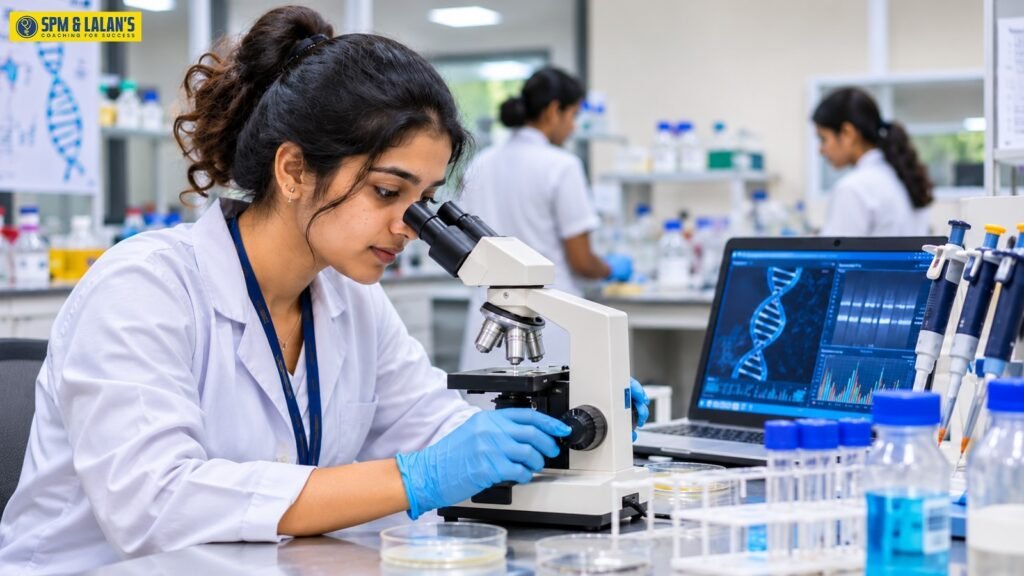
Biotechnology uses living organisms, cells, or biological molecules to develop products and solve practical problems. For example, scientists use microorganisms to produce insulin, food companies use fermentation to make yoghurt, and diagnostic laboratories use molecular tests to detect signs of disease.
The scope of biotechnology in India goes beyond laboratory research. It includes producing biological medicines at scale, checking the quality of food and medicines, managing clinical trial data and analysing genetic information.
What Is Driving the Scope of Biotechnology in India?
India’s bioeconomy reached US$195.3 billion in 2025, up from US$165 billion in 2024, according to the India BioEconomy Report 2026. India aims to reach US$300 billion by 2030. The government’s BioE3 Policy, short for Biotechnology for Economy, Environment and Employment, supports high-performance biomanufacturing in areas such as bio-based materials, functional foods, precision therapeutics, climate-resilient agriculture and biofuels.
These developments broaden the scope of biotechnology in India across several industries:
| Sector | What biotechnology professionals work on |
| Healthcare and pharmaceuticals | Biologic medicines, vaccines, biosimilars and diagnostic tests |
| Agriculture | Plant tissue culture, crop improvement, biofertilisers and biopesticides |
| Food and industrial production | Fermentation, food safety testing, industrial enzymes and bio-based materials |
| Environment | Wastewater treatment, pollution monitoring and bioremediation |
| Genomics and bioinformatics | Biological data analysis, genomic interpretation and computational support for drug discovery |
Bioeconomy figures measure economic activity across these industries. For career planning, look at the qualifications and skills listed in vacancies for your preferred role.
Biotechnology Courses After 12th: Eligibility, Duration and Admission
Your degree choice shapes how you enter the field. Compare the subjects, practical training and admission requirements before applying. Students who are unsure about choosing between life sciences and engineering can also explore medical vs engineering career options to make an informed academic decision.
| Course | Duration | What you study |
| B.Sc. Biotechnology | 3 or 4 years, depending on the programme | Genetics, microbiology, biochemistry, cell biology and laboratory methods |
| B.Tech. Biotechnology | 4 years | Life sciences alongside engineering, bioprocess design and industrial production |
| Integrated B.Sc.–M.Sc. Biotechnology | Typically 5 years where offered | Undergraduate foundations followed by advanced coursework and research projects |
Biotechnology Courses After 12th for PCB and PCM Students
- PCB (Physics, Chemistry and Biology): Consider B.Sc. Biotechnology and check which B.Tech. programmes accept Biology in place of Mathematics. For example, VIT accepts eligible PCB applicants for selected B.Tech. Biotechnology programmes through the Biology route in VITEEE. Students interested in emerging fields can also explore career options for PCB students in AI, genetics and biotechnology beyond traditional medical professions.
- PCM (Physics, Chemistry and Mathematics): Consider B.Tech. Biotechnology where the engineering admission route accepts your subject combination. Check each B.Sc. programme separately, since some require Biology.
- Admissions: Universities may use Class 12 marks, CUET-UG or an institution-specific entrance exam, depending on the course. For B.Tech. programmes, check whether the institute uses JEE scores, a state entrance exam or its own test. Verify subject requirements and minimum marks in the current admission brochure. Students considering medical courses alongside biotechnology can explore the best coaching for NEET in Guwahati to strengthen their entrance exam preparation.
How Postgraduate Study Expands the Scope of Biotechnology in India
Choose an M.Sc. if you want deeper training in areas such as molecular biology, biochemistry or bioinformatics. An M.Tech. can build expertise in bioprocessing or related engineering areas, subject to programme eligibility. A Ph.D. is a common route into independent research and academic careers.
- GAT-B serves as an admission route for DBT-supported postgraduate programmes at participating institutions.
- IIT JAM Biotechnology offers another route into eligible postgraduate programmes. Check the admitting institute’s degree and subject requirements.
- In Assam, IIT Guwahati offers undergraduate and postgraduate study through its Department of Biosciences and Bioengineering. NIPER Guwahati offers postgraduate study in biotechnology.
Career Opportunities in Biotechnology: Roles and Skills
The scope of biotechnology in India includes laboratory, manufacturing, clinical, regulatory and computational careers. Use the day-to-day work in the table to identify roles that match your interests.
| Career option | What you do | Useful skills |
| Quality control analyst | Test raw materials and finished products against quality specifications | Analytical testing, documentation and Good Manufacturing Practices (GMP) |
| Bioprocess or production associate | Monitor production processes and maintain batch records | Bioprocess fundamentals, process monitoring and GMP |
| Research assistant | Support experiments, record results and prepare data for review | Laboratory methods, statistics and scientific writing |
| Clinical research coordinator | Help manage study visits, records and trial documentation | Good Clinical Practice, data accuracy and communication |
| Regulatory affairs associate | Compile documents for product submissions and maintain regulatory records | Technical writing, attention to detail and regulatory knowledge |
| Bioinformatics analyst | Analyse biological datasets and interpret results | Python or R, statistics and biological databases |
A bachelor’s degree can help you compete for trainee or assistant roles, depending on the job requirements. Employers may prefer postgraduate training for specialised research and computational roles. Careers such as genetic counselling require relevant specialist training.
Biotechnology Jobs in India: Employers and Where to Look
The scope of biotechnology in India gives graduates several places to look for work:
- Biopharma and vaccine manufacturers: Explore employers such as Biocon, Serum Institute of India and Bharat Biotech for roles in production, quality and research.
- Clinical research organisations: Check employers such as IQVIA for roles in clinical operations, data management and related services.
- Public research institutions and universities: Look for project appointments and fellowships at CSIR laboratories, DBT institutes, ICAR institutes and university departments. Read each advertisement for degree and experience requirements.
- Food, agricultural and diagnostics companies: Search for roles in food testing, quality control, plant tissue culture and diagnostic product support.
When searching job portals, use role titles such as QC trainee, bioprocess associate, clinical research coordinator and bioinformatics analyst. Before choosing a college, ask for recent placement data for the specific biotechnology programme, including the roles graduates secured and the median package, where available.
Biotechnology Salary in India: Fresher Pay and Research Stipends
Published salary estimates put fresher biotechnologist pay at approximately ₹2.9–6.3 lakh per year. Use this as an indicative range across reported positions. Private employers base their offers on the job profile, location, qualifications and practical experience.
| Pay benchmark | Reported amount | What it measures |
| Fresher biotechnologist | ₹2.9–6.3 lakh per year | Indicative salary range for professionals with 0–1 year of experience |
| Quality control associate | About ₹2.82 lakh per year | Reported average base salary across industries and experience levels |
| CSIR-UGC NET Junior Research Fellowship | ₹37,000 per month for the first two years | Research fellowship stipend for eligible awardees |
When assessing the scope of biotechnology in India, compare offers for the same job title and experience level. Check whether recruiters quote annual cost to company (CTC) or base salary. For research, compare the stipend and the duration of funding.
Download CBSE & CEBA PYQs here
NEET & JEE Mock Test
Conclusion
The scope of biotechnology in India gives students a choice between research, engineering, data analysis and industry operations. Choose a B.Sc. if you prefer life sciences and laboratory study, or a B.Tech. if you want to work with engineering and production processes. Then use internships and final-year projects to build experience that matches your target role. Students seeking academic guidance and entrance exam preparation after Class 12 can explore SPM and Lalans Coaching Centre in Guwahati as they plan their higher education journey.
Students and parents can also visit SPM and Lalans in Guwahati to enquire about coaching programmes and admission guidance.
FAQs on the Scope of Biotechnology in India
Q1. Is biotechnology a good career option in India?
Biotechnology is a good career option if you enjoy applied biology and want to work across healthcare, agriculture, food production or data analysis. Graduates can start in quality control, production or clinical research support. Specialist research roles often favour postgraduate training, so choose a degree that suits your target role.
Q2. Can PCB students pursue biotechnology courses after 12th without Mathematics?
Yes. PCB students can apply to many B.Sc. Biotechnology programmes and selected B.Tech. Biotechnology courses that accept Biology as an entry subject. Eligibility varies by institution. Before applying, check the required Class 12 subjects, minimum marks and entrance test papers in the current admission brochure.
Q3. What is the starting biotechnology salary in India?
A published estimate puts fresher biotechnologist salaries in India at around ₹2.9 lakh to ₹6.3 lakh per year. Your offer depends on the role, employer, location and practical experience. Compare annual base pay and cost to company separately, and check internship or fellowship stipends on their own terms.
READ MORE:

This article is written by the SPM & LALAN’S Content Team, a group of skilled writers, researchers, and content strategists passionate about creating accurate, reliable, and student-friendly educational content. Every article is thoroughly researched, fact-checked, and updated to ensure readers receive trustworthy and relevant information. The goal is to help students make informed academic decisions through clear, well-researched, and easy-to-understand content.