
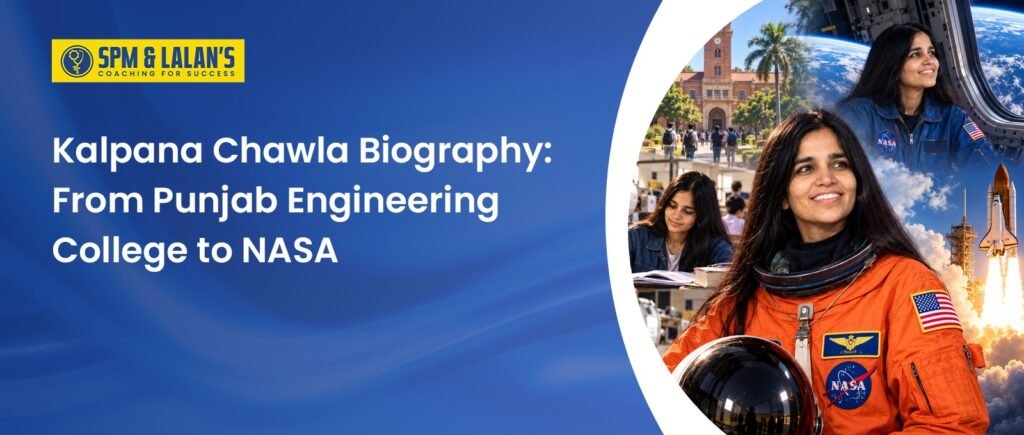
The Kalpana Chawla biography is the story of a young girl from Karnal who dreamed of flying and eventually became the first woman of Indian origin to travel into space. Her journey from studying aeronautical engineering in India to becoming a NASA astronaut continues to inspire students and aspiring aerospace professionals worldwide. Born on March 17, 1962, in Karnal, Haryana, Kalpana Chawla developed an early interest in aircraft and space. She later moved to the United States for higher education and built a successful career in aerospace research before joining NASA.
What Was Kalpana Chawla’s Early Life Like?
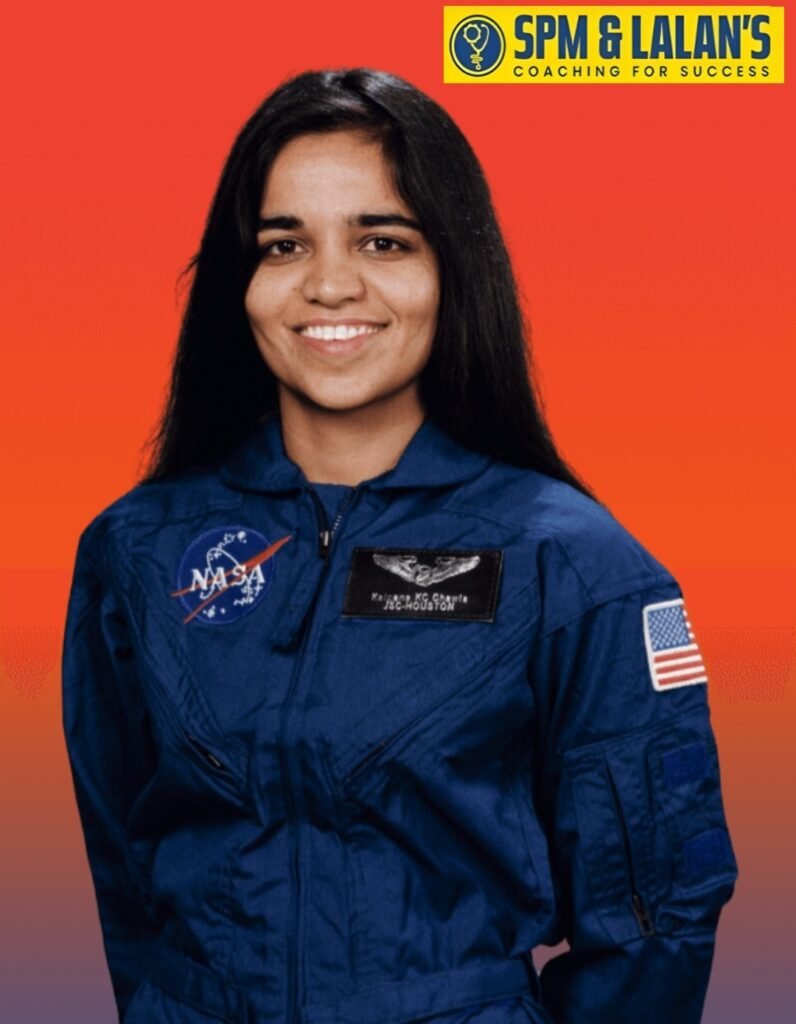
The Kalpana Chawla biography begins in Karnal, where she completed her early education. She studied at Tagore Baal Niketan Senior Secondary School and later attended Kumari Vidyavati Anand DAV College for Women. Her interest in flying led her towards engineering. Since Karnal did not have an engineering college, she moved to Chandigarh and joined Punjab Engineering College. In 1982, she became the first woman to earn an aeronautical engineering degree from Punjab Engineering College.
| Education | Year |
| Pre-university education | 1977 |
| Aeronautical Engineering, Punjab Engineering College | 1982 |
| M.S. in Aerospace Engineering, University of Texas at Arlington | 1984 |
| Ph.D. in Aerospace Engineering, University of Colorado | 1988 |
How Did Kalpana Chawla Begin Her Career?
After completing her doctorate in 1988, Chawla started working at NASA’s Ames Research Center. Her early research focused on computer-based simulations of airflow around aircraft. In 1993, she joined Overset Methods Inc., a California-based research organization, where she worked on aerodynamic optimisation and later became its vice president. After becoming a U.S. citizen in 1991, she applied to the NASA astronaut programme. NASA selected her in December 1994, and she began astronaut training at the Johnson Space Center in Houston in 1995.
Her training and work included:
- Space shuttle software testing
- Robotic systems and situational awareness displays
- Astronaut operations
- EVA and robotics-related activities
When Did Kalpana Chawla First Go to Space?
A major milestone in the Kalpana Chawla biography came in 1997 when she was selected as a mission specialist and primary robotic arm operator for the STS-87 mission. The mission launched aboard Space Shuttle Columbia in November 1997. With this flight, Chawla became the first woman of Indian origin to travel to space. During the mission, Columbia completed 252 orbits around Earth before returning in December 1997.
What Was Her Second Space Mission?
In July 2000, Chawla was selected for her second mission, STS-107, again aboard Columbia. The mission faced several delays before finally launching on January 16, 2003. The crew spent 16 days in space and conducted more than 80 experiments. They worked around the clock in two alternating shifts to complete the scientific program. However, the mission ended in tragedy during its return to Earth.
What Happened to Kalpana Chawla?
During the launch of STS-107, a piece of insulating foam separated from the shuttle’s external tank and struck the left wing of Columbia. The damage later allowed extremely hot gases to enter the shuttle during atmospheric reentry. On February 1, 2003, Columbia disintegrated over parts of Louisiana and Texas. All seven crew members, including Kalpana Chawla, died in the disaster. The event became one of the most significant tragedies in the history of human spaceflight.
What Awards and Honours Did She Receive?
The Kalpana Chawla biography also includes several honors awarded after her death.
| Honour or Recognition | Details |
| Congressional Space Medal of Honor | Awarded posthumously in 2004 |
| NASA Space Flight Medal | Awarded for her contribution to spaceflight |
| NASA Distinguished Service Medal | Awarded posthumously |
| Punjab Engineering College | Established a memorial award in her name |
| University of Texas at Arlington | Created a memorial featuring her flight suit and photographs |
Her legacy also reached beyond universities and space agencies. Asteroid 51826 was renamed 51826 Kalpanachawla in 2003. In 2020, Northrop Grumman named an International Space Station resupply spacecraft the SS Kalpana Chawla.
How Did Kalpana Chawla Inspire Students?
The Kalpana Chawla biography remains particularly meaningful for students because her career showed how education and determination can turn an ambitious dream into reality. At her request, NASA began inviting two students from her former school, Tagore Baal Niketan Senior Secondary School, to participate in its Summer Space Experience programme from 1998 onward.
For students in Assam who wish to pursue engineering careers, preparing for entrance examinations is an important step. Aspirants can explore Best JEE coaching in Guwahati to strengthen their understanding of physics, chemistry, and mathematics while preparing for JEE Main and JEE Advanced.
Her story continues to encourage students to:
- Pursue science and engineering with dedication.
- Explore careers in aerospace and space research.
- Continue learning beyond their home country when opportunities arise.
- Stay committed to long-term goals despite challenges.
Students inspired by Kalpana Chawla’s journey can begin developing their engineering interests through strong foundations in mathematics, physics, and problem-solving. Following a structured long-term engineering preparation guide can help aspiring engineers develop the knowledge and skills needed to pursue their career goals.
What Is Kalpana Chawla’s Lasting Legacy?
The Kalpana Chawla biography is not only about her achievements as an astronaut. It represents the journey of a student who dreamed of exploring space and worked steadily towards that goal. Her name has been given to educational institutions, roads, awards, and scientific projects in India and the United States. The band Deep Purple also honored the Columbia crew with the song “Contact Lost.” Kalpana Chawla’s journey from Karnal to NASA remains an enduring example of courage, education, and perseverance.
Download CBSE & CEBA PYQs here
NEET & JEE Mock Test
Conclusion
The Kalpana Chawla biography reflects a remarkable journey from a small-town student in Karnal to a NASA astronaut who made history in space exploration. Her passion for aeronautical engineering, dedication to education, and determination helped her achieve a dream that once seemed impossible. Although her life ended tragically during the Columbia disaster, her achievements continue to inspire students to pursue science, engineering, and space research with confidence and determination.
Students interested in exploring engineering and medical entrance examination preparation can find educational resources, course information, and academic guidance through SPM & LALAN’S Coaching. Students and parents in Guwahati who wish to explore classroom coaching options can also view SPM & LALAN’S Coaching Centre on Google Maps before planning a visit.
Frequently Asked Questions
Who was Kalpana Chawla?
Kalpana Chawla was an Indian-born American astronaut and aerospace engineer. She became the first woman of Indian origin to travel to space when she flew aboard Space Shuttle Columbia in 1997.
When did Kalpana Chawla go to space for the first time?
She first travelled to space in November 1997 as part of the STS-87 mission aboard Columbia. She served as a mission specialist and primary robotic arm operator.
What did Kalpana Chawla study?
She earned a degree in aeronautical engineering from Punjab Engineering College in 1982. She later completed an M.S. and Ph.D. in aerospace engineering in the United States.
When did Kalpana Chawla die?
Kalpana Chawla died on February 1, 2003, when Space Shuttle Columbia disintegrated during atmospheric reentry. All seven crew members aboard the shuttle were killed.
Sources…
- Remembering the Columbia STS-107 Mission
- ISRO – Space India Publication
- Kalpana Chawla: The First South Asian American Woman in Space
Also Read
This article is written by the SPM & LALAN’S Content Team, a group of skilled writers, researchers, and content strategists passionate about creating accurate, reliable, and student-friendly educational content. Every article is thoroughly researched, fact-checked, and updated to ensure readers receive trustworthy and relevant information. The goal is to help students make informed academic decisions through clear, well-researched, and easy-to-understand content.