
Students aiming for JEE Advanced 2027 should know about the JEE Advanced 2027 Exam pattern thoroughly. IIT Delhi will release the JEE Advanced 2027 Exam Pattern on its official website. The exam pattern will include important information such as the marking scheme, type of questions, total marks, exam duration, and other important details. JEE Advanced 2027 is scheduled to be held on May 23, 2027.
In this article, we will discuss the JEE Advanced 2027 Exam Pattern based on previous years. The syllabus is likely to remain unchanged except for some minor changes, so candidates need to regularly visit the official website jeeadv.ac.in for up-to-date information.
For a broader understanding of the examination, including eligibility, important dates, and preparation strategies, explore our JEE Advanced 2027 complete guide.
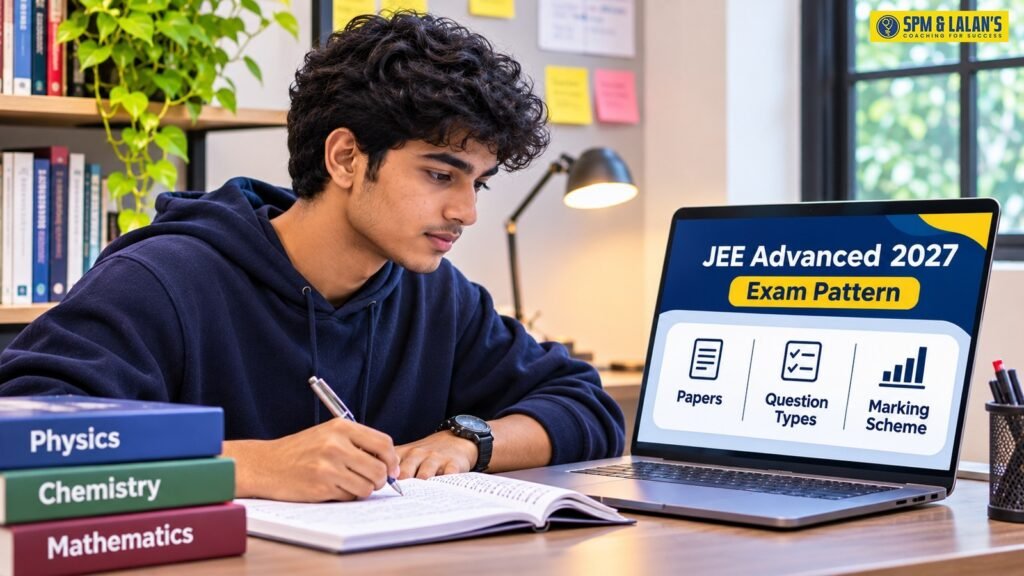
JEE Advanced 2027 Exam Pattern
The JEE Advanced 2027 will be conducted in CBT mode. The exam will consist of two papers, and the duration of the exam is fixed at three hours for each paper. JEE Advanced 2027 tests three subjects, which are Physics, Chemistry, and Mathematics.
JEE Advanced 2027 Exam Pattern: At a glance
| Particulars | Details |
| Mode of examination | Computer-based examination |
| Medium of examination | English and Hindi |
| Number of papers | Two compulsory papers: Paper 1 and Paper 2 |
| Duration | 3 hours per paper; 4 hours for candidates eligible for compensatory time |
| Sections in Paper 1 | Physics, Chemistry and Mathematics (PCM) |
| Sections in Paper 2 | Physics, Chemistry and Mathematics (PCM) |
| Total number of questions | 54 questions (18 per subject) |
| Marking scheme | Full, partial, zero, and negative marks, depending on the question type and paper instructions |
Note: The JEE Advanced exam pattern can change each year, including the question types, marking scheme, and structure of Paper 1 and Paper 2. Reviewing previous years’ papers can help you understand the format and know what to expect. However, use them only as a guide for your preparation. Refer to the official JEE Advanced 2027 information brochure for confirmed exam details, and check each paper’s instructions carefully for its marking scheme.
JEE Advanced 2027 Paper 1 Marking Scheme
| Section | Number of Questions | Total Marks | Marking Scheme |
| 1 | 4 | 12 | +3 (if the correct option is chosen) 0 (if none of the options is chosen) -1 (in all other cases) |
| 2 | 3 | 12 | +4 (if the correct options are chosen) +3 (if all four options are correct but only three are chosen) +2 (if three or more options are correct but only two are chosen and both are correct) +1 (if two or more options are correct but only one is chosen, and it is correct) 0 (if none of the options is chosen) -2 (in all other cases) |
| 3 | 6 | 24 | +4 for the correct answer 0 for no attempts. |
| 4 | 4 | 12 | +3 (if only the correct option is chosen) 0 (if none of the options are chosen) -1 for wrong attempts. |
| Total | 17 | 60 |
JEE Advanced 2027 Paper 2 Marking Scheme
| Section | Number of Questions | Total Marks | Marking Scheme |
| 1 | 4 | 12 | +3 (if only the correct option is chosen)0 (if unanswered)−1 (in all other cases) |
| 2 | 3 | 12 | +4 (if all correct options are chosen)+3 (if all four options are correct but only three are chosen)+2 (if three or more options are correct but only two are chosen)+1 (if two or more options are correct but only one is chosen)0 (if unanswered)−2 (in all other cases) |
| 3 | 6 | 24 | +4 (for the correct answer.)0 (if unanswered)No negative marks. |
| 4 | 4 | 12 | +3 (if only the correct option is chosen)0 (if unanswered)No negative marks. |
JEE Advanced 2027 Question Types
Previous JEE Advanced papers have included different question types to test students’ understanding and problem-solving skills. Students preparing for the JEE Advanced 2027 exam pattern should become familiar with the following formats. However, the exact question types and marking rules for 2027 will depend on the official paper instructions.
Single Correct Option Questions
- These questions provide four options, but only one option is correct.
- Students need to solve the question and select the correct answer.
- A wrong answer may attract negative marks, depending on the section’s instructions. Therefore, read the marking scheme carefully before attempting these questions.
Multiple Correct Option Questions
- These questions provide four options, and one or more options may be correct.
- Students need to check each option carefully and select all the correct answers.
- Some sections may award partial marks when students select only some correct options without choosing any incorrect option.
- However, choosing an incorrect option may attract negative marks. Therefore, understand the partial marking rules before selecting your answers.
Numerical Answer Type Questions
- These questions require students to calculate an answer and enter its numerical value instead of selecting an option.
- Students enter their answers using the on-screen numeric keypad.
- The answer may be an integer or a decimal value. Therefore, follow the instructions about decimal places and rounding carefully.
- Also, check the marking scheme for the section rather than assuming that every numerical question carries no negative marks. Since numerical questions involve calculations, students should also understand the JEE Advanced 2027 calculator rules to know the calculator-related instructions and restrictions applicable during the examination.
Paragraph-Based and Matching Questions
- Paragraph-based questions provide a passage, situation or set of data, followed by related questions.
- Students need to read the information carefully and use the relevant concepts to answer each question. Depending on the paper, they may need to select an option or enter a numerical answer.
- Matching questions ask students to connect related items from two lists or columns and choose the correct combination.
- Therefore, practise both formats through previous years’ papers. Also, check the response format and marking instructions before attempting them.
JEE Advanced Paper 1 vs Paper 2: Key Differences
JEE Advanced includes two compulsory papers. Both cover Physics, Chemistry and Mathematics. However, the question types and marking rules may differ. The table below follows previous years’ exam details and provides a guide for students preparing for 2027.
| Particulars | Paper 1 | Paper 2 |
| Exam session | First session of the exam day | Second session on the same day |
| Duration | Three hours; additional time for eligible candidates | Three hours; additional time for eligible candidates |
| Subjects | Physics, Chemistry and Mathematics | Physics, Chemistry and Mathematics |
| Question types | Follows the question types specified in Paper 1 | May include a different combination or arrangement of question types |
| Marking scheme | Follows Paper 1’s section-wise marking instructions | Follows Paper 2’s section-wise marking instructions, which may differ from Paper 1 |
| Negative and partial marking | Apply wherever specified in the section instructions | Apply wherever specified in the section instructions |
| Compulsory attendance | Students must appear for Paper 1 for consideration in the rank list | Students must also appear for Paper 2 for consideration in the rank list |
| Score calculation | Marks contribute to the combined subject scores and overall total | Marks add to Paper 1 scores to calculate the combined subject scores and overall total |
Therefore, students should prepare for both papers and check their instructions separately. Refer to the official JEE Advanced 2027 brochure and paper instructions for the applicable details.
Conclusion
Understanding the JEE Advanced 2027 exam pattern can help students plan their preparation with greater clarity. Practise different question types, review previous years’ papers and take mock tests to improve speed and accuracy. Also, check the official instructions for both papers, especially the marking scheme. With consistent practice and careful revision, you can approach the exam with confidence.
Students looking for the best coaching for JEE Advanced can explore the structured preparation programmes, expert guidance, and practice resources offered by SPM & Lalan’s in Guwahati.
For structured JEE Main and Advanced preparation, students can explore SPM & Lalan’s Coaching Centres in Guwahati to learn about the institute’s courses, faculty, and study programmes.
Students and parents interested in visiting the institute can view SPM & Lalan’s coaching centre location on Google Maps for directions and location information.
Frequently Asked Questions
Q1. What is the JEE Advanced 2027 exam pattern?
Based on previous years, students can expect two compulsory computer-based papers covering Physics, Chemistry and Mathematics, each lasting three hours. However, the question count, question types and marking scheme may vary. Therefore, use previous papers for practice and check the official 2027 instructions for confirmed details.
Q2. Does the JEE Advanced 2027 marking scheme include negative marking?
Previous JEE Advanced papers have included negative marking for certain question types. However, the deductions and partial marking rules depend on the section instructions. Therefore, read the JEE Advanced 2027 marking scheme carefully before answering. Avoid assuming that all multiple-choice or numerical questions follow identical rules.
Q3. Is appearing for both JEE Advanced papers compulsory?
Under the established JEE Advanced format, students must appear for both Paper 1 and Paper 2 for consideration in the rank list. Both papers contribute to the combined subject scores and overall total. Therefore, prepare for both sessions and check the official 2027 brochure for applicable rules.
READ MORE:

This article is written by the SPM & LALAN’S Content Team, a group of skilled writers, researchers, and content strategists passionate about creating accurate, reliable, and student-friendly educational content. Every article is thoroughly researched, fact-checked, and updated to ensure readers receive trustworthy and relevant information. The goal is to help students make informed academic decisions through clear, well-researched, and easy-to-understand content.