
PCB stands for Physics, Chemistry, and Biology. This subject combination is particularly popular among Class 11 & 12 students, as it leads to many exciting career opportunities, including NEET. However, there are plenty of PCB courses without NEET through which students can get high-paying jobs.
In this article, we discuss various PCB Courses without NEET, including career opportunities and Job prospects.
What are the entrance exams for PCB students without NEET?
If you’re applying for PCB courses without NEET, check which entrance exam your chosen college accepts. The table below lists common exams and the courses they cover.
What are the career options after 12th PCB without NEET?
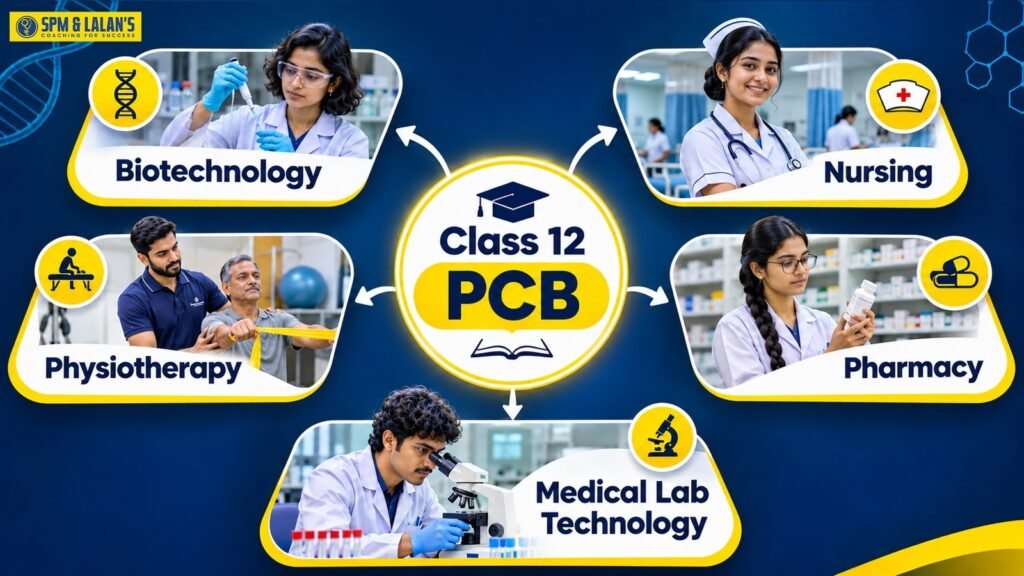
If you studied Physics, Chemistry and Biology in Class 12, you can choose from a range of PCB courses without NEET. Students can also explore emerging career options for PCB students in AI, genetics and biotechnology. Here are the main career options after 12th PCB without NEET, grouped by field.
1. B.Sc. courses in core sciences
- B.Sc. Biology, Botany or Zoology
Study living organisms, with Botany focusing on plants and Zoology on animals.
Career options – Research support, laboratory work, field surveys, and conservation projects. - B.Sc. Microbiology or Biochemistry
Microbiology studies microorganisms, while Biochemistry focuses on chemical processes in living organisms.
Career options – Laboratory work, food and pharmaceutical quality control, and research support. - B.Sc. Biotechnology
Study how biological processes are applied in healthcare, agriculture and industry.
Career options – Biotech laboratory work, pharmaceutical production and quality control. - B.Sc. Environmental Science
Study ecosystems, pollution and the conservation of natural resources.
Career options – Environmental monitoring, conservation projects and sustainability work.
2. Allied health sciences and nursing
- Bachelor of Physiotherapy (BPT)
Learn how exercise and physical therapy help patients regain movement and strength.
Career options – Physiotherapy in hospitals, rehabilitation centres and sports clinics. - Bachelor of Occupational Therapy (BOT)
Learn how to help people regain or develop skills for everyday activities.
Career options – Occupational therapy in hospitals, rehabilitation centres and paediatric care settings. - B.Sc. Nursing
Study patient care, clinical procedures and community health.
Career options – Staff nursing, community health nursing and home healthcare. - Bachelor of Optometry
Learn how to assess vision and fit corrective lenses.
Career options – Optometry in eye hospitals, clinics and optical centres. - Bachelor of Audiology and Speech-Language Pathology (BASLP)
Study how to assess and manage hearing, speech and language difficulties.
Career options – Audiology and speech-language therapy in hospitals, clinics and rehabilitation centres.
3. Paramedical courses
- Medical Laboratory Technology (MLT) – Learn to test blood, urine and other samples. Career options – Medical laboratory technologist in hospitals and diagnostic centres.
- Medical Radiology and Imaging Technology – Learn how X-rays, CT scans and MRIs are produced. Career options – Imaging technologist in hospitals and diagnostic centres.
- Operation Theatre and Anaesthesia Technology – Learn to prepare equipment and assist surgical teams. Career options – Operation theatre or anaesthesia technologist.
- Dialysis Technology – Learn to operate dialysis equipment and care for patients during treatment. Career options – Dialysis technologist in hospitals and dialysis centres.
- Cardiac Care Technology or Respiratory Therapy – Train in heart testing or breathing support, depending on the course. Career options – Cardiac care technologist or respiratory therapist.
4. Forensic science
- B.Sc. Forensic Science
Learn how scientific methods are used to examine evidence in investigations.
Career options – Forensic laboratory support, evidence analysis and further study in specialised areas such as forensic biology or toxicology.
5. Nutrition and dietetics
- B.Sc. Nutrition and Dietetics
Study how food and nutrients affect health, along with meal planning and nutrition assessment.
Career options – Community nutrition programmes, wellness and food services. Clinical dietetics may require further training or qualifications.
6. Psychology
- BA or B.Sc. Psychology
Study human behaviour, emotions and mental processes.
Career options – Behavioural research support, human resources and social-sector work. Clinical psychology requires an approved professional qualification and registration.
7. Pharmacy courses
- D.Pharm – A two-year diploma focused on dispensing medicines. Career options – Community or hospital pharmacy, subject to registration requirements.
- B.Pharm – A four-year degree covering drug formulation and manufacturing. Career options – Pharmaceutical production, quality control, regulatory affairs and pharmacy practice.
- Pharm.D – A six-year programme focused on clinical pharmacy and the safe use of medicines. Career options – Hospital and clinical pharmacy.
8. Agriculture, fisheries and food science
- B.Sc. Agriculture – Study crops, soil and farm management. Career options – Agricultural extension, seed companies and agribusiness.
- B.Sc. Horticulture, Forestry or Sericulture – Study fruit and vegetable production, forest management or silk production. Career options – Nursery management, conservation or the silk industry, depending on the degree.
- Bachelor of Fisheries Science (B.F.Sc.) – Study fish farming and hatchery operations. Career options – Aquaculture, fisheries development and seafood processing.
- B.Sc. Food Science or Food Technology – Study food processing, preservation and safety. Career options – Food quality control, production and product development.
Conclusion
If you studied Physics, Chemistry and Biology in Class 12, PCB courses without NEET can lead to careers in healthcare, pharmacy, research, agriculture and more. Start with the kind of work you’d enjoy, whether that’s caring for patients, working in a lab or spending time in the field. Then check your preferred college’s eligibility criteria and admission process. Students seeking academic guidance and entrance exam preparation can explore SPM and Lalans Coaching Centre in Guwahati to plan their next steps after Class 12. Students and parents can also visit the SPM and Lalans Guwahati coaching centre for more information about coaching programmes and entrance exam preparation.
Students who are still considering MBBS or BDS alongside alternative PCB courses can explore the best coaching for NEET in Guwahati to prepare for the medical entrance examination.
Frequently Asked Questions
Q1. What are the career options after 12th PCB without NEET?
You can explore pharmacy, nursing, allied healthcare, biotechnology, forensic science and agriculture. If you enjoy working with patients, consider nursing or optometry. If you prefer lab work, microbiology, biotechnology and medical laboratory technology are options. Admission requirements vary by college and course.
Q2. What are the entrance exams for PCB students without NEET?
Examples include the AIIMS B.Sc. Nursing entrance exam, SSUHS entrance exams in Assam and BITSAT for B.Pharm. The exam you need depends on your chosen course and college. Check the institution’s admission notice for the relevant exam, eligibility criteria and application dates.
Q3. Which BSc courses can I pursue after 12th PCB without NEET?
Common BSc courses after 12th PCB without NEET include Botany, Zoology, Microbiology, Biochemistry, Biotechnology and Environmental Science. You can also explore Forensic Science, Food Science or Nutrition and Dietetics. Depending on the university, admission may be based on Class 12 marks or an entrance exam.
READ MORE:
This article is written by the SPM & LALAN’S Content Team, a group of skilled writers, researchers, and content strategists passionate about creating accurate, reliable, and student-friendly educational content. Every article is thoroughly researched, fact-checked, and updated to ensure readers receive trustworthy and relevant information. The goal is to help students make informed academic decisions through clear, well-researched, and easy-to-understand content.