If you are targeting the Assam Combined Entrance Examination this year, understanding the Assam CEE Syllabus is the foundation of your entire preparation plan. The Assam Science and Technology University (ASTU) does not officially release a separate Assam CEE Syllabus document. Instead, ASTU prepares the question paper based on the higher secondary syllabus, specifically the Assam Higher Secondary Education Council (AHSEC) syllabus and the NCERT syllabus for Classes 11 and 12.
The Assam CEE Syllabus covers three subjects, Physics, Chemistry, and Mathematics, drawn from both Class 11 and Class 12 levels. Knowing the full subject-wise and unit-wise topic list helps you plan your preparation systematically, avoid missing important areas, and allocate time to each subject based on its weightage in the exam.
Assam CEE Syllabus 2026 – Why Knowing It Matters
The Assam CEE Syllabus is the roadmap to your entire preparation. Since ASTU does not release a separate official syllabus PDF, candidates must follow the AHSEC and NCERT higher secondary syllabi for Classes 11 and 12 to prepare. Knowing this in advance helps you:
- Understand which topics carry more weight in the exam
- Plan your subject-wise and unit-wise study schedule
- Avoid wasting time on topics outside the scope of the exam
- Identify areas of strength and weakness early
Now, let us go through the complete syllabus, subject by subject.
Assam CEE Physics Syllabus 2026
The Physics section of the Assam CEE Syllabus is based on Class 11 and Class 12 Physics from AHSEC/NCERT. Here is the complete unit-wise list:
| Class 11 Units | Class 12 Units |
| Unit I: Physical World and Measurement | Unit I: Electrostatics |
| Unit II: Kinematics | Unit II: Current Electricity |
| Unit III: Laws of Motion | Unit III: Magnetic Effects of Current and Magnetism |
| Unit IV: Work, Energy, and Power | Unit IV: Electromagnetic Induction and Alternating Currents |
| Unit V: Motion of Systems of Particles and Rigid Bodies | Unit V: Electromagnetic Waves |
| Unit VI: Gravitation | Unit VI: Optics |
| Unit VII: Properties of Bulk Matter | Unit VII: Dual Nature of Matter and Radiation |
| Unit VIII: Thermodynamics | Unit VIII: Atoms and Nuclei |
| Unit IX: Behaviour of a Perfect Gas and Kinetic Theory | Unit IX: Electronic Devices |
| Unit X: Oscillations and Waves | Unit X: Communication Systems |
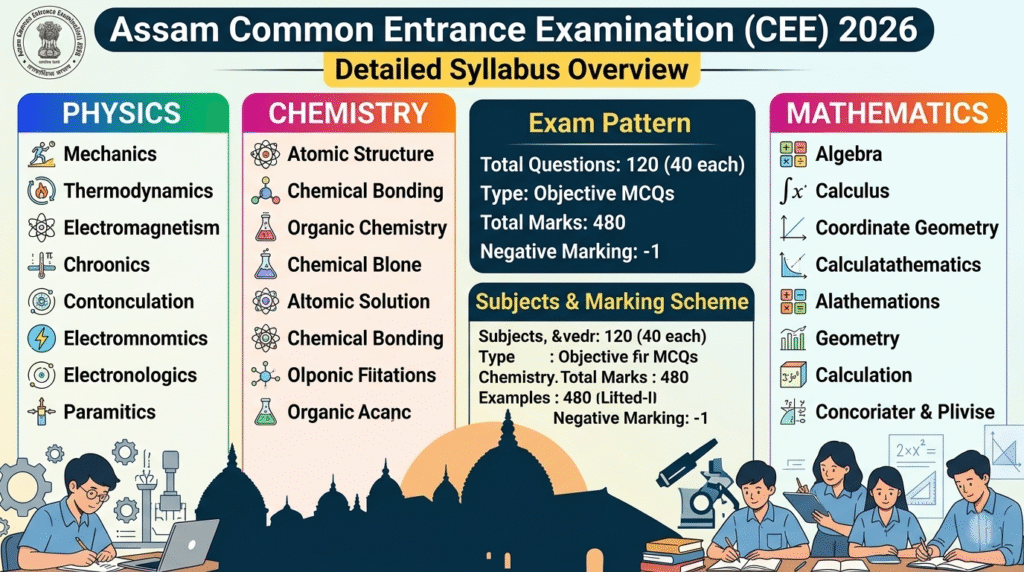
Physics covers 10 units from Class 11 and 10 units from Class 12, a total of 20 units contributing to 40 questions in the exam. Pay special attention to topics like Mechanics (Laws of Motion, Work, Energy, Power, Electrostatics, Current Electricity, and Optics tend to carry significant question weight in entrance exams of this type.
Assam CEE Mathematics Syllabus 2026
The Mathematics section of the Assam CEE Syllabus is drawn from Class 11 and Class 12 AHSEC/NCERT mathematics. Here is the complete unit-wise breakdown:
| Class 11 Units | Class 12 Units |
| Unit I: Sets and Functions | Unit I: Relations and Sets |
| Unit II: Algebra | Unit II: Algebra |
| Unit III: Coordinate Geometry | Unit III: Calculus |
| Unit IV: Calculus | Unit IV: Vectors and 3-Dimensional Geometry |
| Unit V: Mathematical Reasoning | Unit V: Linear Programming |
| Unit VI: Statistics and Probability | Unit VI: Probability |
Mathematics has 6 units from Class 11 and 6 units from Class 12. Calculus appears in both classes and is one of the highest-weighted areas in the Mathematics section of most engineering entrance exams. Algebra, coordinate geometry, vectors, and probability are other key areas to prepare thoroughly.
Assam CEE Chemistry Syllabus 2026
The Chemistry section of the Assam CEE Syllabus is the most extensive of the three subjects in terms of unit count. It covers 14 units from Class 11 and 16 units from Class 12:
| Class 11 Units | Class 12 Units |
| Unit I: Some Basic Concepts of Chemistry | Unit I: Solid State |
| Unit II: Structure of the Atom | Unit II: Solutions |
| Unit III: Classification of Elements and Periodicity in Properties | Unit III: Electrochemistry |
| Unit IV: Chemical Bonding and Molecular Structure | Unit IV: Chemical Kinetics |
| Unit V: States of Matter – Gases and Liquids | Unit V: Surface Chemistry |
| Unit VI: Thermodynamics | Unit VI: General Principles and Processes of Isolation of Elements |
| Unit VII: Equilibrium | Unit VII: p-Block Elements |
| Unit VIII: Redox Reactions | Unit VIII: d and f Block Elements |
| Unit IX: Hydrogen | Unit IX: Coordination Compounds |
| Unit X: s-Block Elements (Alkali and Alkaline Earth Metals) | Unit X: Haloalkanes and Haloarenes |
| Unit XI: Some p-Block Elements | Unit XI: Alcohols, Phenols, and Ethers |
| Unit XII: Organic Chemistry – Some Basic Principles and Techniques | Unit XII: Aldehydes, Ketones, and Carboxylic Acids |
| Unit XIII: Hydrocarbons | Unit XIII: Organic Compounds Containing Nitrogen |
| Unit XIV: Environmental Chemistry | Unit XIV: Biomolecules |
| — | Unit XV: Polymers |
| — | Unit XVI: Chemistry in Everyday Life |
Chemistry has the most units in the Assam CEE Syllabus 2026. The Class 12 portion is particularly heavy, with organic chemistry, electrochemistry, coordination compounds, and block elements being areas that need focused and consistent preparation.
Assam CEE 2026 – Exam Pattern Overview
It is important to understand exam pattern together with the syllabus which gives you the context to prepare effectively. Here are all the key exam details:
| Particulars | Details |
| Mode of Exam | Offline (Pen-and-Paper-Based Test) |
| Duration | 3 Hours (180 minutes) |
| Medium of Exam | English and Assamese |
| Sections | Physics, Chemistry, and Mathematics |
| Type of Questions | Objective Multiple-Choice Questions |
| Total Number of Questions | 120 |
| Total Marks | 480 |
| Marking Scheme | +4 marks for every correct answer; -1 mark for every wrong answer |
Highlights of Assam CEE Exam Pattern 2026
- The authorities conduct Assam CEE 2026 in offline mode as a pen-and-paper-based test
- Candidates must solve the entire question paper within 180 minutes
- There are 120 multiple-choice questions for a total of 480 marks
- The paper has three sections, with 40 questions each from Physics, Chemistry, and Mathematics
Assam CEE 2026 Marking Scheme
Here is the complete marking scheme for Assam CEE exam
| Subject | Number of Questions | Marks per Question |
| Physics | 40 questions | 4 marks |
| Chemistry | 40 questions | 4 marks |
| Mathematics | 40 questions | 4 marks |
| Total | 120 questions | 480 marks |
Every correct answer earns 4 marks, and every wrong answer results in a deduction of 1 mark. Unattempted questions carry no penalty. Since negative marking applies, attempt only those questions you are confident about.
How to Use the Assam CEE Syllabus 2026 for Preparation

Now that the complete Assam CEE Syllabus is in front of you, here is how to use it effectively for your exam preparation:
- Start with NCERT books for all three subjects across Class 11 and Class 12. ASTU prepares the question paper based on the AHSEC and NCERT higher secondary curriculum, so NCERT is your primary and most reliable source.
- Divide your preparation by class. Do not mix up Class 11 and Class 12 topics randomly. Finish Class 11 for each subject before moving to Class 12 content, this builds knowledge in a natural sequence.
- Give equal time to all three subjects. The exam has 40 questions from Physics, 40 from Chemistry, and 40 from Mathematics, each carrying equal marks. No subject should be neglected.
- Practise MCQs topic-wise. After completing each unit from the Assam CEE Syllabus 2026, solve MCQs from that unit immediately. This reinforces the concepts and builds exam readiness simultaneously.
- Revise regularly. With the volume of content across 3 subjects and 2 class levels, revision is non-negotiable. Make short notes for each unit as you complete it and revise them weekly.
- Take full-length mock tests. As the exam date approaches, practise solving all 120 questions within 180 minutes under timed conditions. This builds speed, accuracy, and confidence.
Final Thoughts
The Assam CEE Syllabus is clear, well-structured, and based entirely on the AHSEC and NCERT higher secondary curriculum for Classes 11 and 12 across Physics, Chemistry, and Mathematics. With 120 MCQs for 480 marks in a 3-hour offline exam, the path to a good score runs through thorough syllabus coverage, consistent NCERT-based preparation, regular MCQ practice, and a disciplined negative-marking strategy.
Start with the complete unit-wise syllabus shared in this blog, build your preparation systematically from Class 11 units to Class 12 units across all three subjects, practice under timed conditions as the exam approaches, and walk into the exam center on June 7, 2026, fully prepared.
The application window opens on March 16, 2026. Please ensure your eligibility and submit your application at astu.ac.in by March 31, 2026.
Is Assam CEE conducted in online mode?
No, Assam CEE is not conducted in online mode. The authorities conduct Assam CEE 2026 in offline mode as a pen-and-paper-based test as clearly stated in the official Assam CEE exam pattern. Candidates must physically attend the exam centre and attempt all 120 questions on a printed OMR or answer sheet using a pen. This is an important detail to keep in mind when preparing, because offline exams require candidates to be physically comfortable with reading and marking printed MCQ answer sheets quickly and accurately. There is no digital interface involved the question paper is printed, and answers are marked on paper within the 180-minute time limit.
For how many hours will the Assam CEE 2026 exam be conducted?
The Assam CEE 2026 exam will be conducted for 3 hours (180 minutes). During this time, candidates must attempt all 120 multiple-choice questions across Physics, Chemistry, and Mathematics, with 40 questions in each subject. This means candidates have an average of 90 seconds per question, though in practice, you will spend more time on some questions and less on others. Given the negative marking of -1 for each wrong answer, managing your time is critical spending too long on difficult questions and running out of time for easier ones can cost you significant marks. The best strategy is to go through all 120 questions once in the first pass, mark the ones you are confident about, and then use the remaining time to revisit the questions you skipped or were uncertain about.
What will be the total number of questions in the Assam CEE 2026 exam?
The total number of questions in the Assam CEE 2026 exam is 120, distributed equally across three subjects: 40 questions from Physics, 40 from Chemistry, and 40 from Mathematics. Each correct answer carries 4 marks, making the maximum total score 480 marks. Each wrong answer results in a deduction of 1 mark, so selective and confident answering is essential. This question distribution also means that no single subject dominates the exam, each contributes equally to the total score. A candidate who is strong in all three subjects will consistently score higher than someone who excels in one subject but neglects the others. Equal and systematic preparation across the full Assam CEE Syllabus 2026 is the most effective approach.
Is there any negative marking in the Assam CEE 2026 exam?
Yes, there is negative marking in the Assam CEE 2026 exam. For every wrong answer, 1 mark is deducted from your total score. Since each correct answer earns 4 marks, answering 4 questions incorrectly effectively cancels out one correct answer. This makes question selection strategy just as important as subject knowledge during the exam. Candidates should attempt questions they are genuinely confident about, skip questions where they are completely unsure, and revisit uncertain questions only if time allows. Unattempted questions carry zero penalty, so it is always better to leave a question blank than to guess randomly. Building this discipline during mock test practice before the actual exam is one of the most effective ways to improve your final score on June 7, 2026.