
The JEE Advanced Marking Scheme plays a major role in planning the students strategy for the exam. As the official structure for 2026 is still awaited, the pattern followed in recent years becomes the most reliable for the reference. Therefore, the expected JEE Advanced Marking Scheme for 2026 will likely follow the same style, with only minor changes (if any). As a result, students get a clear idea of how marks are awarded, how negative marks work, and also how every section contributes to the total score.
As the exam always tests accuracy and problem-solving speed, it is important to understand the JEE Advanced Marking Scheme as it is the first step in improving performance. Since every type of question carries different marks, students must know the scoring method before practicing mock tests and previous papers.
Students preparing seriously for the jee advanced exam often begin their structured preparation under expert mentorship.
JEE Advanced Exam Pattern 2026 Overview
The JEE Advanced Marking Scheme connects closely with the overall test structure. So, it is important to know the exam pattern together with the marking scheme.The exam will be held online, and both Paper 1 and Paper 2 will be compulsory. Each paper will run for 3 hours, while PwD candidates will get 4 hours. Moreover, the exam will be conducted in both English and Hindi, which allows students to select the language of their choice.
Since the exam pattern and marking scheme are closely linked to the syllabus, students should first review the officially released JEE Advanced syllabus 2026 for a complete subject-wise understanding.
The data below simplifies the exam pattern:
| Exam Detail | Description |
| Exam Conducted By | One of the IITs (To be announced) |
| JEE Advanced exam mode | Online (Computer-based Test) |
| Medium of the examination | English and Hindi (JEE Advanced exam language options) |
| Total time duration | 3 hours for each paper (4 hours for PwD candidates) |
| Number of Papers | Two (Paper 1 & Paper 2) – both mandatory |
| Subjects Covered | Physics, Chemistry, Mathematics |
| Number of questions in JEE Advanced 2026 | 51 (17 questions in each subject) |
| Types of questions in JEE Advanced | MCQs, NAT, Matching-type |
| Marking Scheme | Includes full, partial, zero, and negative marks |
Because the JEE Advanced Marking Scheme varies from section to section, students must understand how each part works.
JEE Advanced Exam Pattern 2026 for Paper 1 (B.Tech/B.E.)
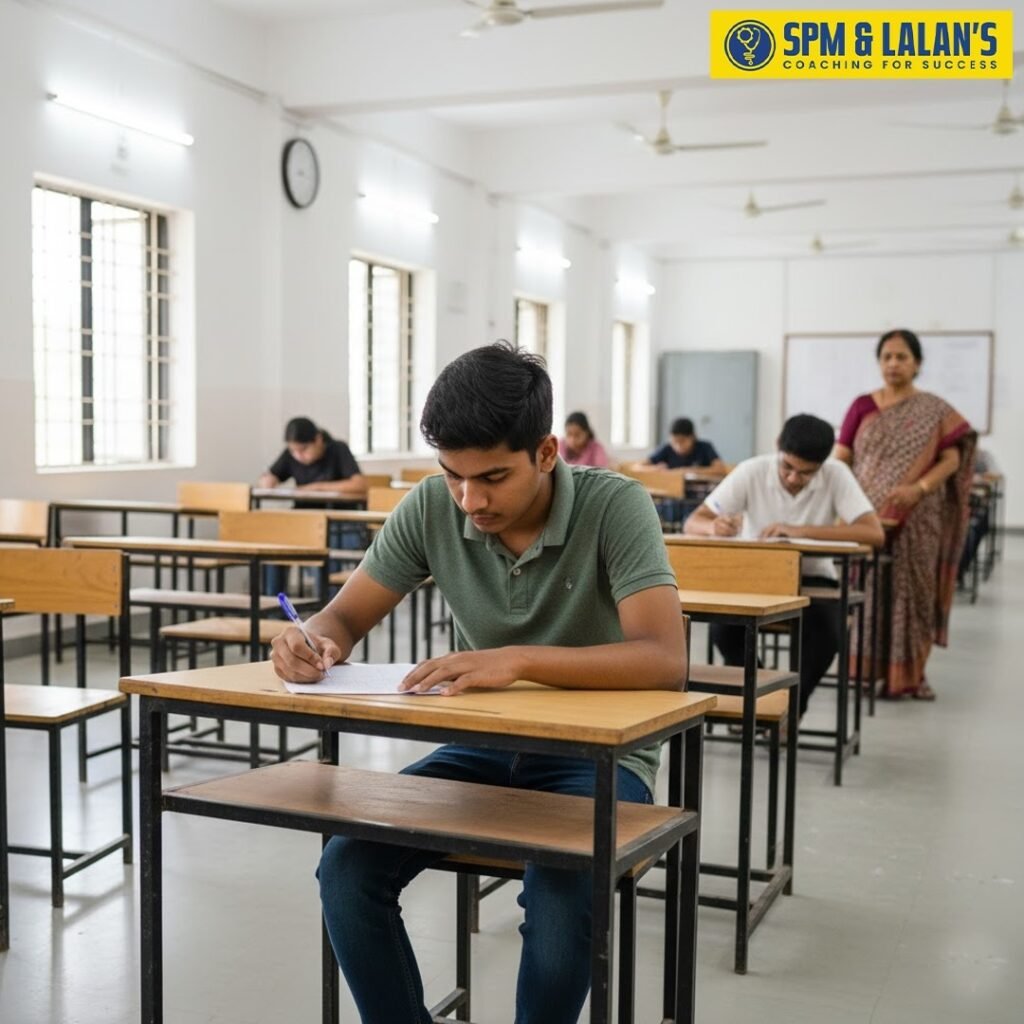
The Paper 1 evaluates conceptual clarity and problem-solving skills through 51 questions. Since every subject carries equal weight, so the JEE Advanced Marking Scheme remains balanced across Physics, Chemistry, and Math.
Paper 1 consists of four sections:
- First, the Section I: it is the Single correct MCQs
- Section II: It is the Multiple correct MCQs
- Section III: It comes with the Numerical Answer Type (NAT)
- Section IV: It is Matching-type or comprehension-based questions
As each section has its own scoring style, the JEE Advanced Marking Scheme rewards accuracy and punishes careless attempts.
JEE Advanced Exam Pattern for Paper 2 (B.Arch & B.Plan)
Students aiming for B.Arch or B. Plan programs must qualify for JEE Advanced and also appear for the Architecture Aptitude Test (AAT). The AAT does not follow the standard JEE Advanced Marking Scheme, and it focuses more on drawing and design skills.
| Particulars | Details |
| Exam Name | Architecture Aptitude Test (AAT) |
| Applicable For | B.Arch & B.Plan admissions at IIT Roorkee, IIT Kharagpur |
| Eligibility | Only for candidates who qualify for JEE Advanced |
| Mode of Examination | Offline (Pen and Paper-based) |
| Exam Duration | 3 Hours |
| Subjects Covered | – Freehand Drawing- Geometrical Drawing – Three-dimensional Perception – Imagination and Aesthetic Sensitivity- Architectural Awareness |
| Marking Scheme | No official announcement on negative marking Marks based on drawing & aptitude skills |
Subject-Wise Question Distribution in JEE Advanced 2026
The JEE Advanced Marking Scheme assigns 60 marks to each subject:
| Section | Number of Questions | Total Marks |
| Section I | 4 | 12 |
| Section II | 3 | 12 |
| Section III | 6 | 24 |
| Section IV | 4 | 12 |
| Total | 17 Questions | 60 Marks |
Since every subject follows the same layout, candidates can plan uniform preparation. Students starting their preparation early can also explore the JEE fresher course designed to build strong fundamentals from the beginning
JEE Advanced 2026 Marking Scheme for Paper 1
The marking system for Paper 1 is explained below. This is provisional but follows the latest trends of the JEE Advanced Marking Scheme.
Paper 1 Marking Scheme
| Section | Number of Questions | Total Marks | Marking Scheme |
| Section 1 | 4 | 12 | +3 if ONLY the correct option is chosen0 if none is chosen-1 in all other cases |
| Section 2 | 3 | 12 | +4 if ALL correct options are chosen+3 if all four correct options are chosen but ONLY three are chosen+2 if three or more correct, but ONLY two are chosen+1 if two or more are correct, but ONLY one is chosen0 if unanswered-2 in all other cases |
| Section 3 | 6 | 24 | +4 for correct answer0 for no attempts |
| Section 4 | 4 | 12 | +3 if ONLY the correct option is chosen0 if none is chosen-1 for wrong attempt |
As the Paper 1 has multiple scoring rules, JEE Advanced Marking Scheme encourages careful selection rather than guesswork. Focused jee advanced preparation helps students understand where to attempt and where to avoid negative marking.
JEE Advanced 2026 Marking Scheme for Paper 2
The Paper 2 uses a similar blueprint with slight differences in sections:
| Section | Number of Questions | Total Marks | Marking Scheme |
| Section 1 | 4 | 12 | +3 if ONLY the correct option is chosen0 if unanswered-1 in all other cases |
| Section 2 | 3 | 12 | +4 if all correct options are chosen+3 if all four correct options are chosen but ONLY three are chosen+2 if three or more correct, but ONLY two are chosen+1 if two or more are correc,t but ONLY one is chosen0 if unanswered-2 in all other cases |
| Section 3 | 6 | 24 | +4 for correct answer0 if unansweredNo negative marking |
| Section 4 | 4 | 12 | +3 if ONLY the correct option is chosen0 if unansweredNo negative marking |
Since Paper 2 mixes negative and non-negative sections, the JEE Advanced Marking Scheme helps students balance attempts.
JEE Advanced 2026 Mode of Exam and Language Options
The exam will be conducted in CBT mode, and students can choose both English or Hindi during registration. Moreover, the PwD candidates receive an extra hour for each paper. As the format remains consistent every year, the JEE Advanced Marking Scheme stays predictable and easy to understand.
Students aiming for top ranks often enroll in best coaching for jee in guwahati to master exam strategy and time management.
Apart from understanding the marking system, candidates should also be aware of the JEE Advanced reservation policy as it plays an important role during seat allocation.
Conclusion
The JEE Advanced Marking Scheme guides students and helps them to understand how to attempt the paper with maximum accuracy and minimum loss. As every section follows a unique marking rule, it becomes important to master the pattern for getting a higher score. Moreover, knowing the marking system helps students build the right test strategy, avoid unnecessary mistakes, and manage time effectively. As the official notification arrives, students must double-check updates, but until then, this expected JEE Advanced Marking Scheme provides a clear and reliable direction for preparation.
For the latest exam updates, preparation resources, and expert guidance, students can visit SPM & Lalans Coaching.
FAQs
Q1. What is the JEE Advanced 2026 marking scheme?
The exam uses full, partial, zero, and negative marking depending on the type of question and section.
Q2. When will the official JEE Advanced 2026 marking scheme be released?
The official marking scheme will be released by the organizing IIT with the official notification.
Q3. How does scoring take place in JEE Advanced 2026?
Scores depend on the accuracy of answers, the type of question, and the specific rules for each section.
Q4. Where can I find authentic information?
Authentic information is available on the official JEE Advanced website and through the notices issued by the conducting IITs.
Q5. Does JEE Advanced 2026 have negative marking?
Yes, many sections include negative marking, especially for multiple-choice questions (MCQs).
Q6. What are the total marks of JEE Advanced?
Each paper generally carries around 180 marks, depending on the exam structure.
Q7. How many questions are there in JEE Advanced?
Each paper typically has 51 questions, with 17 questions from each of the three subjects: Physics, Chemistry, and Mathematics.