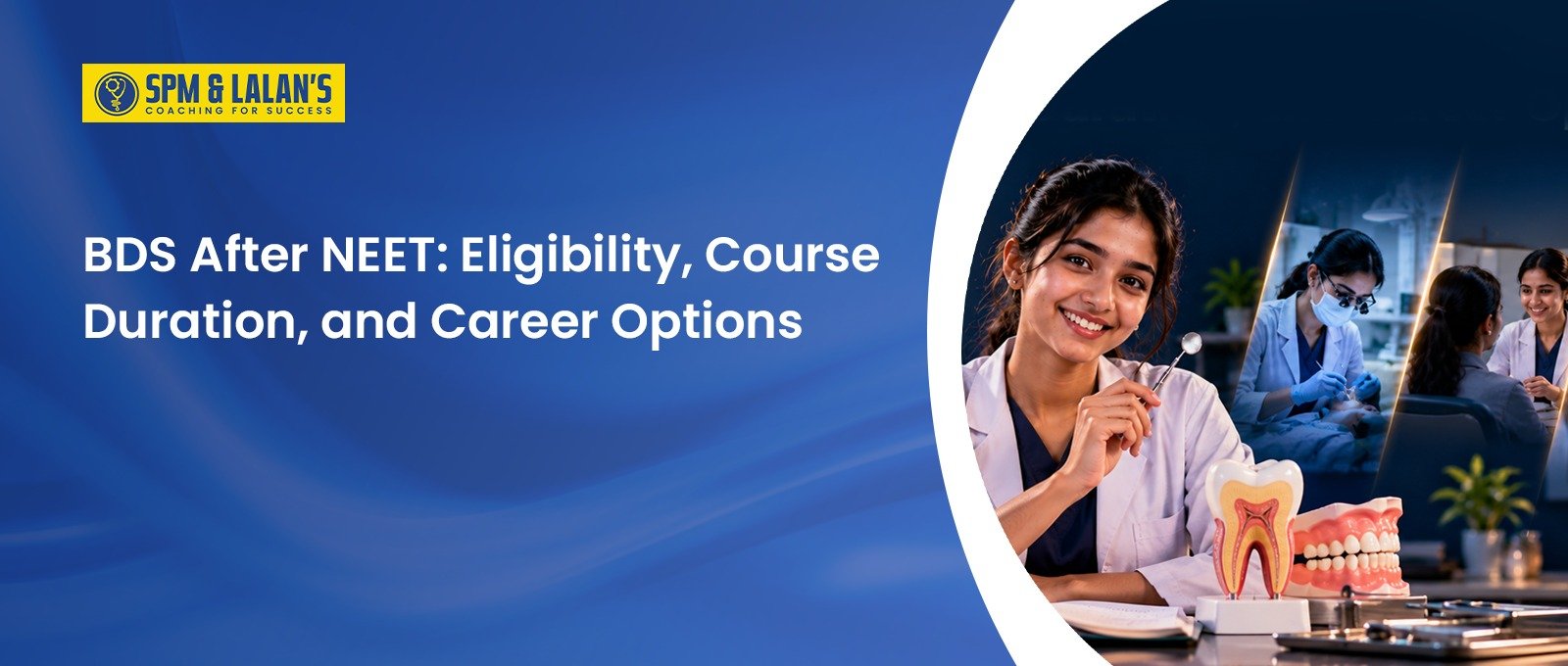

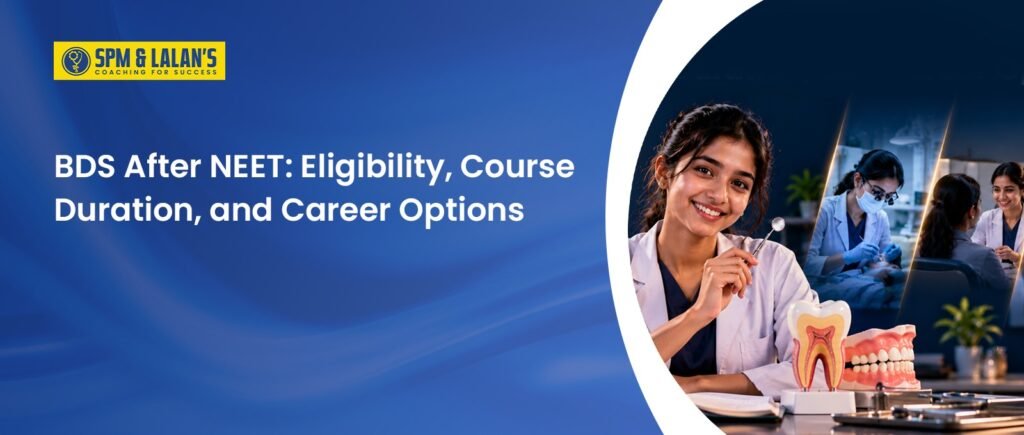
Students who want to enter the dental field can choose BDS After NEET as an undergraduate career option. BDS stands for Bachelor of Dental Surgery and focuses on dental science, oral health, diagnosis, and surgery. The BDS course lasts 5 years, including 4 years of academic study and a 1-year compulsory internship. Admission to BDS colleges in India is based on NEET UG performance and counselling.
What is the BDS full form?
The BDS full form is Bachelor of Dental Surgery.
It is an undergraduate dental program that prepares students for careers in dentistry. The course includes theoretical subjects, laboratory work, clinical training, and a compulsory internship.
What is the eligibility for BDS After NEET?
Students planning BDS After NEET, one must meet the required academic and entrance examination conditions.
The basic eligibility includes:
- Pass Class 12 with Physics, Chemistry, and Biology (PCB).
- General category candidates generally need at least 50% marks in PCB.
- Reserved category candidates generally need at least 40% marks.
- Qualify for NEET UG.
- Complete the minimum age requirement of 17 years.
Candidates should also check the latest admission rules before applying because eligibility requirements can change.
How can you get admission for BDS After NEET?
Admission for BDS After NEET takes place, NEET UG, followed by counselling.
The general process is:
- Appear for NEET UG.
- Qualify the required NEET criteria.
- Register for the relevant counselling.
- Select preferred dental colleges.
- Receive a seat based on rank, category, availability, and preferences.
- Complete the admission formalities.
Students can participate in All India or applicable state-level counselling depending on the seat and college. Students applying for Assam state-quota seats can read our Assam NEET counselling guide for MBBS and BDS.
How long is the BDS course?
The total duration of BDS After NEET is 5 years.
This includes:
- 4 years of academic and clinical education
- 1 year of compulsory internship
The internship gives students practical exposure and allows them to apply the concepts learned during their academic training.
What is the BDS syllabus?
The syllabus for BDS after NEET covers basic medical sciences as well as specialised dental subjects.
| Year | Major Subjects |
| 1st Year | Anatomy, Physiology, Biochemistry |
| 2nd Year | Pathology, Microbiology, Pharmacology |
| 3rd Year | General Medicine, General Surgery |
| 4th Year | Prosthodontics, Orthodontics, Oral Surgery, Periodontics |
The later stages also include clinical training and hands-on practice.
What is the NEET pattern for BDS admission?
Students seeking BDS After NEET must appear for NEET UG. The examination tests candidates in Physics, Chemistry, and Biology.
The supplied NEET pattern includes:
- Total questions: 200
- Questions to attempt: 180
- Maximum marks: 720
- Subjects: Physics, Chemistry, Biology
BDS admission is based on NEET UG performance and the subsequent counselling process. The BDS admission examination is NEET UG, not NEET PG.
What are the BDS fees in India?
The cost of BDS After NEET depends on the college and its management type.
| College Type | Approximate Annual Fees |
| Government | ₹20,000–₹100,000 |
| Private | ₹200,000–₹600,000 |
Government dental colleges generally have lower fees, while private colleges usually charge more.
Students should check the individual college’s latest fee structure before admission.
What is the BDS cutoff after NEET?
The cutoff for BDS After NEET changes every year. Factors such as the number of candidates, NEET difficulty, seat availability, category, and college can affect admission.
The supplied expected marks are:
| Category | Expected Marks |
| General | 450–550 |
| OBC | 400–500 |
| SC/ST | 300–400 |
Government dental colleges generally have higher admission cutoffs than private institutions. These figures are only indicative and should not be treated as fixed admission cutoffs. For an example of actual seat allotments and closing ranks, see the NEET BDS Counselling 2026 Round 1 result.
Which are some popular private BDS colleges in India?
Students considering BDS After NEET can explore several private dental colleges across India.
Some commonly known options include
- Manipal College of Dental Sciences
- SRM Dental College, Chennai
- Saveetha Dental College, Chennai
- ITS Dental College, Greater Noida
- KLE Dental College, Belgaum
Students should compare factors such as fees, clinical exposure, facilities, location, and admission requirements before selecting a college.
What career options are available after BDS?
BDS After NEET can lead to different career paths in clinical practice, hospitals, research, and further education.
Graduates can work as:
- Dentist
- Dental Surgeon
- Orthodontist
- Oral Pathologist
- Dental Hygienist
Some graduates also choose to establish their own dental clinic after gaining the required experience and professional registration.
What is the salary after BDS?
Income after BDS depends on experience, location, job role, workplace, and clinical skills.
The supplied salary range is:
| Experience | Average Salary |
| Fresher | ₹3–5 LPA |
| Experienced | ₹6–12 LPA |
Government hospitals, private dental clinics, dental hospitals, and research institutions can offer employment opportunities.
What can you study after BDS?
Students who complete BDS After NEET can pursue higher education or move into related healthcare fields.
Popular options include:
- MDS (Master of Dental Surgery)
- MBA in Hospital Management
- MPH (Master of Public Health)
- Diploma in Dental Hygiene
MDS is a common choice for students who want to specialize in a particular area of dentistry.
What skills are useful for BDS students?
After NEET, BDS students need both academic knowledge and practical skills.
Important skills include:
- Good hand-eye coordination
- Attention to detail
- Communication skills
- Patience and empathy
- Strong scientific understanding
Dental treatment requires precision, so students also need to become comfortable with practical and clinical work.
What are the advantages of choosing BDS?
Choosing BDS After NEET offers several career possibilities in the dental healthcare sector.
Some key advantages include:
- Growing awareness of oral health
- Opportunities in hospitals and clinics
- Scope for private dental practice
- Options for higher studies and specialization
- Different career paths within dentistry
- Opportunity to work in clinical and research settings
Students should choose BDS based on their interest in dentistry and willingness to work in a clinical healthcare environment.
NEET & JEE Mock Test
Download CBSE & CEBA PYQs here
Conclusion
BDS is a 5-year undergraduate dental program that combines academic education, clinical training, and a compulsory internship. Students must complete Class 12 with the required PCB subjects and qualify for NEET UG for admission. After completing BDS, graduates can work as dentists, pursue MDS, explore healthcare management or public health, or establish their own practice. The right career path depends on the student’s interests, skills, and long-term goals.
Frequently Asked Questions
Is NEET compulsory for BDS admission?
Yes, students seeking BDS after NEET need to qualify NEET UG for admission to recognized BDS programs in India. Seats are allotted through the applicable counselling process based on NEET performance and other admission criteria.
How many years is the BDS course after NEET?
The BDS course generally takes 5 years, including four years of academic and clinical education followed by one year of compulsory internship. The internship provides practical exposure to dental treatment and patient care.
Can I do MDS after BDS?
Yes. After completing BDS and meeting the applicable admission requirements, graduates can pursue MDS for specialized dental education. MDS allows students to focus on specific branches of dentistry.
Preparing for NEET in Guwahati? Explore our NEET coaching in Guwahati or learn more about SPM & LALAN’S Coaching Centres. You can also find our location on Google.
Also Read…
This article is written by the SPM & LALAN’S Content Team, a group of skilled writers, researchers, and content strategists passionate about creating accurate, reliable, and student-friendly educational content. Every article is thoroughly researched, fact-checked, and updated to ensure readers receive trustworthy and relevant information. The goal is to help students make informed academic decisions through clear, well-researched, and easy-to-understand content.