

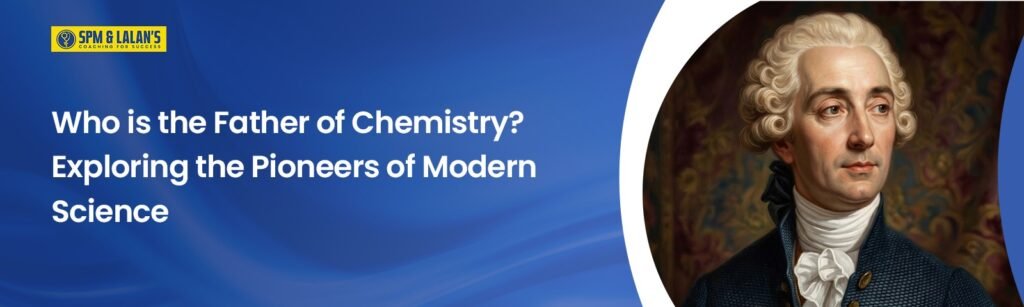
Chemistry is the science that underpins everything. It affects everything from the air we breathe to the medicines that save lives. It plays a role in industrial manufacturing and the food on our plates. It plays a role in industrial manufacturing and the food on our plates. To explore more about chemistry learning resources, visit guwahati coaching centre. When we ask, “Who is the Father of Chemistry?”, however, the answer is not straightforward. This title has been debated by historians of science for centuries. There is a good reason for this debate. The story of chemistry’s birth stretches from medieval Islamic scholars to Enlightenment Europe. It encompasses revolutionary thinkers who transformed superstition into science.
Several figures have earned a claim to this prestigious title. Among them, the most widely recognised as the Father of Chemistry in the modern era is Antoine Lavoisier. He was a French scientist whose 18th-century discoveries fundamentally redefined how we understand matter. However, a complete and honest history must also honour Jabir ibn Hayyan and Robert Boyle. They were two intellectual giants without whom the chemical revolution could never have taken place.
Preparing for competitive exams like NEET or JEE? Practice with real exam-level questions and improve your performance.
The Ancient Origins: Jabir ibn Hayyan and the Birth of Alchemy
Who was Jabir ibn Hayyan?
Long before European scientists formulated the principles of modern chemistry, an eighth-century Arab scholar named Jabir ibn Hayyan (c. 721–815 CE), known in the West as Geber, was conducting systematic experiments in what we would today recognise as a laboratory. Writing in Arabic during the Islamic Golden Age, Jabir produced hundreds of texts on the nature of substances, metals, and chemical processes. Many historians of science regard him as the original Father of Chemistry in the ancient world.
His contributions to the chemistry history are remarkable for their time. Among Jabir’s most significant achievements were:
- The development of early experimental methodology emphasised direct observation over philosophical speculation.
- Descriptions of fundamental chemical processes, including distillation, calcination, crystallisation, and sublimation.
- The preparation of substances such as sulphuric acid, nitric acid, and aqua regia is of critical importance to later chemistry.
- A theoretical framework linking the properties of substances to their underlying elemental composition.
While Jabir operated within the tradition of alchemy rather than modern science, his rigorous empirical approach planted seeds that would grow into the scientific method. He distinguished chemistry from mysticism by insisting that claims about substances must be tested and verified, a revolutionary idea in the medieval world.
The Transition: Robert Boyle and The Sceptical Chymist
Breaking Away from Alchemy
The bridge between ancient alchemy and modern chemistry was significantly built by Robert Boyle, an Irish-born philosopher (1627–1691). In 1661, he published The Sceptical Chymist, a foundational text in chemistry that is still studied today. Boyle challenged the Greek idea of four classical elements, earth, fire, water, and air, as well as the alchemists’ principles of salt, sulphur, and mercury.
He proposed that matter consists of tiny corpuscles, which foreshadowed modern atomic theory, and emphasised that chemistry should be based on experimentation rather than ancient authority. His key contributions include:
- The concept of a chemical element is any substance that cannot be broken down into simpler components.
- Formulating Boyle’s Law, which describes the inverse relationship between the pressure and volume of a gas at constant temperature.
- Insisting that chemical knowledge must be based on controlled, reproducible experiments is a cornerstone of modern scientific practice.
- Separating chemistry from medicine and alchemy, establishing it as an independent and respectable science.
Boyle’s willingness to question centuries of received wisdom exemplifies exactly the kind of intellectual courage that has always driven great science. Though he stopped short of fully articulating the modern theory of elements, his work in The Sceptical Chymist cleared the intellectual ground that Antoine Lavoisier would later cultivate so brilliantly.
The Modern Revolution: Antoine Lavoisier and the Chemical Revolution
1. Why Antoine Lavoisier is Called the Father of Chemistry
No figure in the history of chemistry looms larger than Antoine Lavoisier (1743–1794). A French nobleman, tax administrator, and relentlessly meticulous scientist, Lavoisier transformed chemistry from a collection of practical observations and speculative theories into a rigorous quantitative science. His contributions were so sweeping and so decisive that his designation as the Father of Chemistry is, for most scientists and historians, the most fitting tribute possible.
2. The Law of Conservation of Mass
Perhaps Lavoisier’s most profound contribution was the precise formulation of the Law of Conservation of Mass. Through carefully designed experiments using sealed containers and precise balances, Lavoisier demonstrated that matter is neither created nor destroyed in chemical reactions; the total mass of reactants always equals the total mass of products. This deceptively simple principle was, in fact, a radical departure from the prevailing thinking of the time and remains one of the most fundamental laws of science.
3. The Discovery of Oxygen and the Demolition of Phlogiston Theory
Before Lavoisier, scientists believed that combustion was explained by the release of a mysterious substance called phlogiston. Lavoisier’s meticulous experiments with gases, building on earlier work by Carl Wilhelm Scheele and Joseph Priestley, led him to correctly identify and name oxygen as the element responsible for both combustion and respiration. This single insight dismantled the phlogiston theory entirely and laid the foundation for our modern understanding of chemical reactions.
4. Systematic Naming and the First Table of Elements
Lavoisier understood that science cannot advance without a precise common language. Working with colleagues, he developed a systematic chemical nomenclature, a naming system for compounds that is, in its essentials, still in use today. He also compiled the first reasonably modern list of chemical elements, classifying 33 substances and distinguishing elements from compounds for the first time in a systematic way. His landmark textbook, Traité Élémentaire de Chimie (Elementary Treatise of Chemistry, 1789), synthesised these discoveries and is widely regarded as the first truly modern chemistry textbook.
The chemical revolution Lavoisier spearheaded was not just intellectual; it was transformational for the practice of science itself. He introduced quantitative measurement, careful notation, and systematic theory-building, giving the world a model of how rigorous scientific inquiry should be conducted.
Why the Title Matters: A Legacy That Changed the World
The discoveries made by these three pioneers, Jabir ibn Hayyan, Robert Boyle, and Antoine Lavoisier, did not merely advance an academic discipline. They laid the practical and theoretical groundwork for virtually every major technological and medical advance of the past two centuries.
These concepts are also essential for students preparing for competitive exams like JEE coaching in Guwahati, where chemistry plays a crucial role.
1. Medicine: The understanding of chemical reactions underpins the development of pharmaceuticals, anaesthetics, and diagnostic tools.
2. Agriculture: Insights from chemistry led to the development of synthetic fertilisers, transforming food production and enabling the modern world’s population growth.
3. Industry: The chemical industry, from plastics and polymers to fuels and textiles, is built directly upon the principles these scientists first articulated.
4. Environmental Science: The Law of Conservation of Mass and understanding of combustion are critical to our comprehension of pollution, climate change, and ecological systems.
Recognising who deserves the title of Father of Chemistry is therefore not merely an academic exercise; it is an acknowledgement of the specific intellectual breakthroughs that made the modern world possible.
Conclusion: A Shared Legacy of Rigorous Experimentation
The question of who is the true Father of Chemistry does not have a single, definitive answer, and that is precisely what makes the question so rich. Science is not the work of lone geniuses operating in isolation. It is a cumulative, collaborative enterprise built across centuries and cultures.
Jabir ibn Hayyan gave us the first systematic experimental approach. Robert Boyle freed chemistry from alchemy’s mystical legacy through The Sceptical Chymist. And Antoine Lavoisier crowned these efforts with the Law of Conservation of Mass, the identification of oxygen, and a systematic language for the entire discipline, triggering the chemical revolution that remade science. If you want to truly understand chemistry concepts, learning from an experienced mentor like the best chemistry teacher can make a big difference.
If we must name one figure as the Father of Chemistry for the modern era, then Antoine Lavoisier remains the consensus choice among scientists and historians alike. But the full, extraordinary story of chemistry’s birth belongs to a lineage of brilliant minds spanning continents and millennia, each one standing on the shoulders of those who came before.
Frequently Asked Questions
1. Why is Antoine Lavoisier called the Father of Modern Chemistry?
Antoine Lavoisier earned the title of Father of Chemistry in the modern era because of the sheer breadth and depth of his contributions. He formulated the Law of Conservation of Mass, identified and named oxygen, dismantled the phlogiston theory, developed systematic chemical nomenclature, and authored the first modern chemistry textbook. Crucially, he transformed chemistry into a quantitative science grounded in careful measurement, establishing the methodology that all chemists have followed ever since. Students often look for guidance from a top chemistry teacher for JEE NEET to build strong fundamentals in chemistry.
2. Did Robert Boyle contribute to the “Father of Chemistry” title?
Yes, significantly. Some historians refer to Robert Boyle himself as the Father of Chemistry for his role in breaking from alchemy and establishing chemistry as an independent science. His 1661 work The Sceptical Chymist introduced the modern concept of a chemical element and insisted on experimental verification of all chemical claims, principles absolutely central to the history of chemistry. While Lavoisier is more commonly awarded the title for his later systematic achievements, Boyle’s foundational work was indispensable.
3. Who was the Father of Chemistry in ancient times?
In ancient times, the figure most often credited as the Father of Chemistry is the Arab-Persian scholar Jabir ibn Hayyan (c. 721–815 CE). Operating during the Islamic Golden Age, Jabir conducted systematic experiments, described key chemical processes such as distillation and crystallisation, and prepared substances including sulphuric acid and nitric acid. His insistence on empirical testing over philosophical authority made him a trailblazer in the history of chemistry and a direct intellectual ancestor of all later chemists.
4. What was the most important discovery made by the Father of Chemistry?
If we focus on Antoine Lavoisier as the primary Father of Chemistry, his most important discovery is arguably the Law of Conservation of Mass, because it provided the first rigorous quantitative foundation for all of chemistry and directly enabled everything that followed. The identification of oxygen and the destruction of phlogiston theory runs a very close second, as it corrected a fundamental misunderstanding about combustion and respiration that had held science back for decades. Together, these discoveries triggered the chemical revolution of the 18th century.

This article is written by the SPM & LALAN’S Content Team, a group of skilled writers, researchers, and content strategists passionate about creating accurate, reliable, and student-friendly educational content. Every article is thoroughly researched, fact-checked, and updated to ensure readers receive trustworthy and relevant information. The goal is to help students make informed academic decisions through clear, well-researched, and easy-to-understand content.